Spatial Computing Market Size and Growth 2026 to 2035
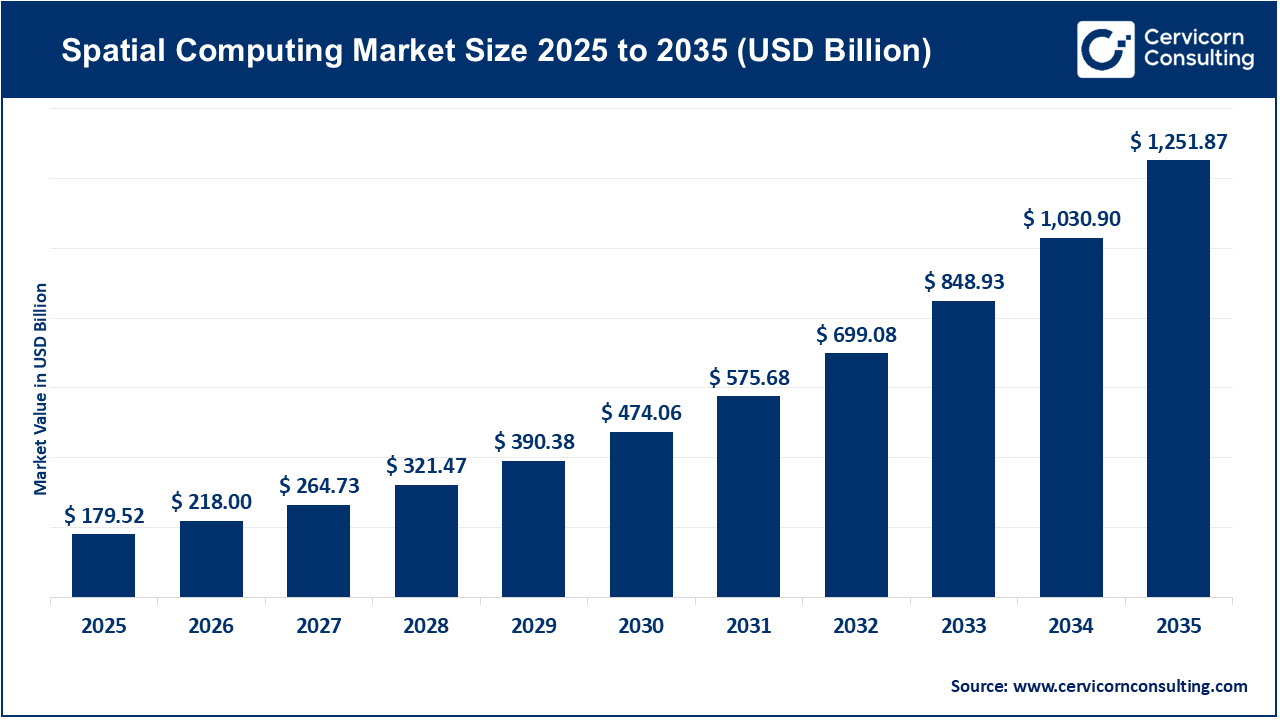
The global spatial computing market size was valued at USD 179.52 billion in 2025 and is expected to be worth around USD 1,251.87 billion by 2035, exhibiting at a compound annual growth rate (CAGR) of 21.4% over the forecast period from 2026 to 2035. The spatial computing market is experiencing accelerated growth as enterprises integrate immersive technologies into core operational and customer engagement workflows. Recent industry surveys indicate more than 65% of large organizations are actively investing in augmented and mixed reality capabilities. Adoption is expanding beyond pilots, driven by measurable efficiency improvements in design validation, remote collaboration, and experiential visualization use cases. Technology vendors report headset shipment volumes increasing over 40% year over year, reflecting growing commercial and industrial demand. This sustained growth trajectory is further reinforced by improving device ergonomics, enterprise-grade security features, and expanding developer ecosystems globally.
Key drivers of spatial computing adoption include workforce training transformation, digital twin deployment, and real-time spatial data visualization capabilities. Studies show immersive training solutions can reduce error rates by up to 30% compared to traditional instruction methods. Healthcare, manufacturing, and logistics sectors are leading adoption, supported by proven productivity gains and reduced operational downtime. Advances in artificial intelligence, sensor fusion, and edge computing are significantly enhancing environmental awareness and interaction accuracy. Consulting assessments indicate organizations leveraging spatial computing report stronger innovation velocity and faster decision-making cycles.
Report Highlights
- North America leads the global market with an estimated 34.3% share, driven by strong enterprise, defense, and technology ecosystem adoption.
- Asia-Pacific holds around 24.8% share, benefiting from rapid industrial digitization, smart infrastructure projects, and manufacturing-scale deployments.
- By component, the hardware dominates with about 63.7% market share, reflecting high demand for headsets, sensors, and spatial devices.
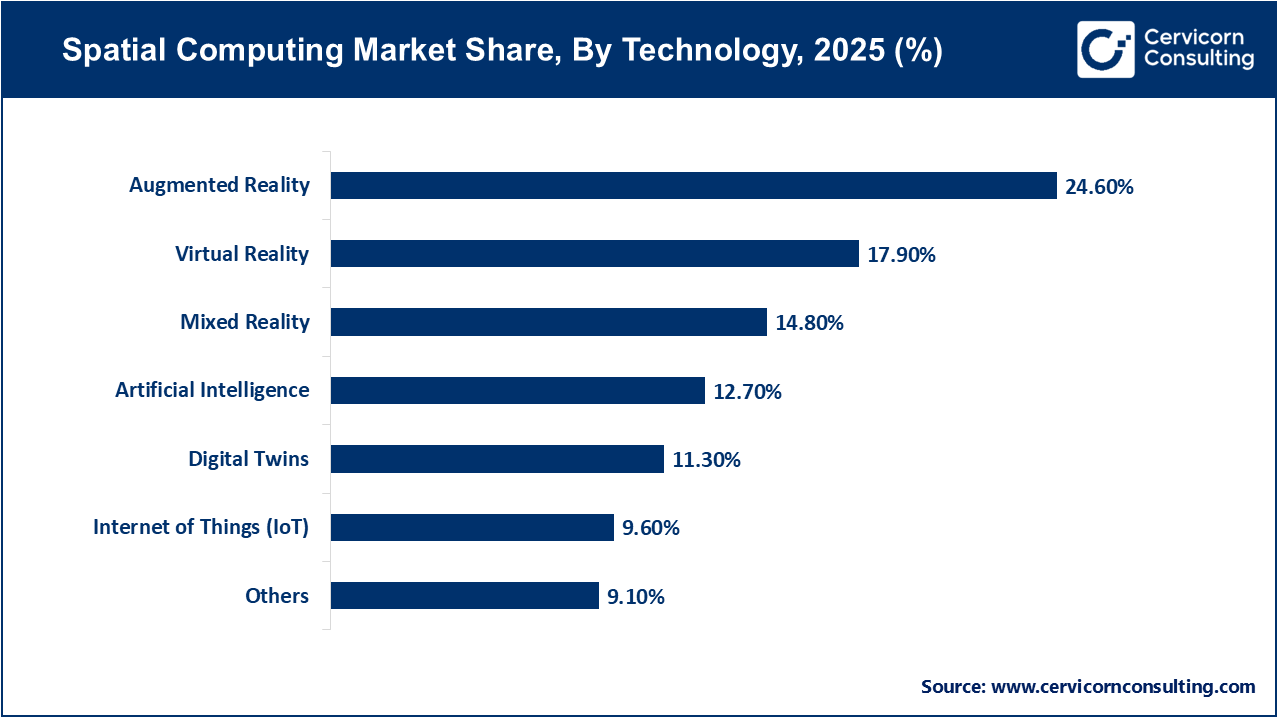
- By technology, the augmented reality leads with approximately 24.6% share, due to widespread enterprise and consumer usability.
- By end user, the gaming remains the largest segment with nearly 16.6% share, driven by immersive entertainment adoption.
Surging Consumer Demand for AR and VR as a Market Growth Catalyst
Surging consumer demand for augmented and virtual reality is significantly driving spatial computing adoption, with more than 171 million people worldwide using VR technology across gaming, education, and entertainment in 2024. The global user base continues expanding as mainstream interest broadens beyond niche hobbyists, and accessibility improves through more affordable and ergonomic devices. Recent reports suggest AR/VR user penetration could approach over half of global digital consumers by the end of this decade, reflecting strong engagement growth worldwide. Increased demand for immersive experiences in entertainment, social platforms, and mobile AR applications is encouraging content creators and platform operators to invest heavily in tailored experiences. This consumer-led momentum is fueling broader ecosystem participation, as sustained usage and rising ownership rates reinforce technology investment and drive deeper innovation across hardware, software, and interactive content portfolios.
Spatial Computing Technologies - Year-on-Year Adoption Growth Analysis (2024-2025)
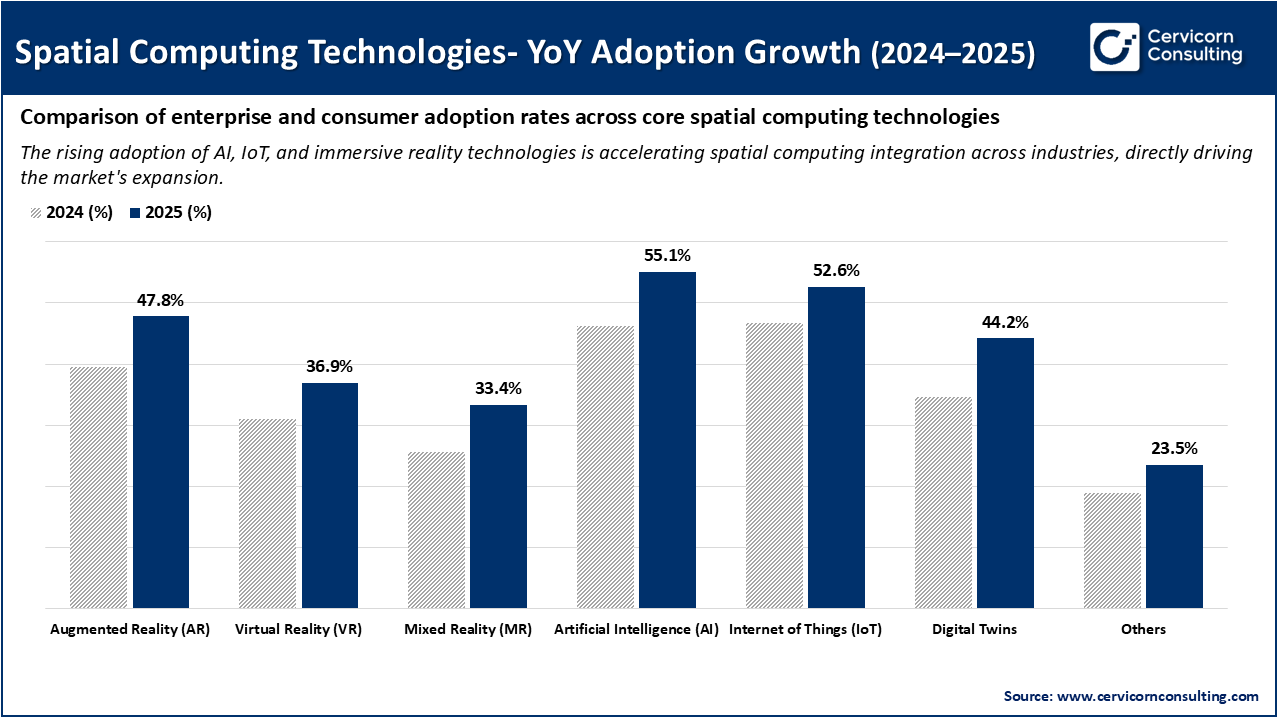
The chart illustrates accelerating year-on-year adoption across core spatial computing technologies, highlighting Artificial Intelligence and Internet of Things as the strongest growth catalysts between 2024 and 2025. Augmented Reality and Digital Twins also demonstrate notable increases, reflecting expanding enterprise use cases in training, visualization, and asset management. Mixed Reality and Virtual Reality show steady upward momentum, indicating improving hardware maturity and content availability. Overall, the adoption trends underscore how converging technologies are collectively strengthening spatial computing integration across industries, driving broader market expansion and investment activity.
Recent Major Milestones
1. Launch and Expansion of Niantic Spatial, Inc.
In May 2025 Niantic Spatial, Inc. was established as a dedicated spatial computing and geospatial AI company following the spin-off from Niantic.
This strategic restructuring, backed by significant initial funding, catalyzes enterprise-grade AR use cases beyond gaming into logistics, intelligent mapping, and immersive training. By providing advanced AI-powered spatial models and partnering with ecosystem players, Niantic Spatial accelerates real-world integration of spatial computing, expanding commercial demand and application diversity.
2. Android XR Operating System Launch
The Android XR operating system, launched in October 2025 by Google and Samsung, marks a major platform milestone in spatial computing infrastructure.
By offering a unified OS tailored for extended reality devices, Android XR reduces fragmentation and improves developer support, making it easier to build interoperable AR/VR applications. This milestone drives hardware and software ecosystem growth, attracts more developers, and supports broader adoption of spatial computing technologies across device categories.
3. Meta Ray-Ban Display Introduction
Meta’s release of the Ray-Ban Display AI smart glasses with integrated visual output in September 2025 highlights a shift toward mainstream wearable spatial computing.
This device blurs lines between classic eyewear and spatial computing platforms, making AR experiences more accessible to general consumers. By lowering entry barriers and increasing daily usability, it expands the user base, encourages new content creation, and stimulates consumer demand across lifestyle and productivity scenarios.
4. IEEE Spatial Computing for Metaverse Initiative
The IEEE Spatial Computing for Metaverse Initiative focuses on developing standards and reference implementations for spatial computing technologies.
Establishing compatibility and guidelines helps reduce integration friction across hardware and software components, addressing interoperability challenges. This encouraging framework supports industry collaboration and boosts investor confidence, which speeds up innovation cycles and supports larger-scale deployments of spatial computing solutions.
Market Dynamics
Market Drivers
- Enterprise Adoption of Immersive Technologies: Enterprise adoption of spatial computing is accelerating as organizations seek measurable improvements in training, design, and remote collaboration. Immersive simulations reduce errors, shorten learning curves, and improve knowledge retention compared to traditional methods. Manufacturing, healthcare, and engineering sectors increasingly rely on spatial visualization to enhance precision and decision-making. Proven productivity gains and cost savings are encouraging enterprises to move from pilot programs to scaled deployments, directly driving sustained market growth.
- Rising Consumer Engagement with AR and VR Applications: Growing consumer engagement with augmented and virtual reality applications is significantly supporting spatial computing market expansion. Social media filters, mobile AR shopping tools, and immersive gaming experiences are driving frequent usage across younger demographics. Improved content quality and device affordability are increasing session duration and repeat usage. This expanding consumer base encourages platform providers and developers to invest more heavily in immersive ecosystems, strengthening long-term market momentum.
Market Restraint
- High Implementation and Hardware Costs: High implementation costs remain a major restraint for spatial computing adoption, particularly among small and mid-sized enterprises. Advanced headsets, sensors, and custom software development require substantial upfront investment. Ongoing maintenance, upgrades, and integration with legacy systems further increase total cost of ownership. These financial barriers slow adoption rates and limit deployment scale, especially in cost-sensitive industries and emerging markets.
- Data Privacy and Security Concerns: Spatial computing solutions rely heavily on real-world data capture, creating significant privacy and security challenges. Continuous environmental scanning, facial recognition, and spatial mapping raise concerns regarding data misuse and regulatory compliance. Industries handling sensitive information face stricter governance requirements, increasing deployment complexity. These concerns reduce user trust and slow adoption, particularly in public-sector, healthcare, and regulated enterprise environments.
Market Opportunities
- Expansion of Digital Twin and Smart Infrastructure Use Cases: The growing adoption of digital twins and smart infrastructure initiatives presents strong opportunities for spatial computing market growth. Governments and enterprises are investing in virtual replicas of physical assets to improve monitoring, predictive maintenance, and urban planning. Spatial computing enhances visualization and interaction with these models, enabling more accurate simulations. Long-term infrastructure programs create recurring demand and support large-scale, sustainable deployments.
- Integration of Spatial Computing with Artificial Intelligence: Integration of spatial computing with artificial intelligence unlocks advanced contextual awareness and automation capabilities. AI-powered perception, object recognition, and real-time analytics enhance accuracy and usability across industrial and consumer applications. This convergence supports autonomous systems, intelligent assistants, and advanced training simulations. As AI capabilities mature, spatial computing solutions become more scalable, intelligent, and valuable, driving broader adoption across multiple industries.
Market Challenges
- Fragmented Ecosystem and Lack of Standards: A fragmented ecosystem remains a significant challenge for the spatial computing market. Diverse hardware platforms, operating systems, and development tools complicate application portability and interoperability. Developers face higher costs and longer development cycles due to platform-specific requirements. Limited standardization slows ecosystem maturation and reduces cross-platform scalability, delaying mass adoption and increasing uncertainty for long-term investments.
- User Experience and Adoption Barriers: User experience limitations continue to challenge widespread spatial computing adoption. Device comfort, battery life constraints, and motion-related discomfort affect prolonged usage. Additionally, complex interfaces and learning curves reduce accessibility for non-technical users. Achieving seamless integration into daily workflows remains difficult, requiring careful design balance between immersive functionality and practical usability.
Spatial Computing Market Regional Analysis
The spatial computing market is segmented into various regions, including North America, Europe, Asia-Pacific, and LAMEA. Here is a brief overview of each region:
North America Spatial Computing Market: Defense Modernization as a Scale Driver
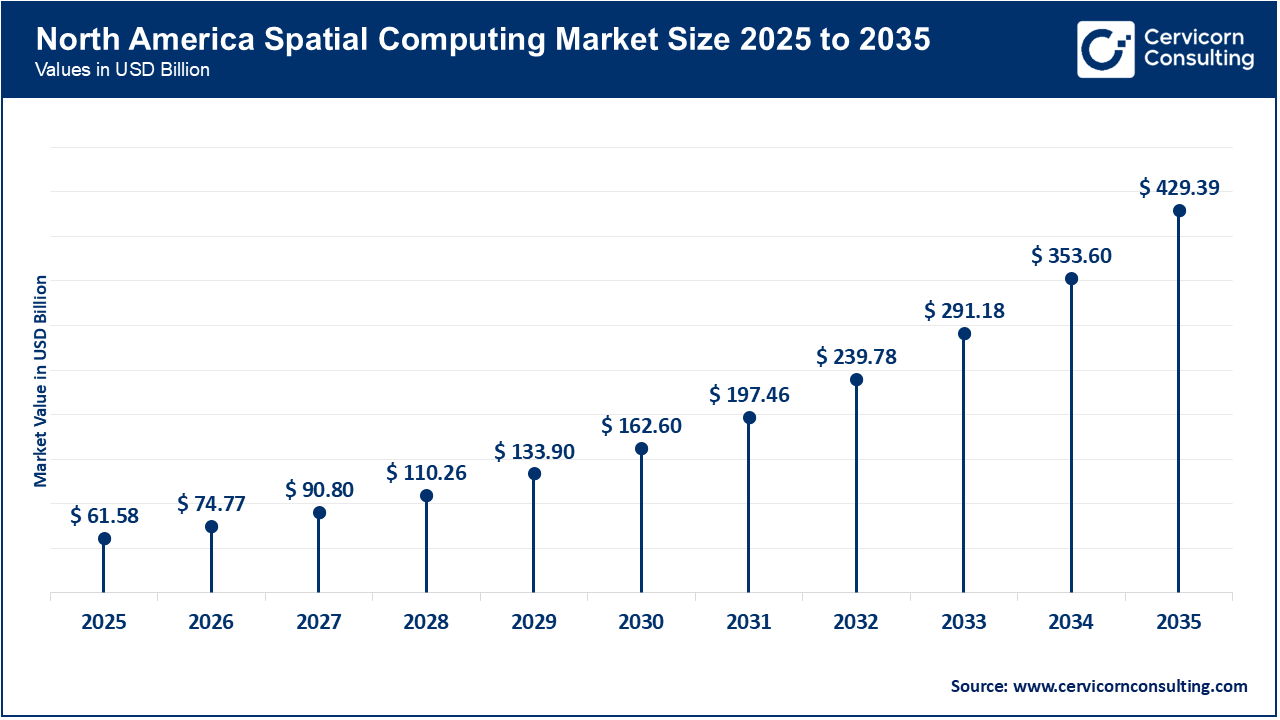
The North America spatial computing market size was valued at USD 61.58 billion in 2025 and is expected to hit around USD 429.39 billion by 2035. North America leads spatial computing adoption because defense, aerospace, and enterprise buyers fund large, repeatable deployments. U.S. military programs are expanding XR for tactical, flight, maintenance, and medical training, creating durable demand for ruggedized headsets and secure software stacks. In parallel, enterprise digital-twin workflows are moving into immersive review and collaboration, pulling hardware and platform ecosystems forward. The region’s deep venture capital, systems integrators, and hyperscale cloud capacity compress pilots into production rollouts faster than most markets.
Recent Developments:
- U.S. Army IVAS program transitioned from Microsoft to Anduril via contract novation in April 2025.
- Dassault Systèmes partnered with Apple to bring 3D design and digital twins onto Vision Pro.
Asia-Pacific (APAC) Spatial Computing Market: Smart-City Digital Twins as a Mass-Adoption Driver
The Asia-Pacific spatial computing market size was estimated at USD 44.52 billion in 2025 and is predicted to surpass around USD 310.46 billion by 2035. Asia-Pacific growth is accelerated by smart-city programs and infrastructure operators adopting digital twins and spatial analytics at metropolitan scale. Singapore’s government-led digital twin efforts illustrate how ports, logistics, and planning agencies convert geospatial data into operational decision tools. South Korea’s metaverse and XR strategy supports ecosystem-building through coordinated policy, skills, and industry programs. The region’s dense manufacturing base also drives AR-guided work instructions and remote assistance, reinforcing recurring software and services demand.
Recent Developments:
- Singapore launched its first Maritime Digital Twin with MPA and GovTech partnerships.
- South Korea’s MSIT published a pan-government metaverse strategy under its digital policy agenda.
Europe Spatial Computing Market: Public Digital-Transformation Funding as a Deployment Driver
The Europe spatial computing market size was reached at USD 46.85 billion in 2025 and is forecasted to hit around USD 326.74 billion by 2035. Europe’s market is propelled by policy-backed digitization and city-scale modernization, which favor interoperable spatial platforms. EU programs fund advanced digital capabilities across governments and industry, lowering adoption friction for XR and digital-twin deployments. City-focused initiatives are pushing “CitiVerse” style applications, turning urban planning and citizen services into visible reference cases. Europe also benefits from a growing investment layer targeting “spatial AI” and immersive infrastructure, helping startups scale beyond pilots into regulated enterprise environments.
Recent Developments:
- EU Digital Europe Programme continues funding deployment of advanced digital technologies across member states.
- EU-funded CitiVerse projects (e.g., x-CITE, SENSE, CU, 3DxVERSE) reported progress across multiple cities.
Spatial Computing Market Share, By Region, 2025 (%)
| Region |
Revenue Share, 2025 (%) |
| North America |
34.3% |
| Europe |
26.1% |
| Asia-Pacific |
24.8% |
| LAMEA (Latin America, Middle East & Africa) |
14.8% |
LAMEA Spatial Computing Market: Government-Led Metaverse Strategies as an Ecosystem Driver
The LAMEA spatial computing market was valued at USD 26.57 billion in 2025 and is anticipated to reach around USD 185.28 billion by 2035. LAMEA adoption is increasingly shaped by government digital-economy agendas and practical enterprise use cases in energy, infrastructure, and skills. Dubai’s Metaverse Strategy signals a policy push to attract investment, talent, and applications that rely on spatial data, AI, and IoT. In the Middle East, national geospatial and “digital twin” frameworks support large-scale planning and asset management programs. Across Africa, capability-building and workforce initiatives are expanding the developer base needed to sustain deployments.
Recent Developments:
- UAE published and continues executing the Dubai Metaverse Strategy under its digital transformation agenda.
- Saudi Arabia advanced national geospatial ecosystem work referencing spatial digital twin and metaverse frameworks.
Spatial Computing Market Segmental Analysis
The spatial computing market is segmented into component, technology, end user, and region.
Component Analysis
The hardware segment dominates the spatial computing market, supported by strong demand for head-mounted displays, sensors, cameras, and advanced processing units. Enterprise deployments and consumer adoption rely heavily on continuous improvements in device performance, ergonomics, and spatial sensing accuracy. Major technology companies are investing aggressively in next-generation headsets and wearable devices, driving higher shipment volumes. Hardware remains foundational for ecosystem growth, as software and services adoption scales in parallel with installed device bases.
Spatial Computing Market Share, By Component, 2025 (%)
| Component |
Revenue Share, 2025 (%) |
| Hardware |
63.7% |
| Software |
21.4% |
| Services |
14.9% |
The software segment is the fastest growing, driven by rising demand for spatial operating systems, development platforms, and application-layer solutions. Enterprises increasingly prioritize custom visualization, simulation, and collaboration software tailored to industry-specific workflows. Growth is further supported by expanding developer ecosystems, cloud-based spatial platforms, and AI-powered perception engines. As hardware penetration increases, recurring software licensing and platform monetization accelerate, strengthening long-term revenue sustainability.
Technology Analysis
Augmented reality currently dominates the technology landscape due to its broad applicability across enterprise and consumer environments. AR enables contextual overlays without fully immersive experiences, making it more practical for training, maintenance, retail, and navigation use cases. Strong adoption across smartphones, smart glasses, and industrial devices supports sustained demand. Its lower deployment complexity compared to fully immersive systems reinforces AR’s leadership position within the spatial computing technology mix.
Digital twins represent the fastest growing technology segment, driven by increasing demand for real-time asset visualization and predictive analytics. Industries such as manufacturing, energy, and smart cities are rapidly adopting virtual replicas to optimize performance and reduce downtime. Integration with IoT sensors and AI analytics enhances decision-making accuracy. Government-backed infrastructure modernization initiatives further accelerate adoption, positioning digital twins as a high-growth pillar of spatial computing.
End User Analysis
Gaming remains the dominant end-user segment, benefiting from strong consumer engagement and continuous content innovation. Immersive gameplay experiences, social interaction features, and expanding esports ecosystems support sustained adoption of spatial computing technologies. Major platform launches and exclusive content investments drive hardware sales and software usage. Gaming continues to serve as a primary commercialization channel, accelerating broader consumer familiarity with spatial interfaces.
Spatial Computing Market Share, By End User, 2025 (%)
| End User |
Revenue Share, 2025 (%) |
| Aerospace & Defense |
8.9% |
| Automotive |
9.7% |
| Healthcare |
12.8% |
| Gaming |
16.6% |
| Consumer Electronics |
10.9% |
| Energy & Utilities |
6.4% |
| Education |
7.6% |
| AEC (Architecture, Engineering & Construction) |
7.1% |
| Information Technology |
7.9% |
| Government & Public Sector |
5.8% |
| Others |
7.3% |
Healthcare is the fastest growing end-user segment, driven by rising adoption of immersive training, surgical planning, and patient visualization solutions. Spatial computing enhances procedural accuracy, medical education, and remote collaboration among clinicians. Increasing acceptance of digital health technologies and supportive regulatory environments fuel adoption momentum. As healthcare systems focus on efficiency and outcomes improvement, spatial computing adoption is expanding rapidly across clinical and research applications.
Spatial Computing Market Top Companies
Recent Developments by Major Companies
- Microsoft Corporation: In December 2025, Microsoft retired its standalone Microsoft Mesh mixed-reality platform and launched Immersive Events natively in Microsoft Teams. This change embeds 3D avatar-based interactive spaces into a widely adopted enterprise collaboration tool, improving scalability and lowering barriers for virtual spatial meeting deployments. Organizations can now schedule and customize immersive 3D environments directly from Teams calendars, significantly expanding practical use cases for spatial computing across remote work, training, and large-scale digital events.
- NVIDIA Corporation: In August 2025, NVIDIA unveiled enhanced Omniverse libraries, Cosmos physical AI models, and RTX PRO Blackwell servers, enabling large-scale world reconstruction and spatial reasoning for robotics, simulation, and digital twins. This accelerates spatial computing development by providing developers high-performance tools for generating immersive virtual worlds and physics-based environments, expanding applications in industrial simulation and AI-augmented workflows.
- Google LLC: In October 2025, Google and Samsung launched Android XR, a dedicated extended-reality operating system that integrates generative AI capabilities (Gemini) for mixed reality devices like the Samsung Galaxy XR. Android XR’s open platform approach allows broader hardware compatibility and easier spatial app development, potentially transforming spatial computing adoption economics across consumer and enterprise segments.
Market Segmentation
By Component
- Software
- Hardware
- Services
By Technology
- Augmented Reality
- Mixed Reality
- Virtual Reality
- Artificial Intelligence
- Internet of Things (IoT)
- Digital Twins
- Others
By End User
- Aerospace & Defense
- Automotive
- Healthcare
- Gaming
- Consumer Electronics
- Energy & Utilities
- Education
- Architecture, Engineering, and Construction (AEC)
- Information Technology
- Government and Public Sector
- Others
By Region
- North America
- APAC
- Europe
- LAMEA