South Korea Humanoid Robot Market Size, Growth, Forecast 2026 to 2035
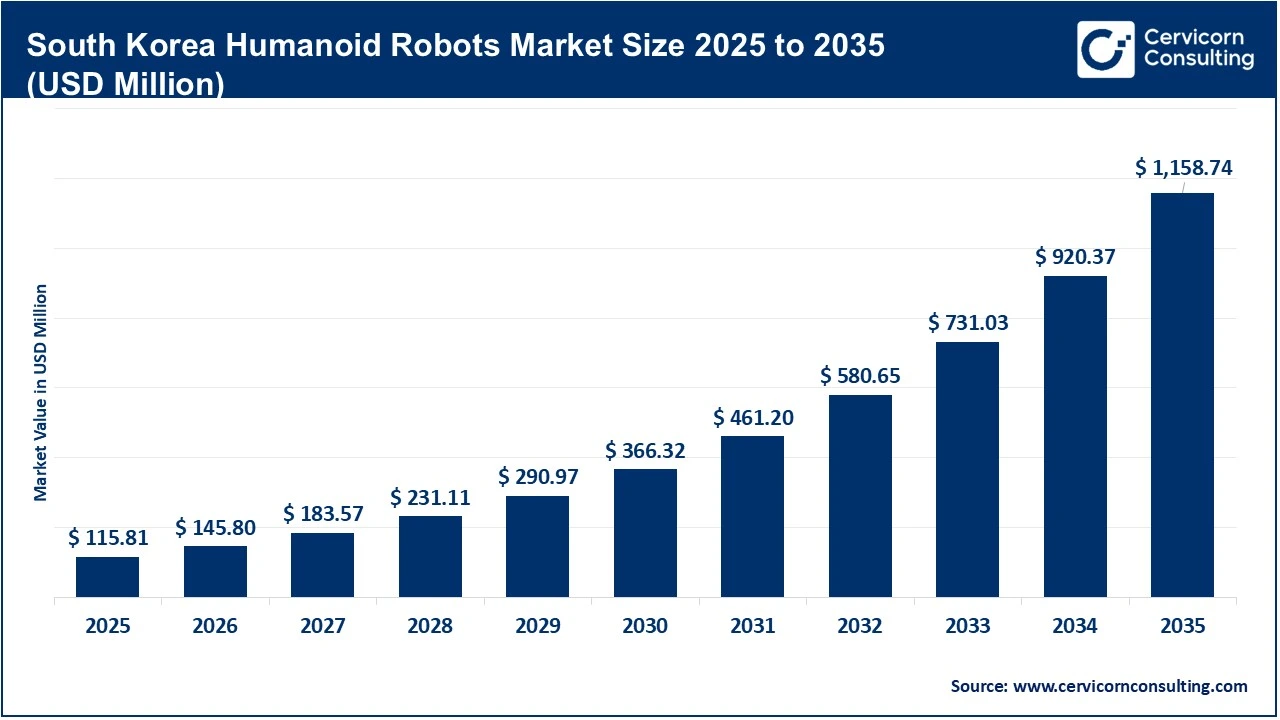
The South Korea humanoid robot market size was valued at USD 115.81 million in 2025 and is estimated to be worth around USD 1158.74 million by 2035 and expected to grow at a CAGR of 26% during the forecast period of 2026-2035. South Korea's humanoid robot market is being driven by aggressive government investment and long-term industrial policies aimed at positioning the country as a global leader in AI-powered robotics and intelligent manufacturing.
Report Highlights
- By motion type, the biped segment dominated the market in 2025 owing to its ability to operate efficiently in human-centric environments and industrial facilities.
- By motion type, the wheel drive segment is expected to witness notable growth during the forecast period owing to its cost efficiency, faster indoor mobility, and increasing adoption across commercial and service sectors.
- By functionality, the human interaction & communication segment accounted for the largest market share in 2025 due to increasing deployment in healthcare, retail, hospitality, and public service applications.
- By functionality, the autonomous decision-making segment is projected to grow notably during the forecast period, driven by advancements in AI, edge computing, and intelligent robotics.
- By application, the personal assistance & caregiving segment is anticipated to register the fastest growth during the forecast period due to rising demand for elderly care, rehabilitation, and healthcare support.
- By application, the inspection, maintenance & material handling segment held the dominant market share in 2025, supported by widespread adoption across manufacturing, semiconductor, and electronics industries.
- By end user, the manufacturing segment dominated the market in 2025 as industries increasingly adopted humanoid robots to improve productivity, precision, and operational efficiency.
- By end user, the healthcare segment is expected to experience the fastest growth during the forecast period, fueled by an aging population, increasing healthcare automation, and government support for care robotics.
Why South Korea Is Emerging as a Global Hub for Humanoid Robot Components?
With the world’s best semiconductor, precision manufacturing technologies, and highly interconnected robotics supply chain, South Korea is rising as a key node in the production of components for humanoid robots globally. Global technology giants including Samsung Electronics, LG Electronics, SK hynix, Hyundai Motor Group, Rainbow Robotics and Robotis are present in South Korea, driving innovations in the AI processing, memory chips, actuators and control systems required for humanoid robots.
“South Korea, already boasting the highest density of industrial robots in the world, 1,012 robots per 10,000 manufacturing employees with an existing ecosystem for advanced robotics components design and production, also leads in advanced robot development.”
South Korea Humanoid Robot Industry: Adoption, Development, and Production Statistics
- The country’s government plans to allocate more than $2.24 billion of public and private investment by 2030, according to the Fourth Intelligent Robot Basic Plan to accelerate robotics and AI commercialization.
- South Korea has also launched a KRW 50.4 billion ($33.5 million) national project to develop domestic AI humanoid robots and their related core technologies by 2030, beginning in 2026.
- In addition, a national initiative for humanoid robot development will bring together a goal of producing over 20 humanoid robots by 2030 that are widely applicable to sectors including elder care, healthcare, and public service.
- Hyundai Motor plans to build 30,000 of their Atlas humanoid robots per year by 2028 to support big-data industrial and logistics automation, with a view to producing as many as 30,000 units annually from that point on.
- In addition, the country is estimated to produce about 30% of global humanoid robot output and supplies chains by 2035.
- Policy aims to raise the share of domestically manufactured core robot components to 8% from the current 44% by 2030 to decrease dependence on imports.
Top Government Initiatives
| Initiative |
Launch Year |
Key Highlights |
| Fourth Intelligent Robot Basic Plan (2024–2028) |
2024 |
Focuses on expanding robotics commercialization, strengthening domestic robot component manufacturing, and increasing public-private investments through 2030. |
| K-Humanoid Alliance |
2025 |
Brings together government agencies, universities, AI researchers, and companies including Rainbow Robotics, LG Electronics, Hyundai Motor Group, and Doosan Robotics to develop a common AI foundation model for humanoid robots by 2028. |
| National AI Humanoid Robot Project |
2026 |
Allocates KRW 50.4 billion (approximately USD 33.5 million) through 2030 to develop domestically designed AI humanoid robots and core technologies. |
| AI Robot M.AX Alliance |
2026 |
Establishes a national collaboration platform involving robotics companies, universities, and research institutes to develop AI software, robotics hardware, and manufacturing technologies. |
Market Dynamics
Driver
Rising Adoption of AI-Powered Automation Drives the South Korea humanoid robot Market
South Korea's leading manufacturing sector and robotics industry, combined with its aggressive government push for intelligent automation, have driven the growing appetite for humanoid robot. The world’s leading industrial robot density, 1,012 industrial robots per 10,000 manufacturing workers offers a ready adoption platform for AI-powered robots in electronics, automotive, semiconductor and logistics industries. South Korea’s government investment in smart automation is escalating on the back of the country’s Fourth Intelligent Robot Basic Plan and special AI humanoid robot plans.
South Korea is also exceptionally well-placed to be an epicenter for humanoid robot, thanks to its strengths in semiconductors, AI chip, sensor and 5G technologies, which provide all necessary capabilities for faster commercialization of smart robotics solutions for industry and service environments.
Restraint
High Development Costs and Technical Complexity Limit Market Expansion
While South Korea humanoid robot market continues to witness impressive technological advancements, there are significant hurdles that might curb mass deployment in coming years. The creation of humanoid robots and embodied AI products will involve huge costs, which include AI software, high performance chips, precision actuators, sensors and computing power. Technical constraints that range from autonomous decision-making, adept handling to robot battery life and safety remain to hinder mass commercial adoption of these solutions.
Opportunity
Growing Investments in Humanoid Robotics Create New Growth Opportunities
South Korea's humanoid robot market development potential via investments in humanoid robots, AI chips, smart manufacturing and the development of next-generation automation solutions. Initiatives for domestic human robot production and expansion, and bolstering production of key robotic components, along with the nurturing of AI R&D, are paving the way for an innovation ecosystem where domestic entities will compete with one another.
Given the competitiveness of the South Korean semiconductor industry worldwide and its state-of-the-art digital infrastructure, technology alliances, in conjunction with collaborative research endeavors among businesses, educational and academic institutions, are enabling it to become the leading country in humanoid robot, ensuring continuous demand and growth potential for component suppliers, manufacturers, and software developers.
Segmental Analysis
Motion Analysis
The biped humanoid robot was the largest segment of the South Korea humanoid robot market in 2025 with a more advanced level of capabilities in an environment designed to human use. These robots could step up/down on stairs, manoeuvre through narrow corridors, operate tools, use machines without modifications in environment setup and therefore they were appropriate for use in industries, healthcare, and in commercial sectors.
Strong manufacturing ecosystem of South Korea, like that of automotive, semiconductor and electronic manufacturing have resulted in the increasing investment on biped humanoid robots which will eventually augment for carrying out repetitive, hazardous, and high-precision tasks along with humans.
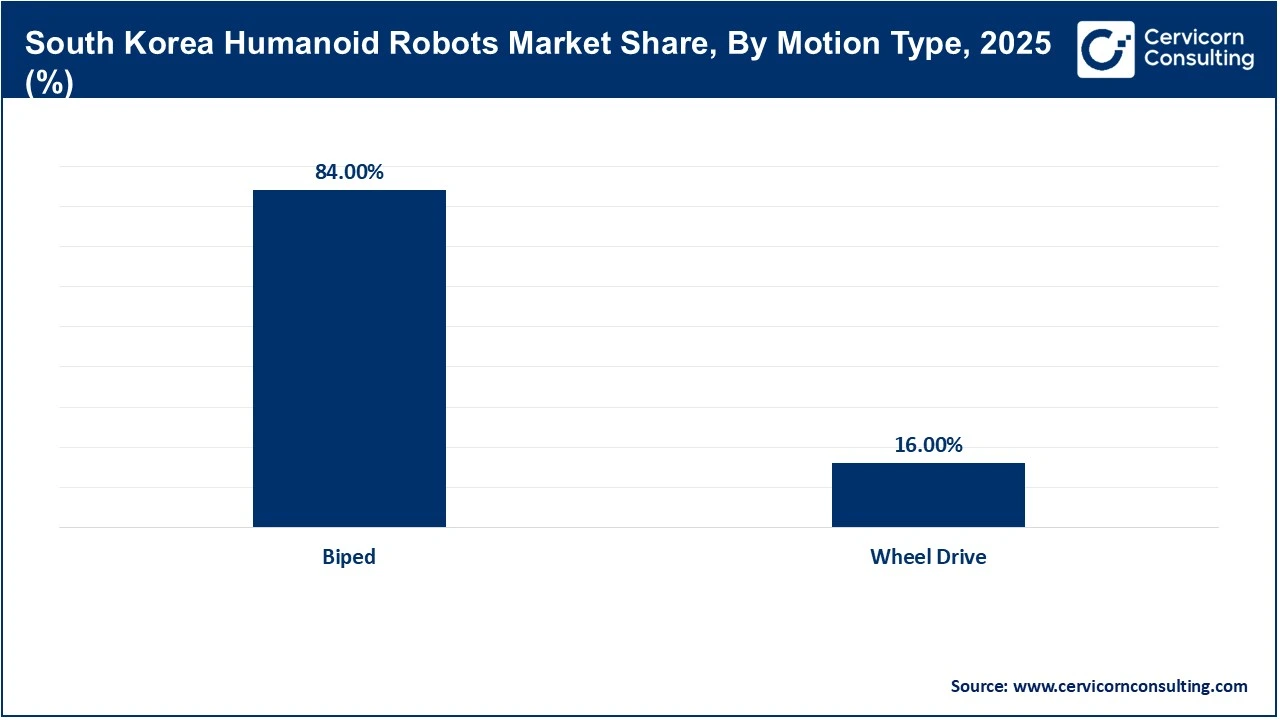
The wheel drive humanoid robot segment is projected to record significant growth in the forecast period, attributed to a number of reasons such as the low-cost operations, better efficiency in terms of power consumption, better mobility and steady operations in well-defined indoor environments. Rising demand for service robots and an increased requirement of the people assistance services, logistics and movement of robots across inner regions will boost the market.
Functionality Analysis
Human interaction and communication segment accounted for the largest share in the South Korea humanoid robot market in 2025. The demand for the human interaction and communication segment was attributed to the accelerated growth of service robots in various healthcare, hospitality, retail, education, and public services industries of South Korea.
Humanoid robots featuring advanced voice recognition, multilingual natural language processing, facial recognition, emotional intelligence algorithm, and gesture control features are widely deployed to cater to an enriched customer experience. Additionally, the aging demographic in South Korea has been playing a critical role in bolstering the adoption of socially interactive robots capable of delivering companion robot, elderly care, rehabilitation services, and patient monitoring assistance.
Autonomous decision making segment to grow substantially during the forecast period. Artificial intelligence (AI) systems are rapidly revolutionizing the humanoids robot capabilities. South Korea's growing emphasis on AI-enabled smart factories, logistics automation, and semiconductor industry has a significant impetus for adoption of autonomous decision-making robots, especially in complex work environments.
Application Analysis
The inspection, maintenance, and material handling segment dominated in South Korea humanoid robot market in 2025, thanks to the nation's strong industrial manufacturing sector that is competitive on a global level. South Korea’s manufacturing sectors such as semiconductors, automobile manufacturing, electronics, heavy engineering, and advanced manufacturing increasingly utilize humanoid robots to accomplish redundant, labor-intensive, and hazardous operational duties.
Smart humanoid robots equipped with high-precision manipulation capabilities and perceptual systems supported by AI enable automated inspections, predict potential machine failure, monitor equipment status, and move equipment throughout factories.
The personal assistance and caregiving market segment is projected to witness the fastest expansion in South Korea in the coming years. Aging population and high dependence on support services have created a growing need for assistive devices in the country. Humanoid robots are now used in hospitals, nursing homes, home-care settings and rehab centers in order to provide elder support services like medicine management, motion assistance, vital sign monitoring and psychological care for people in need. The government's initiatives and investment into assistive robotic technologies and AI medical services in South Korea support the expansion of intelligent personal assistant and caregiving robots.
End User Analysis
The manufacturing sector contributed the largest share to the South Korea humanoid robot market in 2025, attributed to the country’s role as one of the major global manufacturing powerhouses. With strong footholds in automotive production, semiconductor fabrication, consumer electronics, shipbuilding, and heavy industrial manufacturing, South Korea has demonstrated significant demand for sophisticated humanoid robots that can enhance efficiency and flexibility in operations.
These intelligent robots are increasingly being utilized for tasks such as assembly, quality control, equipment maintenance, material handling, and warehouse automation to mitigate labor shortages and escalating operating expenses.
The healthcare sector is anticipated to register the quickest growth in the coming years due to the country's aging population, rising healthcare spending, and the growing adoption of AI-driven medical solutions. Humanoid robots are increasingly deployed in hospitals, rehabilitation centers, nursing homes, and private residences to aid patients in recovery, assist the elderly, conduct remote monitoring, facilitate surgeries, manage hospital logistics, and engage patients.
Leveraging technologies such as AI, computer vision, speech recognition, and human-robot interaction, healthcare robots can provide better and personalized care to patients, easing the burden on healthcare providers.
Recent News and M&A
- March 2025, South Korea's Fair Trade Commission approved Samsung's acquisition, making Rainbow Robotics a Samsung subsidiary and strengthening the company's humanoid robotics strategy. The acquisition enables Samsung to integrate AI, semiconductors, sensors, and robotics technologies to accelerate the commercialization of humanoid robots.
- July 2025, The acquisition expands Doosan Robotics' engineering, automation integration, and collaborative robotics capabilities in North America. It also strengthens the company's ability to deliver complete AI-powered automation solutions that can support future humanoid robot deployments.
South Korea Humanoid Robots Market Top Companies
Segments Covered
By Motion Type
By Deployment
- Hardware
- SENSORS
- GYROSCOPES
- MICROPHONES
- ACCELEROMETERS
- TILT SENSORS
- FORCE/TORQUE SENSORS
- POSITION SENSORS
- VISION/IMAGE SENSORS
- Others
- ACTUATORS
- ELECTRICAL
- PNEUMATIC
- HYDRAULIC
- PIEZOELECTRIC
- ULTRASONIC
- POWER SOURCES
- CONTROL SYSTEMS/CONTROLLERS
- Others
- Software
- Services
By Functionality
- Autonomous Decision-Making
- Manipulation & Grasping
- Learning & Adaptation
- Mobility & Navigation
- Perception & Sensing
- Human Interaction & Communication
- Others
By Application
- Search & Rescue
- Security & Surveillance
- Personal Assistance & Caregiving
- Inspection, Maintenance & Material Handling
- Research & Space Exploration
- Others
By End User
- BFSI
- Agriculture
- Entertainment & Gaming
- Retail
- Hospitality
- Research & Education
- Healthcare
- Manufacturing
- Technology
- Others