Quantum AI Market Size, Growth, Forecast 2026 to 2035
The global quantum AI market size was estimated at USD 454.71 million in 2025 and is expected to surpass around USD 7,930.84 million by 2035, exhibiting a compound annual growth rate (CAGR) of 33.1% over the forecast period from 2026 to 2035. The quantum AI market is driven by rising demand for solving optimization, simulation, and machine learning problems beyond classical computing capabilities. More than 40 countries have launched national quantum initiatives, while cloud-based quantum platforms now serve over 600,000 registered users worldwide. Additionally, 80% of quantum computing projects focus on optimization, cryptography, simulation, and AI-driven applications. Growing public funding and enterprise investments continue accelerating Quantum AI research and commercialization.
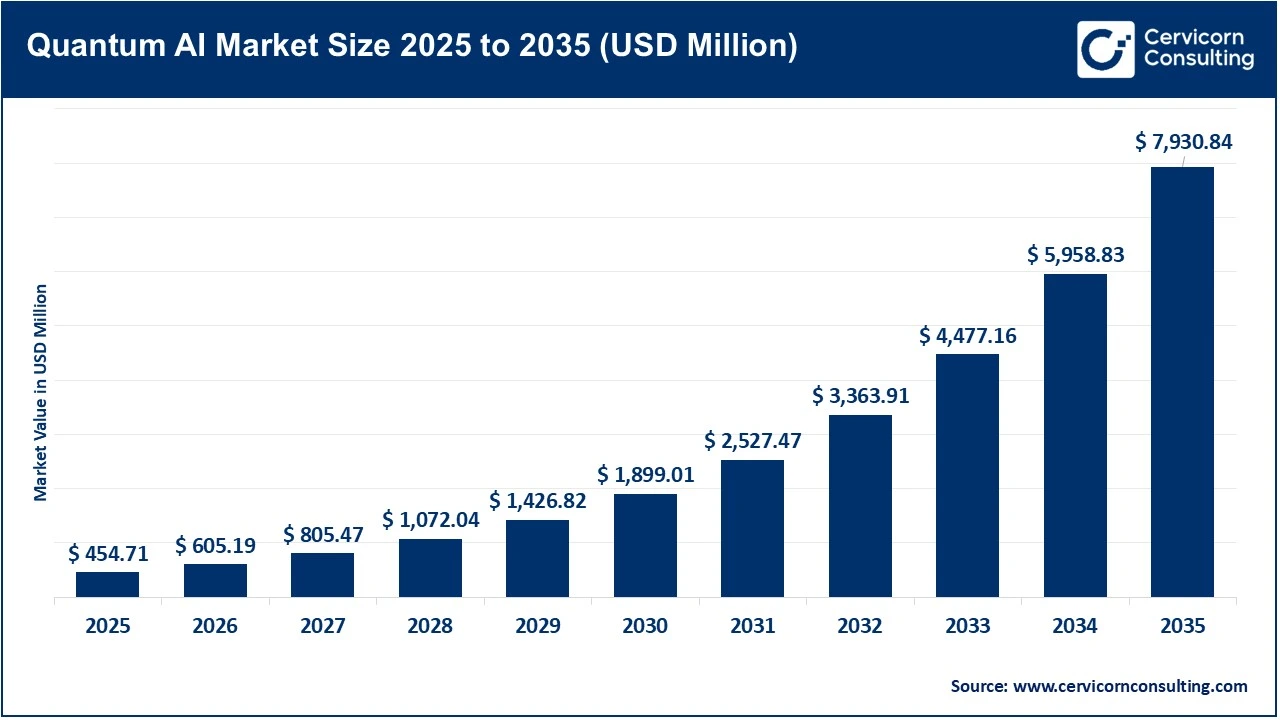
Another key growth factor is the expansion of collaboration among technology companies, cloud providers, and research institutions to develop scalable quantum AI solutions. Quantum processors have already surpassed 1,000 qubits in experimental environments, enabling more advanced AI workloads. Industry surveys indicate 97% of business leaders expect quantum computing to disrupt their sectors, while 87% view it as a strategic opportunity. Increasing adoption of hybrid quantum-classical deployments and AI-assisted error correction is strengthening enterprise adoption across finance, healthcare, manufacturing, and cybersecurity.
Report Highlights
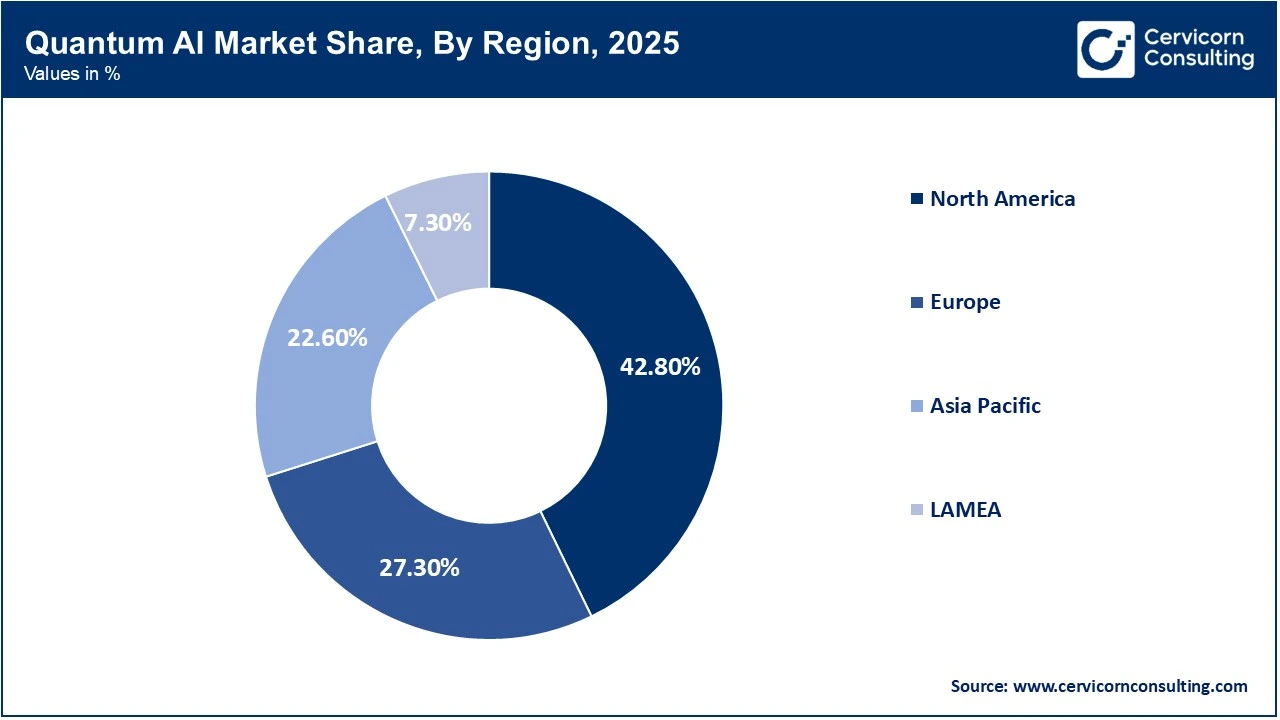
- North America dominated the global quantum AI market, accounting for 42.8% of the market share, supported by strong government funding, advanced quantum research, and leading technology companies.
- Hardware emerged as the leading component segment with 51.4% market share, driven by substantial investments in quantum processors, cryogenic systems, and qubit technology development.
- Cloud-based deployment led the market with 63.7% share, owing to growing enterprise preference for scalable, cost-effective, and remotely accessible quantum computing platforms.
- Machine Learning & Optimization dominated the application segment, capturing 39.6% market share due to increasing adoption in finance, healthcare, logistics, and manufacturing.
What is Quantum AI?
Quantum AI is the integration of quantum computing and artificial intelligence (AI) to solve computational problems that are beyond the capabilities of classical computers. By leveraging quantum phenomena such as superposition and entanglement, Quantum AI accelerates machine learning, optimization, data analysis, and simulation tasks. The technology is increasingly used across pharmaceuticals, finance, manufacturing, logistics, and cybersecurity. With 40+ countries investing in national quantum programs and more than 600,000 users accessing cloud-based quantum platforms, Quantum AI is emerging as a transformative computing paradigm for next-generation intelligent applications.
Benefits of Quantum AI
- Accelerates complex optimization, enabling faster solutions for logistics, supply chains, and financial portfolio management compared to classical approaches.
- Enhances AI model training, with quantum algorithms capable of reducing computation time for selected machine learning workloads by 10–100× in research environments.
- Improves drug discovery, allowing pharmaceutical companies to simulate molecular interactions more efficiently, potentially reducing early-stage research timelines by 20–30%.
- Strengthens cybersecurity, supporting the development of quantum-resistant cryptography as over 30 countries prepare for post-quantum security standards.
- Advances scientific simulations, enabling accurate modeling of complex chemical and material systems that are difficult for traditional supercomputers.
- Supports enterprise innovation, with over 100 organizations participating in global quantum ecosystems to accelerate commercial Quantum AI development and adoption.
Report Scope
| Area of Focus |
Details |
| Market Size in 2026 |
USD 605.19 Million |
| Market Size in 2035 |
USD 7,930.84 Million |
| CAGR 2026 to 2035 |
33.10% |
| Dominant Area |
North America |
| High-growth Region |
Asia-Pacific |
| Key Segments |
Component, Deployment Mode, Application, Region |
| Key Companies |
Amazon Web Services, Inc., Fujitsu, D-Wave Quantum Inc., IBM Corporation, Google LLC, Hitachi, Ltd., Intel Corporation, SandboxAQ, Microsoft, Toshiba Corporation |
Quantum AI Market Dynamics
Market Drivers
1. Rising Government Investments in Quantum Technologies
Governments are accelerating Quantum AI development through large-scale funding, national strategies, and research collaborations. More than 40 countries have launched national quantum initiatives, while India alone has committed over INR 6,000 crore (USD 730 million) through its National Quantum Mission. These investments support quantum hardware, AI algorithm development, workforce training, and startup ecosystems. Strong public funding reduces commercialization barriers, strengthens research infrastructure, and encourages faster enterprise adoption across strategic sectors.
2. Growing Demand for High-Performance AI Computing
Organizations increasingly require computing platforms capable of solving optimization, simulation, and machine learning challenges beyond classical systems. Quantum AI addresses these requirements by accelerating complex computational workloads across finance, healthcare, logistics, and manufacturing. Industry estimates suggest quantum computing could generate a USD 1.3 trillion economic opportunity by 2035, encouraging enterprises to invest in hybrid quantum-classical computing architectures. This growing demand continues to drive commercialization and technological innovation.
Market Restraints
1. Limited Availability of Fault-Tolerant Quantum Hardware
Despite rapid technological progress, commercially viable fault-tolerant quantum computers remain limited. Most existing systems are still in research or early commercialization stages, with qubit instability and error rates restricting large-scale deployment. Although processors exceeding 1,000 qubits have been demonstrated, reliable error-corrected quantum computing is still under development. These technical limitations delay enterprise-scale implementation and increase deployment risks across industries.
2. Shortage of Skilled Quantum Professionals
The Quantum AI market faces a growing shortage of professionals skilled in quantum computing, AI, mathematics, and quantum software engineering. Global demand for quantum talent is expected to reach approximately 600,000 jobs by 2040, while the available workforce remains limited. The shortage increases development costs, slows innovation, and delays commercial implementation, particularly for organizations lacking specialized quantum expertise.
Market Opportunities
1. Expansion of Cloud-Based Quantum Computing Services
Cloud-based quantum platforms are democratizing access to Quantum AI by eliminating the need for expensive on-premise quantum hardware. More than 600,000 developers and researchers worldwide now access cloud quantum computing services for algorithm development, testing, and experimentation. This accessibility lowers entry barriers for startups and enterprises, accelerates innovation, and supports faster commercialization across healthcare, finance, manufacturing, and scientific research.
2. Increasing Adoption in Drug Discovery and Healthcare
Healthcare represents a major growth opportunity as Quantum AI enables faster molecular simulations, protein modeling, and drug candidate identification. Pharmaceutical companies increasingly collaborate with quantum technology providers to improve research efficiency and reduce discovery timelines. Growing investments in precision medicine, genomics, and biomedical research further strengthen demand. Quantum computing's ability to solve molecular simulations beyond classical computing capabilities positions healthcare as a key long-term application area.
Market Challenges
1. High Cost of Quantum Infrastructure Development
Developing quantum processors requires expensive cryogenic systems, specialized control electronics, and advanced fabrication facilities. Governments and large technology companies continue investing billions to overcome these barriers. For example, the U.S. Commerce Department announced USD 2 billion in investments across multiple quantum computing companies to strengthen domestic capabilities. However, high infrastructure costs continue limiting participation by small and medium-sized enterprises.
2. Uncertain Commercial Readiness and Standardization
The Quantum AI ecosystem lacks universal hardware standards, software interoperability, and performance benchmarks, creating uncertainty for enterprise adoption. Numerous quantum platforms use different architectures, programming frameworks, and qubit technologies, complicating deployment decisions. While over 440 quantum startups operate across 42 countries, the fragmented ecosystem makes technology selection and long-term investment planning challenging for businesses seeking scalable commercial solutions.
Quantum AI Market Regional Analysis
The quantum AI market is segmented by region into North America, Europe, Asia-Pacific, Latin America, and LAMEA. Here is a brief overview of each region:
Why does North America hold the largest share of the quantum AI market?
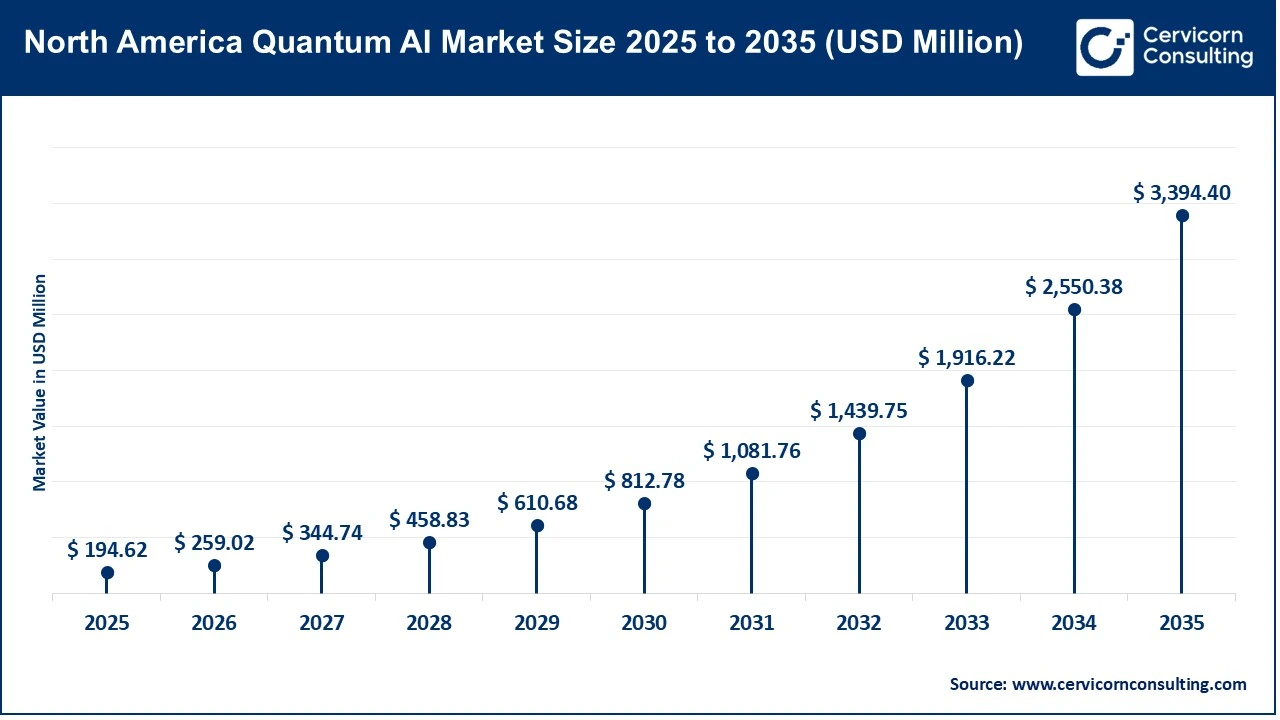
The North America quantum AI market is expected to skyrocket from USD 454.71 million in 2025 to over USD 7,930.84 million by 2035. The North America market is experiencing robust growth due to substantial government investments, a well-established quantum research ecosystem, and increasing commercialization of quantum computing technologies. The region benefits from the presence of leading quantum hardware manufacturers, cloud service providers, AI software companies, and research institutions developing next-generation quantum processors and hybrid AI applications. Rising enterprise adoption across financial services, healthcare, aerospace, defense, pharmaceuticals, and cybersecurity is further accelerating market expansion. Additionally, growing public-private partnerships, increasing venture capital funding for quantum startups, and expanding cloud-based quantum computing platforms continue strengthening North America's leadership in the global Quantum AI market.
United States: Strong federal investments, leading quantum technology companies, and expanding enterprise adoption continue driving market growth.
- The U.S. National Quantum Initiative has committed more than USD 3.8 billion toward quantum research, infrastructure, and workforce development.
- The United States accounts for over 50% of global quantum computing startups, creating a highly competitive innovation ecosystem.
- More than 100 universities and national laboratories actively conduct quantum computing and Quantum AI research, supporting commercialization across multiple industries.
Canada: Expanding national quantum strategy, world-class research institutions, and growing startup investments support market growth.
- Canada has committed more than CAD 360 million through its National Quantum Strategy to accelerate quantum commercialization and workforce development.
- The country hosts globally recognized quantum research centers, including institutions in Waterloo, Toronto, and Vancouver, supporting innovation in Quantum AI.
- Canada ranks among the world's leading quantum startup ecosystems, with increasing venture capital investments in quantum software and hardware companies.
Why is Asia-Pacific witnessing rapid growth in the quantum AI market?
The Asia-Pacific quantum AI market size was valued at USD 102.76 million in 2025 and is projected to hit around USD 1,792.37 million by 2035. The Asia-Pacific market is witnessing rapid growth due to increasing government funding, expanding quantum research initiatives, and widespread adoption of artificial intelligence across major economies. Countries such as China, Japan, South Korea, India, and Singapore are investing heavily in quantum computing infrastructure, semiconductor technologies, and AI innovation. The region benefits from a strong electronics manufacturing base, growing cloud computing adoption, and increasing collaboration between universities, research institutes, and technology companies. Rising investments in quantum communication, cybersecurity, healthcare, financial services, and smart manufacturing are further accelerating the commercialization and deployment of Quantum AI solutions across Asia-Pacific.
China: Massive government funding, world-leading quantum research, and expanding industrial applications continue driving market leadership.
- China has invested over USD 15 billion in quantum technology research and infrastructure, making it the world's largest public investor in quantum computing.
- The country operates the USD 1.4 billion National Laboratory for Quantum Information Sciences, supporting advanced quantum AI and communication research.
- China leads global quantum communication deployments, including the world's first quantum satellite network, strengthening secure AI-enabled communications.
India: National quantum initiatives, expanding AI ecosystem, and growing research collaborations support strong market growth.
- India launched the National Quantum Mission with a budget exceeding INR 6,000 crore (approximately USD 730 million) to strengthen quantum computing, communication, and sensing capabilities.
- More than 70 AI and quantum research institutions are actively engaged in quantum technology development through government and industry collaborations.
- Rapid growth of India's cloud computing ecosystem is encouraging enterprises and startups to explore cloud-based Quantum AI applications.
Why is Europe experiencing significant growth in the quantum AI market?
The Europe quantum AI market is expnading rapidly from USD 124.14 million in 2025 to over USD 2,165.12 million by 2035. The Europe market is experiencing significant growth due to strong government funding, collaborative research initiatives, and increasing adoption of quantum computing across industrial sectors. The region benefits from well-established research institutions, advanced semiconductor capabilities, and supportive regulatory frameworks promoting quantum innovation. The European Union's Quantum Flagship program, along with national quantum strategies, is accelerating the development of quantum hardware, software, and AI applications. Growing investments in cybersecurity, automotive, pharmaceuticals, financial services, and aerospace are further strengthening Europe's position as a major global Quantum AI innovation hub.
Germany: Strong industrial ecosystem, expanding quantum research, and advanced manufacturing capabilities continue driving market growth.
- Germany has committed more than EUR 3 billion toward quantum technology development through federal government initiatives and research programs.
- The country is investing heavily in quantum processors, AI integration, and semiconductor technologies to strengthen industrial competitiveness.
- Leading automotive, manufacturing, and engineering companies are increasingly adopting Quantum AI for optimization, simulation, and material discovery.
United Kingdom: Growing quantum startup ecosystem, strong academic research, and increasing commercial investments support market expansion.
- The UK National Quantum Technologies Programme has invested more than GBP 1 billion in quantum research, commercialization, and skills development.
- The United Kingdom hosts over 50 quantum technology companies, making it one of Europe's leading quantum startup ecosystems.
- Universities including Oxford, Cambridge, and Imperial College London continue advancing research in quantum computing and Quantum AI.
LAMEA Quantum AI Market Trends
The LAMEA quantum AI market was valued at USD 33.19 million in 2025 and is anticipated to reach around USD 578.95 million by 2035. The LAMEA market is gradually emerging as governments and enterprises increase investments in digital transformation, artificial intelligence, and advanced computing research. Countries across the region are strengthening quantum research capabilities through academic collaborations, national innovation strategies, and partnerships with global technology companies. Rising demand for secure communications, financial technology, smart manufacturing, energy optimization, and cybersecurity solutions is creating new opportunities for Quantum AI adoption. Increasing cloud-based quantum computing access is also enabling universities, startups, and enterprises to explore commercial quantum applications without significant infrastructure investments.
Brazil: Expanding research initiatives, growing AI ecosystem, and increasing government support continue driving market growth.
- Brazil is strengthening quantum computing research through national science agencies and leading universities, including the University of São Paulo (USP) and State University of Campinas (UNICAMP).
- The country accounts for over 35% of Latin America's AI startup ecosystem, supporting future Quantum AI commercialization.
- Government-backed digital transformation and Industry 4.0 initiatives are encouraging adoption of advanced computing technologies across manufacturing and financial services.
Saudi Arabia: National innovation strategies, smart city initiatives, and rising investments in emerging technologies support market expansion.
- Saudi Arabia's Vision 2030 continues driving investments in artificial intelligence, quantum computing research, and advanced digital infrastructure.
- The Kingdom has committed more than USD 20 billion toward AI and digital transformation initiatives through government-backed investment programs.
Segmental Analysis
The quantum AI market is segmented into component, deployment mode, application, and geography.
Component Analysis
The hardware segment dominates the Quantum AI market due to substantial investments in quantum processors, control electronics, cryogenic systems, and qubit development. Technology leaders and governments prioritize hardware innovation to improve qubit stability, scalability, and computational performance. Most industry funding is directed toward advancing superconducting, trapped-ion, and photonic quantum computing platforms. Since reliable hardware forms the foundation of Quantum AI systems, continuous infrastructure development and increasing public-private investments maintain the hardware segment's leading market position.
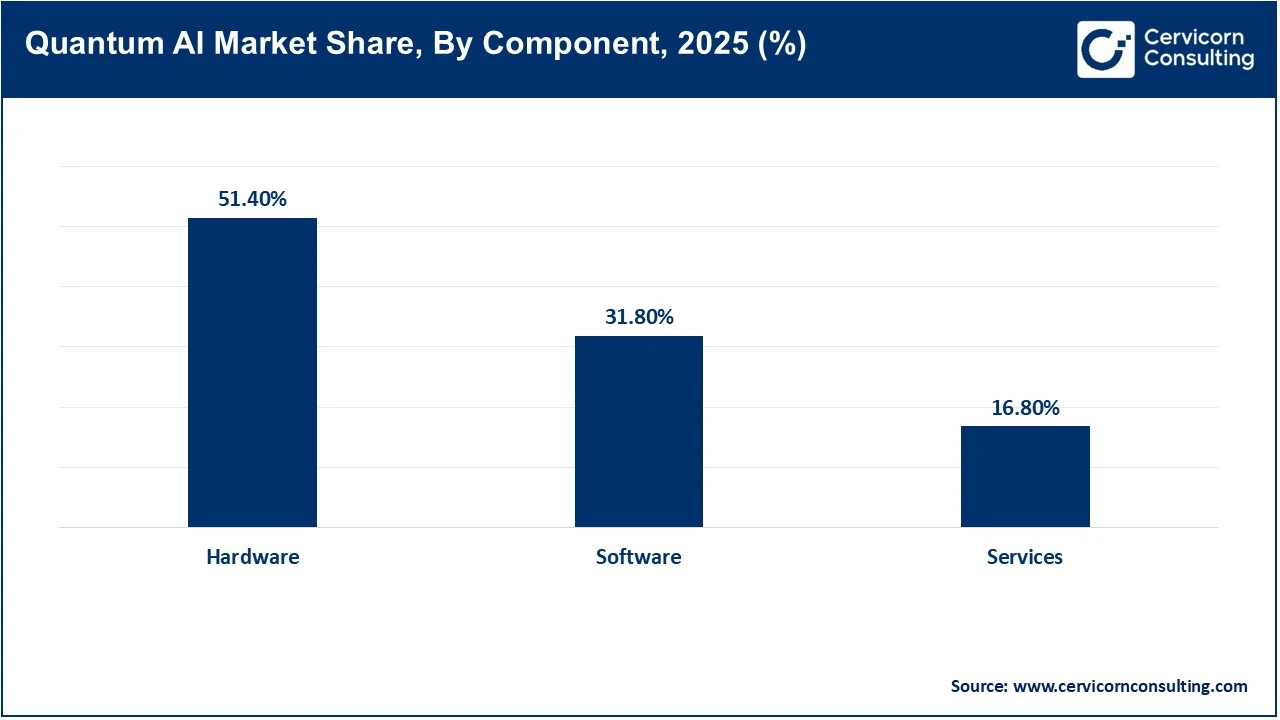
The software segment is expected to register the fastest growth due to rising demand for quantum algorithms, machine learning frameworks, development platforms, and programming tools. Enterprises increasingly adopt quantum software development kits and cloud-based programming environments to build hybrid quantum-AI applications without investing in dedicated hardware. Continuous improvements in quantum compilers, optimization algorithms, and application-specific software are accelerating commercialization, enabling organizations across healthcare, finance, manufacturing, and logistics to develop scalable Quantum AI solutions.
Deployment Mode Analysis
The cloud-based segment dominates the market, providing affordable access to quantum computing resources without requiring expensive infrastructure investments. Leading technology companies offer quantum processors through cloud platforms, allowing researchers, startups, and enterprises to develop and test Quantum AI applications remotely. Cloud deployment supports scalability, collaborative research, rapid experimentation, and reduced implementation costs. Growing accessibility to quantum resources continues driving widespread adoption across commercial, academic, and government organizations.
Quantum AI Market Share, By Deployment Mode, 2025 (%)
| Deployment Mode |
Revenue Share, 2025 (%) |
| Cloud-based |
63.7% |
| On-premises |
36.3% |
The cloud-based segment is also projected to be the fastest-growing deployment mode because organizations increasingly prefer flexible, subscription-based access to quantum computing services. Cloud platforms eliminate infrastructure complexity while enabling rapid software development, AI model training, and hybrid quantum-classical computing. Continuous expansion of cloud quantum ecosystems, improved developer tools, and increasing enterprise experimentation are accelerating adoption. Small and medium-sized businesses particularly benefit from reduced capital expenditure and faster implementation through cloud-based Quantum AI services.
Application Analysis
The Machine Learning & Optimization segment dominates the Quantum AI market owing to strong demand for solving complex optimization, predictive analytics, and decision-making challenges. Industries including finance, logistics, manufacturing, and healthcare increasingly utilize Quantum AI to improve operational efficiency and accelerate AI model training. Hybrid quantum-classical algorithms enhance optimization capabilities beyond conventional computing methods. Rising enterprise investments in advanced analytics and intelligent automation continue strengthening this segment's leadership within the overall Quantum AI market.
Quantum AI Market Share, By Application, 2025 (%)
| Application |
Revenue Share, 2025 (%) |
| Machine Learning & Optimization |
39.6% |
| Simulation & Modeling |
28.1% |
| Quantum Security & Cryptography |
21.7% |
| Others |
10.6% |
The Quantum Security & Cryptography segment is expected to experience the fastest growth due to rising concerns about data protection and emerging quantum-enabled cyber threats. Governments, financial institutions, and defense organizations are accelerating investments in post-quantum cryptography and quantum-secure communication technologies. The transition toward quantum-resistant encryption standards is creating significant opportunities for Quantum AI-driven cybersecurity solutions. Growing regulatory focus and expanding digital infrastructure further support rapid adoption across critical industries.
Quantum AI Market Top Companies
Recent Developments
- In June 2026, IBM announced plans to invest more than USD 10 billion in quantum computing over five years, accelerating development of fault-tolerant quantum computers, expanding manufacturing capacity, and strengthening its global Quantum AI ecosystem.
- In June 2026, Microsoft introduced its AI-designed Majorana 2 quantum chip and announced a roadmap to deliver commercially useful quantum computing systems by 2029, accelerating Quantum AI development through advances in topological qubit technology.
- In February 2025, AWS unveiled its first prototype quantum chip, Ocelot, designed to improve quantum error correction efficiency by up to 90%. The breakthrough advances scalable, fault-tolerant quantum computing and strengthens AWS's Quantum AI ecosystem for enterprise and research applications.
Market Segmentation
By Component
- Hardware
- Software
- Services
By Deployment Mode
By Application
- Machine Learning & Optimization
- Quantum Security & Cryptography
- Simulation & Modeling
- Others
By Geography
- North America
- Europe
- Asia-Pacific
- LAMEA