Organic Electronics Market Size, Growth, Forecast 2026 To 2035
The global organic electronics market size was valued at USD 112.68 billion in 2025 and is expected to surpass around USD 685.34 billion by 2035, exhibiting a compound annual growth rate (CAGR) of 19.8% over the forecast period 2026 to 2035.
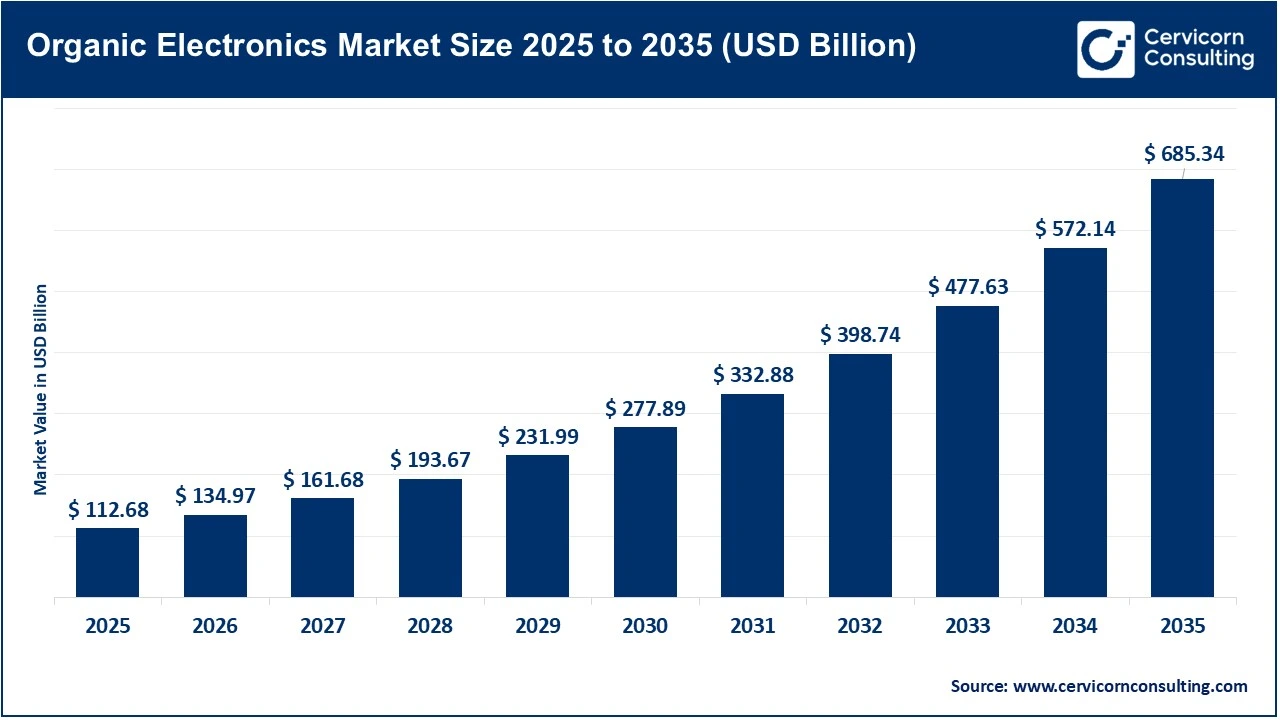
The organic electronics market is gaining momentum due to the rapid shift toward flexible displays, wearable electronics, printed sensors, and sustainable semiconductor technologies. A major growth catalyst is the OLED display industry, where organic materials enable thinner, lighter, and foldable screens for smartphones, TVs, and automotive displays. Additionally, the consumer electronics sector accounts for more than 33% of organic electronics demand, highlighting the strong influence of smartphones, wearables, and next-generation display devices on market expansion. Semiconductor materials account for approximately 36% of the materials segment's share, reflecting the increasing adoption of organic semiconductors in displays, sensors, and transistors. Furthermore, the flexible electronics ecosystem is projected to grow at over 20% annually, creating significant opportunities for organic field-effect transistors (OFETs), printed electronics, and smart packaging solutions. Rising investment in renewable energy is also accelerating the deployment of organic photovoltaic (OPV) technologies, while advancements in roll-to-roll manufacturing are reducing production costs and enabling large-scale commercialization of lightweight electronic devices.
Report Highlights
- North America dominated the global organic electronics market with a 37.9% market share, supported by strong OLED adoption, advanced semiconductor research, and growing demand for wearable electronics.
- By material, Semiconductor was the leading segment with a 41.8% market share, owing to its extensive use in OLED displays, organic photovoltaics (OPVs), transistors, and sensors.
- By application, Displays held the largest share at 52.7%, fueled by rising adoption of OLED technology in smartphones, televisions, laptops, wearables, and automotive displays.
- By end-use industry, Consumer Electronics captured 46.9% of the market, supported by strong demand for smartphones, smartwatches, tablets, foldable devices, and premium display technologies.
What are Organic Electronics?
Organic Electronics are electronic devices and components made from carbon-based organic materials, such as conductive polymers and small organic molecules, instead of traditional inorganic semiconductors like silicon. These materials possess electrical conductivity and semiconducting properties, enabling the development of lightweight, flexible, thin, and energy-efficient electronic products.
Organic electronics are widely used in technologies such as Organic Light-Emitting Diodes (OLEDs), Organic Photovoltaics (OPVs), Organic Field-Effect Transistors (OFETs), printed electronics, flexible displays, wearable devices, smart packaging, and advanced sensors. Their ability to be manufactured using low-cost printing techniques and on flexible substrates makes them particularly attractive for next-generation consumer electronics, healthcare devices, automotive displays, and renewable energy applications.
Shift Toward Flexible and Wearable Technology Driving Organic Electronics Market Growth
The growing adoption of flexible and wearable technologies is a major driver of the organic electronics market, as organic materials offer unique advantages that conventional silicon-based electronics cannot easily provide. Organic semiconductors, conductive polymers, and printed electronic components enable the production of ultra-thin, lightweight, bendable, and stretchable devices, making them ideal for smartwatches, fitness trackers, electronic skin patches, foldable displays, and healthcare monitoring systems. As consumers increasingly demand portable, comfortable wearable devices, manufacturers are investing heavily in organic electronic components that conform to curved surfaces while maintaining performance and durability. The healthcare sector is further accelerating demand through wearable biosensors and remote patient monitoring devices, while advancements in roll-to-roll printing technologies are reducing manufacturing costs and supporting large-scale production. Consequently, the expansion of wearable electronics and flexible display applications continues to create substantial growth opportunities for organic electronics manufacturers worldwide.
Report Scope
| Area of Focus |
Details |
| Market Size in 2026 |
USD 134.97 Billion |
| Market Size in 2035 |
USD 685.34 Billion |
| CAGR 2026 to 2035 |
19.80% |
| Dominant Region |
North America |
| Fastest Growing Region |
Asia-Pacific |
| Key Segments |
Material, Application, End-Use Industry, Region |
| Key Companies |
Samsung Display, LG Display, Universal Display Corporation, Merck KGaA, Konica Minolta, Inc., Sumitomo Chemical Co., Ltd., Novaled GmbH, Heliatek GmbH, FlexEnable Limited, PragmatIC Semiconductor Ltd., BASF SE, AUO Corporation |
Organic Electronics Market Dynamics
Market Drivers
1. Rising Adoption of OLED Displays in Consumer Electronics
The increasing penetration of OLED displays in smartphones, televisions, laptops, smartwatches, and automotive infotainment systems is a major driver for the organic electronics market. OLED technology offers superior contrast ratios, thinner form factors, lower power consumption, and flexible design capabilities compared to traditional LCDs. More than 70% of premium smartphones globally now utilize OLED displays, while OLED TV shipments continue to expand annually. As consumer demand for high-resolution and foldable displays grows, manufacturers are increasing investments in organic semiconductor materials and OLED production facilities, driving overall market expansion.
2. Advancements in Printed Electronics and Roll-to-Roll Manufacturing
Continuous advancements in printed electronics and roll-to-roll manufacturing technologies are significantly driving the organic electronics market by enabling faster, scalable, and cost-effective production of electronic components. Unlike conventional semiconductor fabrication, organic electronic devices can be manufactured using printing techniques on flexible substrates, reducing material waste and production complexity. Studies indicate that roll-to-roll manufacturing can lower production costs by 30–50% compared to traditional fabrication methods while supporting high-volume output. The growing adoption of printed sensors, RFID tags, smart packaging, and flexible circuits is encouraging manufacturers to invest in organic electronic materials, further accelerating market growth across consumer, industrial, and healthcare applications.
Market Restraints
1. Limited Operational Lifetime and Material Stability
Despite technological advancements, organic electronic materials generally exhibit lower durability and shorter operational lifespans than conventional silicon-based components. Exposure to moisture, oxygen, ultraviolet radiation, and high temperatures can degrade organic semiconductors, affecting device performance over time. For example, OLED displays require advanced encapsulation technologies to prevent degradation, increasing manufacturing complexity. Studies indicate that organic materials can experience performance losses significantly faster than inorganic alternatives under harsh operating conditions, limiting adoption in applications requiring long-term reliability and high environmental resistance.
2. High Manufacturing and Development Costs
Although organic electronics promise low-cost production through printing technologies, large-scale commercialization still requires substantial investments in research, materials development, and specialized manufacturing infrastructure. High-purity organic compounds, advanced deposition equipment, and encapsulation processes increase production expenses. OLED fabrication facilities often require investments exceeding several billion dollars, creating barriers for new market entrants. Furthermore, continuous R&D spending is necessary to improve efficiency and durability, making it difficult for smaller companies to compete effectively against established industry leaders.
Market Opportunities
1. Expansion of Organic Photovoltaic (OPV) Technology
Organic photovoltaic technology presents a significant growth opportunity due to increasing global emphasis on renewable energy and sustainable power generation. OPVs offer advantages such as flexibility, lightweight construction, transparency, and compatibility with low-cost roll-to-roll manufacturing. Unlike traditional solar panels, OPVs can be integrated into windows, building facades, and portable electronics. With global renewable energy investments exceeding hundreds of billions of dollars annually, research funding and commercialization efforts for organic solar technologies are accelerating, creating new revenue streams for organic electronics manufacturers.
2. Increasing Adoption in Healthcare and Biomedical Devices
The healthcare sector offers substantial opportunities for organic electronics through wearable diagnostics, biosensors, and remote patient monitoring systems. Organic materials provide flexibility, biocompatibility, and comfort, making them suitable for skin-mounted and implantable devices. The global wearable healthcare device market is experiencing double-digit annual growth, fueled by rising prevalence of chronic diseases and demand for continuous health monitoring. Organic sensors capable of measuring heart rate, glucose levels, and body temperature are expected to become increasingly important in next-generation personalized healthcare solutions.
Market Challenges
1. Competition from Established Silicon-Based Technologies
Organic electronics face strong competition from mature silicon-based semiconductor technologies that offer superior performance, durability, and manufacturing scalability. Silicon continues to dominate high-performance computing, power electronics, and advanced integrated circuits due to decades of technological refinement and extensive infrastructure investments. The global semiconductor industry generates hundreds of billions of dollars in annual revenue, highlighting the dominance of traditional technologies. As a result, organic electronics manufacturers must demonstrate clear advantages in flexibility, weight reduction, or cost efficiency to gain broader market acceptance.
2. Scalability and Mass Production Challenges
Scaling laboratory innovations into high-volume commercial production remains a significant challenge for the organic electronics market. Maintaining consistent material quality, device performance, and manufacturing yield across large production runs is complex. Variations in printing processes, material deposition, and environmental conditions can impact product reliability. While roll-to-roll manufacturing offers substantial cost advantages, achieving industrial-scale production with high yields remains difficult. Industry reports indicate that production yield optimization continues to be one of the primary technical barriers slowing widespread commercialization of advanced organic electronic devices.
Organic Electronics Market Regional Analysis
The organic electronics market is segmented by region into North America, Europe, Asia-Pacific, Latin America, and LAMEA. Here is a brief overview of each region:
North America Organic Electronics Market: Driven by Strong OLED Manufacturing Ecosystem, Rising Adoption of Wearable Electronics, and Growing Investment in Advanced Semiconductor Technologies
The North America organic electronics market size was valued at USD 42.71 billion in 2025 and is expected to hit around USD 259.74 billion by 2035.
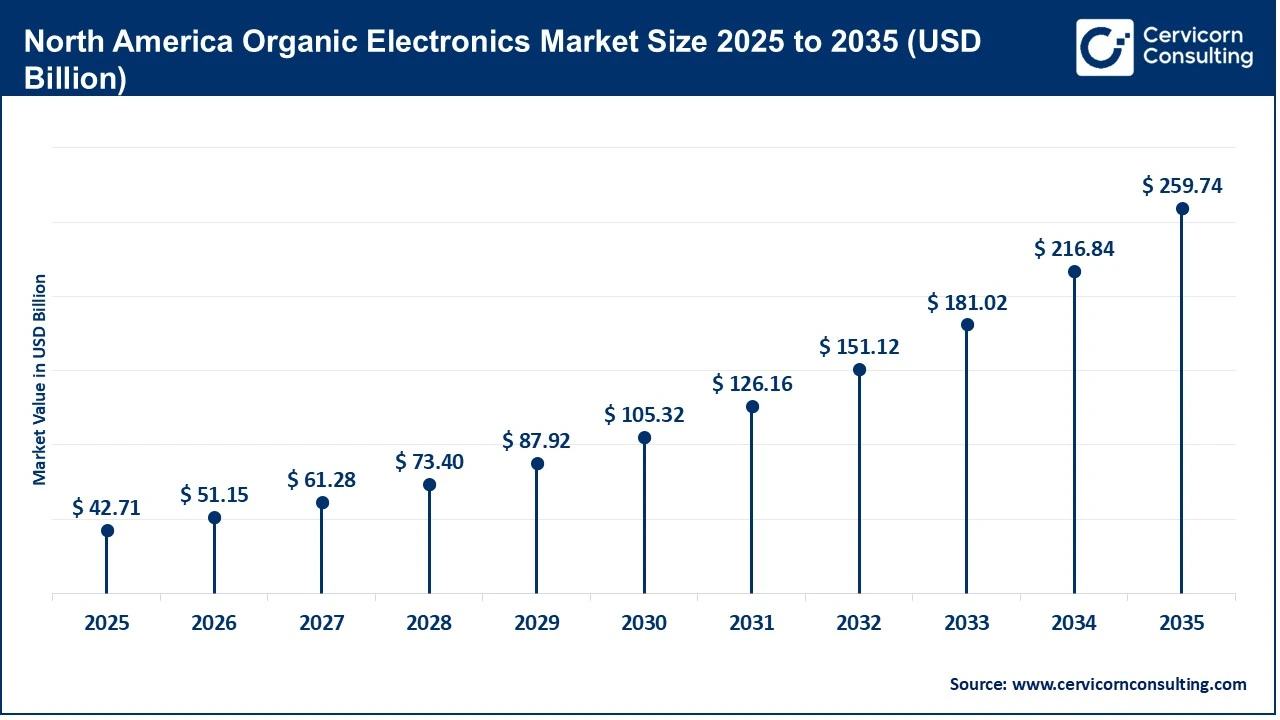
The North America market is experiencing steady growth due to increasing demand for OLED displays, flexible electronics, wearable devices, and advanced healthcare monitoring solutions. The region benefits from strong research and development activities, significant investments in next-generation semiconductor materials, and growing adoption of printed electronics across consumer and industrial applications. The presence of leading technology companies, expanding smart device penetration, and increasing demand for energy-efficient display technologies are further supporting market growth. Additionally, government funding for advanced manufacturing, flexible electronics research, and renewable energy technologies is accelerating innovation and commercialization of organic electronic products across the region.
United States: Strong OLED adoption, growing wearable device market, and extensive semiconductor R&D investments continue driving market growth.
- The United States accounts for more than 35% of global wearable technology revenues, creating substantial demand for organic sensors and flexible electronic components.
- Over 70% of premium smartphones sold in the country utilize OLED displays, supporting increased consumption of organic semiconductor materials.
- The U.S. government has committed more than USD 50 billion through semiconductor and advanced manufacturing initiatives, encouraging innovation in next-generation electronic materials and technologies.
Canada: Expanding advanced materials research, increasing healthcare technology adoption, and strong clean technology investments support market growth.
- Canada continues to increase funding for flexible electronics and advanced materials research through university-industry collaboration programs.
- More than one-third of Canadian adults use wearable health-monitoring devices, boosting demand for organic sensors and printed electronics.
Asia-Pacific (APAC) Organic Electronics Market: Driven by Dominant Electronics Manufacturing Base, Rapid OLED Adoption, and Expanding Flexible Electronics Production
The Asia-Pacific organic electronics market size reached at USD 39.21 billion in 2025 and is predicted to grow around USD 238.50 billion by 2035. The Asia-Pacific market is the largest regional market, driven by major electronics manufacturing hubs, rising investments in OLED production, and growing demand for flexible and wearable devices. Countries across the region are leading the commercialization of organic semiconductors, OLED displays, printed electronics, and organic photovoltaic technologies. Strong demand for consumer electronics, expanding smartphone production, and government support for advanced semiconductor manufacturing continue to drive market growth. Additionally, the region's cost-effective manufacturing ecosystem and robust supply chain infrastructure are accelerating the large-scale deployment of organic electronic components across multiple industries.
China: Massive electronics manufacturing capacity, growing OLED investments, and strong semiconductor development initiatives continue driving market growth.
- China accounts for more than 30% of global electronics manufacturing output, creating substantial demand for organic electronic materials and components.
- The country has invested billions of dollars in semiconductor and display manufacturing projects to strengthen domestic technology production capabilities.
India: Growing electronics manufacturing, rising wearable device adoption, and government-backed semiconductor initiatives support market growth.
- India's electronics manufacturing sector is expanding rapidly under initiatives such as Production Linked Incentive (PLI) programs.
- Smartphone shipments in India consistently exceed 150 million units annually, creating growing demand for OLED-based devices.
- Increasing adoption of smartwatches, fitness trackers, and healthcare wearables is accelerating the use of organic sensors and flexible electronic components in the country.
Europe Organic Electronics Market: Driven by Strong Research and Innovation Ecosystem, Growing Sustainable Electronics Adoption, and Expanding Automotive Applications
The Europe organic electronics market size was estimated at USD 22.65 billion in 2025 and is forecasted to reach around USD 137.75 billion by 2035. The Europe market is witnessing robust growth due to increasing investments in advanced materials research, rising demand for energy-efficient electronic technologies, and growing adoption of organic electronics in automotive, healthcare, and renewable energy applications. The region benefits from strong government support for sustainable technologies, a well-established industrial base, and extensive collaboration between research institutions and industry participants. Europe is also a leader in organic photovoltaic (OPV) development and flexible electronics innovation, while the growing deployment of OLED lighting and advanced vehicle displays continues to create significant growth opportunities across the market.
Germany: Strong automotive industry, advanced materials expertise, and growing flexible electronics investments continue driving market growth.
- Germany is Europe's largest automotive manufacturing hub, supporting increasing adoption of OLED displays, smart lighting, and organic sensors in vehicles.
- The country invests billions of euros annually in semiconductor research and advanced manufacturing technologies.
France: Rising clean technology investments, strong aerospace sector, and growing renewable energy initiatives fuel market growth.
- France is increasing investments in sustainable electronics and renewable energy technologies, supporting adoption of organic photovoltaics.
- The country's aerospace and defense industries are exploring lightweight and flexible electronic solutions for advanced applications.
- National innovation programs continue funding research into organic semiconductors, flexible displays, and printed electronic systems.
Organic Electronics Market Share, By Region, 2025 (%)
| Region |
Revenue Share, 2025 (%) |
| North America |
37.9% |
| Asia-Pacific |
34.8% |
| Europe |
20.1% |
| LAMEA (Latin America, Middle East & Africa) |
7.2% |
LAMEA Organic Electronics Market: Driven by Expanding Renewable Energy Projects, Growing Consumer Electronics Adoption, and Increasing Investments in Advanced Manufacturing Technologies
The LAMEA organic electronics market was valued at USD 8.11 billion in 2025 and is anticipated to reach around USD 49.34 billion by 2035. The LAMEA organic electronics market is gradually expanding due to rising adoption of consumer electronics, increasing investments in renewable energy infrastructure, and growing interest in advanced electronic materials. Governments across the region are promoting digital transformation, smart city initiatives, and clean energy development, creating opportunities for OLED displays, organic photovoltaics (OPVs), and flexible electronic technologies. Additionally, increasing smartphone penetration, expanding healthcare infrastructure, and growing industrial modernization efforts are supporting demand for organic sensors, printed electronics, and energy-efficient display solutions across multiple sectors.
Brazil: Growing consumer electronics market, expanding renewable energy investments, and increasing industrial modernization continue driving market growth.
- Brazil is the largest consumer electronics market in Latin America, supporting rising demand for OLED-based smartphones, televisions, and wearable devices.
- The country generates more than 85% of its electricity from renewable and low-carbon energy sources, creating favorable conditions for future organic photovoltaic applications.
- Growing investments in smart manufacturing and industrial automation are increasing opportunities for printed electronics and advanced sensor technologies.
Saudi Arabia: Strong technology investments, smart city development, and economic diversification initiatives support market expansion.
- Saudi Arabia's Vision 2030 program is accelerating investments in advanced technologies, smart infrastructure, and digital transformation projects.
- Large-scale smart city developments, including projects such as NEOM, are creating demand for innovative electronic and sensing technologies.
Organic Electronics Market Segmental Analysis
The organic electronics market is segmented into material, application, end-use industry, and geography.
Material Analysis
The semiconductor segment dominates the organic electronics market due to its critical role in OLED displays, organic photovoltaics (OPVs), organic field-effect transistors (OFETs), and advanced sensors. Organic semiconductors provide the electrical properties necessary for charge transport and light emission, making them indispensable across major applications. Their widespread use in smartphones, televisions, wearable devices, and flexible electronics has significantly strengthened demand. Continuous innovation in organic semiconductor materials to improve efficiency, stability, and flexibility further reinforces the segment’s leading position within the market.
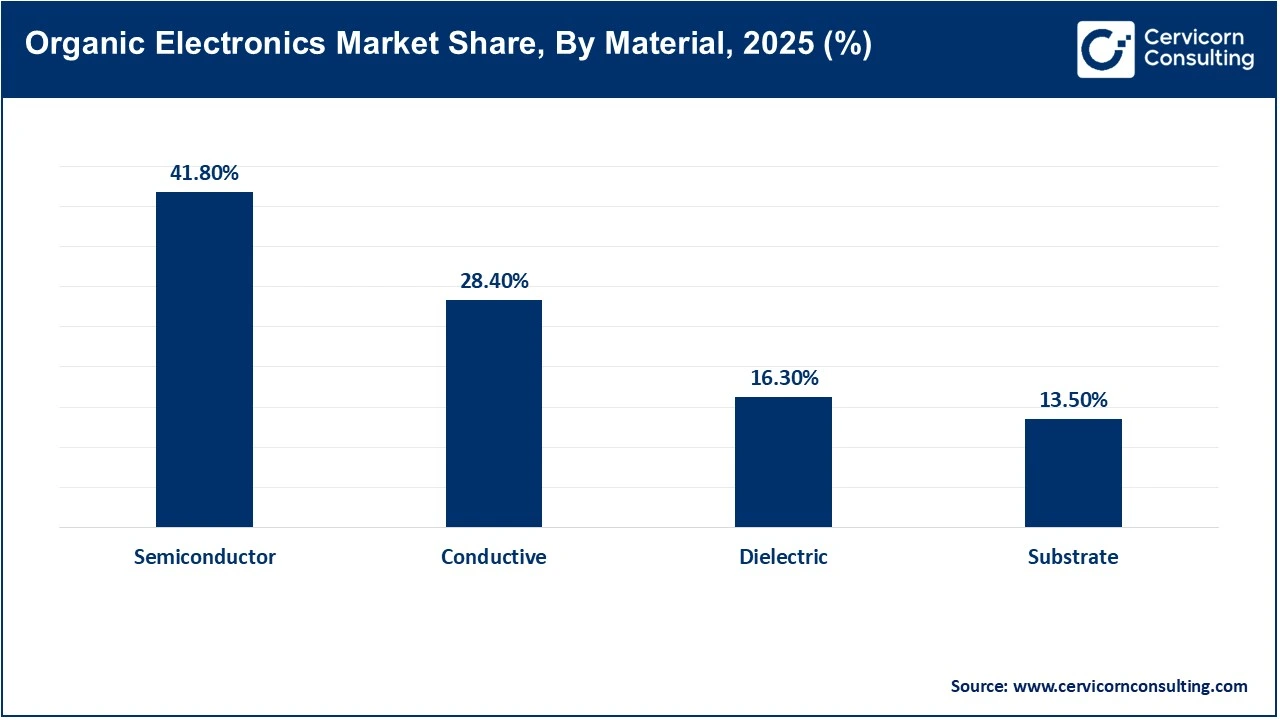
The conductive segment is expected to witness the fastest growth owing to increasing adoption of conductive polymers and inks in printed electronics, smart packaging, RFID tags, and flexible circuits. As manufacturers focus on lightweight and low-cost electronic solutions, conductive materials are becoming essential for roll-to-roll printing processes. Growing demand for wearable devices and IoT-enabled products is accelerating the use of conductive organic materials. Additionally, advancements in printable conductive inks are expanding commercial applications, making this segment one of the most rapidly evolving areas of the market.
Application Analysis
The displays segment holds the largest share of the organic electronics market, driven primarily by the widespread adoption of OLED technology in smartphones, televisions, tablets, laptops, and wearable devices. OLED displays offer superior color quality, higher contrast ratios, faster response times, and lower power consumption compared to traditional display technologies. The increasing popularity of foldable smartphones and premium consumer electronics has further boosted demand for organic display components. Strong investments by display manufacturers continue to support the segment’s dominant market position.
Organic Electronics Market, By Application, 2025 (%)
| Application |
Revenue Share, 2025 (%) |
| Displays |
52.7% |
| OLED Lighting |
11.4% |
| Organic Photovoltaics (OPV) |
10.2% |
| Sensors |
9.8% |
| Transistors/System Components |
8.1% |
| Others |
7.8% |
The Organic Photovoltaics (OPV) segment is anticipated to be the fastest-growing application due to rising global emphasis on renewable energy and sustainable power solutions. OPVs offer unique benefits such as lightweight construction, flexibility, transparency, and compatibility with low-cost manufacturing methods. Their ability to be integrated into windows, building facades, portable devices, and smart infrastructure is attracting significant research and commercial interest. As governments and industries continue investing in clean energy technologies, OPV adoption is expected to accelerate substantially over the coming years.
End-Use Industry Analysis
The consumer electronics segment dominates the organic electronics market owing to extensive utilization of OLED displays, flexible screens, wearable devices, and printed electronic components. The growing demand for smartphones, smartwatches, tablets, televisions, and other connected devices has created substantial opportunities for organic electronic technologies. Consumers increasingly prefer thinner, lighter, and more energy-efficient products, encouraging manufacturers to integrate organic materials into next-generation devices. Continuous product innovation and high replacement rates in consumer electronics further contribute to the segment’s leading market share.
Organic Electronics Market, By End-Use Industry, 2025 (%)
| End-Use Industry |
Revenue Share, 2025 (%) |
| Consumer Electronics |
46.9% |
| Healthcare |
12.8% |
| Automotive |
14.6% |
| Energy |
9.1% |
| Aerospace & Defense |
6.7% |
| Military |
4.3% |
| Others |
5.6% |
The healthcare segment is projected to register the fastest growth due to increasing adoption of wearable medical devices, biosensors, electronic skin patches, and remote patient monitoring systems. Organic electronics offer flexibility, lightweight design, and biocompatibility, making them highly suitable for medical applications that require direct contact with the human body. Rising prevalence of chronic diseases, growing demand for continuous health monitoring, and expansion of digital healthcare services are supporting market growth. Ongoing advancements in organic sensor technology are expected to further strengthen adoption across healthcare environments.
Organic Electronics Market Top Companies
Recent Developments
- In May 2025, Samsung Display Co., Ltd. unveiled its next-generation stretchable OLED display technology at SID Display Week 2025, featuring enhanced flexibility and durability for future wearable devices, automotive interiors, and foldable electronics. The development reinforces the company's leadership in advanced organic display technologies and expands commercial opportunities for flexible electronics applications.
- In May 2025, LG Display Co., Ltd. introduced its fourth-generation OLED technology capable of achieving up to 4,000 nits of peak brightness while improving energy efficiency. The innovation is designed to enhance premium televisions, automotive displays, and IT devices, supporting broader adoption of OLED-based organic electronic products.
- In January 2025, Universal Display Corporation expanded its OLED intellectual property portfolio through the acquisition of strategic OLED patent assets from Merck KGaA. The transaction strengthens the company’s technology leadership and supports the development of next-generation phosphorescent OLED materials.
Market Segmentation
By Material
- Semiconductor
- Conductive
- Dielectric
- Substrate
By Application
- Displays
- OLED Lighting
- Organic Photovoltaics (OPV)
- Sensors
- Transistors/System Components
- Others
By End-Use Industry
- Consumer Electronics
- Healthcare
- Automotive
- Energy
- Aerospace & Defense
- Military
- Others
By Geography
- North America
- Europe
- Asia-Pacific
- LAMEA