Managed Security Services Market Size and Growth 2026 to 2035
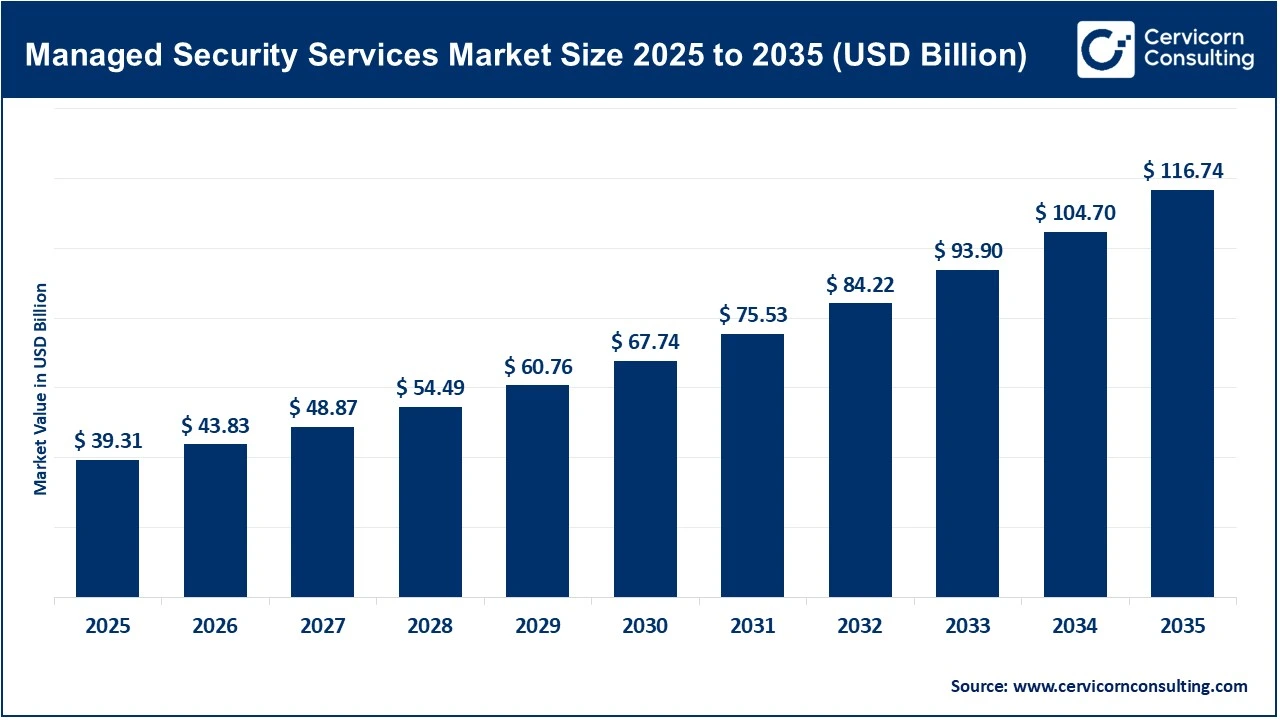
The global managed security services market size was valued at USD 39.31 billion in 2025 and is expected to be worth around USD 116.74 billion by 2035, exhibiting a compound annual growth rate (CAGR) of 11.5% over the forecast period from 2026 to 2035. The managed security services (MSS) market is expanding rapidly, driven by rising cyber threats and growing demand for outsourced security expertise. More organizations are facing complex attacks, which drives up the need for continuous monitoring and incident response. Cybersecurity service spending is projected to grow from USD 77 billion in 2024 to USD 92.7 billion by 2026, reflecting a clear shift toward managed services for threat mitigation. MSSP services are also expanding at a faster rate than traditional security solutions, with estimates suggesting growth rates up to four times higher than standalone security tools. This trend is supported by more enterprises outsourcing their cybersecurity needs, as 84% of organizations now expect service providers to manage their cybersecurity or IT security environments, compared to 65% previously.
Digital transformation, regulatory requirements, and the shortage of cybersecurity professionals are the main drivers of the MSS market. As more companies migrate to the cloud and expand their digital infrastructure, their attack surface increases. Stricter data protection regulations also encourage organizations to adopt advanced security frameworks. The global shortage of cybersecurity professionals, with approximately 4.8 million unfilled positions, leads more enterprises to rely on MSSPs for specialized skills. Simultaneously, the volume and complexity of cyber threats, along with rapid data growth, amplify the need for managed services. Consequently, the MSS market is becoming a vital component of enterprise security strategies.
Report Highlights
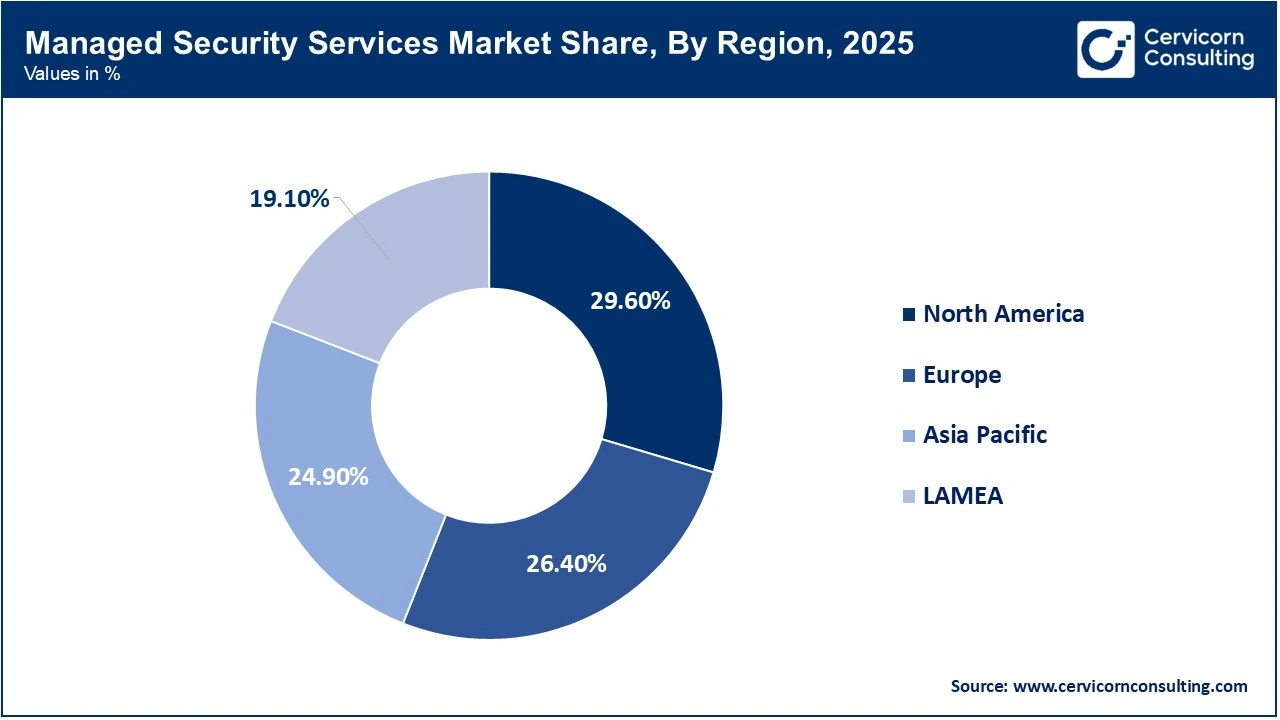
- By Region, North America dominates, with a 29.6% share of the global managed security services market, driven by strong cybersecurity spending, advanced IT infrastructure, and the presence of leading MSS providers and cloud hyperscalers.
- By Deployment Model, cloud-based services dominate the market, capturing around 71.9% share, mainly due to increasing cloud adoption, scalability advantages, and demand for real-time threat monitoring across distributed environments.
- By Service Type, Managed Detection and Response (MDR) dominates the market, accounting for 27.1% share, primarily due to its ability to provide continuous monitoring, threat hunting, and rapid incident response.
- By Provider Type, security-specialist MSSPs dominate the market, holding around 32.1% share, mainly due to their deep cybersecurity expertise, advanced threat intelligence capabilities, and dedicated SOC operations.
- By End-user Industry, BFSI dominates the market, capturing approximately 24.4% share, mainly due to strict regulatory requirements, high exposure to cyber threats, and the need for continuous monitoring and compliance.
Impact of Compliance-by-Design Mandates on MSS Market Growth
Recent compliance-by-design regulations, including the Digital Operational Resilience Act (DORA), NIS2 Directive, and new U.S. SEC cybersecurity rules, are increasing demand for managed security services. These frameworks require organizations to implement continuous monitoring, timely incident reporting, and enhanced risk management. Many enterprises lack the internal resources to meet requirements such as real-time threat detection, short breach reporting windows, and oversight of third-party risks. As a result, more organizations are turning to managed security service providers (MSSPs) to address compliance needs.
For instance, over 70% of EU financial institutions are updating cybersecurity frameworks to comply with DORA, and NIS2 is likely to extend regulatory obligations to up to three times as many entities as before. The new SEC rules also require public companies to report material cyber incidents within 4 business days, prompting greater adoption of managed detection and response services. These developments suggest that cybersecurity is shifting from a reactive IT function to a core, continuously monitored business process. MSSPs are increasingly viewed as practical partners for organizations seeking to manage compliance risks and operational demands.
Rising Capital Investments and Consolidation Trends
1. Investment Landscape & Capital Flow
Investor interest in the MSS market remains strong, reflecting the growing importance of cybersecurity across digital economies. Private equity and strategic investors are prioritizing MSSPs, attracted by their stable revenue streams and long-term contracts with enterprise clients. In 2025, the sector saw more than 125 M&A transactions involving MSS and related service providers, signaling ongoing consolidation. Recent trends show a shift toward larger deal sizes, suggesting that investors are seeking scalable MSS platforms rather than pursuing a higher volume of smaller deals. Security services continue to command a significant share of enterprise IT budgets, with spending projected to increase by approximately 20% between 2024 and 2026. Much of this growth is expected to benefit outsourced managed services, highlighting continued demand for external cybersecurity expertise.
2. Technological Advancements Reshaping MSS
Advances in technology are reshaping how managed security services are delivered. The increasing adoption of Artificial Intelligence and automation is a key driver, with recent estimates indicating that around 60% of cybersecurity venture funding in 2025 will target AI-based security solutions. Managed security service providers are incorporating AI into their security operations centers to support real-time threat detection, behavioral analytics, and automated incident response. These capabilities are likely to reduce response times and improve overall efficiency. The emergence of Extended Detection and Response and Managed Detection and Response platforms is also enabling providers to offer integrated visibility across endpoints, networks, and cloud environments. As a result, managed security services are shifting from reactive monitoring toward more predictive and proactive threat prevention. This suggests that MSSPs able to leverage these technologies may be better positioned to address evolving client needs.
Managed Security Services (MSS) Investment and Technology Trends
| Dimension |
Key Data & Statistics |
Detailed Explanation |
| Investment & M&A Activity |
Over 125 cybersecurity and MSS-related deals are expected in 2025 |
The high volume of acquisitions indicates significant consolidation, as large firms acquire niche MSSPs to enhance capabilities like MDR, cloud security, and threat intelligence |
| Deal Value Trend |
Rising average deal size despite steady deal volume |
Investors are prioritising scalable MSS platforms over smaller vendors, indicating a move toward fewer but more strategic, high-value investments |
| Private Equity Participation |
Rising private equity-backed MSS investments |
Private equity firms are drawn to MSSPs because of stable recurring revenue, long-term agreements, and high client retention |
| Enterprise Security Spending |
Approximately 20% increase in security services spending (2024–2026) |
Organizations are allocating more budget to outsourced security as cyber risks rise and internal capabilities stay limited |
| AI Investment Focus |
Approximately 60% of cybersecurity VC funding goes to AI-based solutions |
AI is increasingly essential to MSS services, supporting predictive analytics, automated threat detection, and quicker incident response |
Recent Major Milestones
1. Launch of Dedicated MSS Divisions by Cybersecurity Vendors (e.g., SonicWall, 2025)
The launch of a dedicated Managed Security Services division by companies like SonicWall in 2025 marks a significant shift toward service-led cybersecurity models. The company introduced a comprehensive MSS suite, including MDR and managed XDR capabilities, supported by a global SOC infrastructure for 24/7 monitoring. This milestone drives market growth by accelerating the shift from product-based security to subscription-based, managed security services, enabling enterprises to outsource complex security operations. It also intensifies competition, encouraging more vendors to enter the MSS space and expand their service portfolios, thereby increasing overall market penetration.
2. Expansion of MSSP Partner Ecosystems (e.g., SOCRadar VAR Program, 2026)
In 2026, SOCRadar revamped its global partner program to strengthen MSSP and reseller ecosystems, offering enhanced incentives, technical collaboration, and go-to-market support. This development is significant because it allows MSS providers to scale more rapidly through channel-driven growth models, especially in the mid-market and regional segments. By enabling partners to deliver managed security services, this milestone broadens access to MSS, accelerates customer acquisition, and boosts revenue growth across the ecosystem.
3. Introduction of New Government Cybersecurity Regulations (e.g., UK Cyber Security & Resilience Bill, 2025)
The introduction of the UK Cyber Security and Resilience Bill in 2025 marks a significant regulatory milestone, broadening cybersecurity obligations to include managed service providers and enforcing strict incident reporting within 24–72 hours, with penalties reaching up to 4% of global turnover. Such government initiatives directly boost the MSS market by making continuous monitoring, compliance, and risk management mandatory. Organizations without internal capabilities are increasingly turning to MSSPs to meet these regulatory requirements, greatly expanding the reachable market.
4. Strategic Spin-offs and Acquisitions to Build MSS Platforms (e.g., LevelBlue & Cybereason, 2025)
The spin-off of AT&T Cybersecurity into LevelBlue and its subsequent acquisition of Cybereason in 2025 highlight the industry’s shift toward integrated MSS platforms. This milestone shows how large enterprises are restructuring to create specialized MSS entities and enhance their capabilities through acquisitions. It drives market growth by enabling providers to deliver end-to-end security services (threat intelligence, MDR, consulting) within a single platform, increasing customer adoption and boosting competitive differentiation.
Managed Security Services Market Regional Analysis
The managed security services market is segmented by region into North America, Europe, Asia-Pacific, Latin America, and LAMEA. Here is a brief overview of each region:
North America Managed Security Services Market: Driven by Advanced Cyber Threat Landscape and Enterprise Security Spending
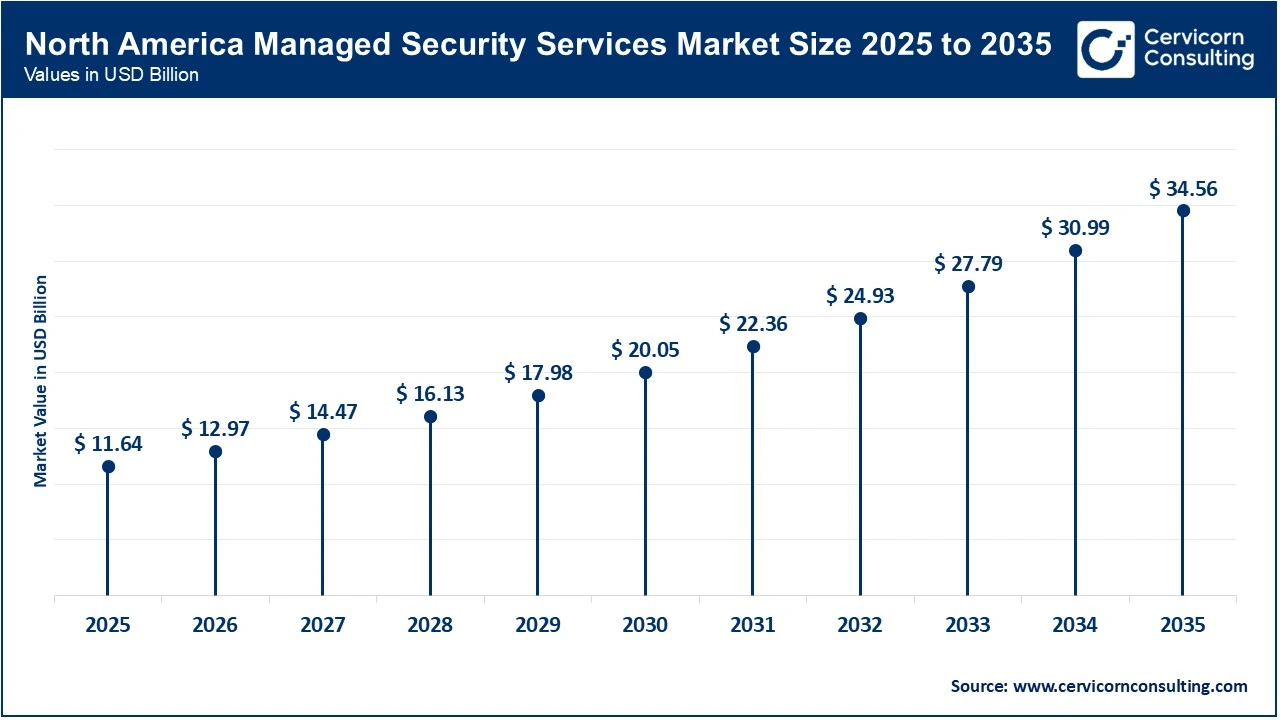
The North America managed security services market size was valued at USD 11.64 billion in 2025 and is expected to reach around USD 34.56 billion by 2035.
North America is the largest and most mature MSS market, supported by high cybersecurity spending, strong cloud adoption, and the presence of leading MSS providers. The region benefits from a highly developed digital ecosystem where enterprises prioritize 24/7 threat monitoring, compliance, and AI-driven security solutions. Increasing ransomware attacks and regulatory requirements (such as breach disclosure mandates) are further accelerating the adoption of MSS. The region also leads in Security Operations Center (SOC) innovation and managed detection capabilities, making it a global hub for advanced MSS offerings.
United States: Leadership in MSS Innovation and Enterprise Adoption
The United States dominates the regional market, accounting for the majority share due to its strong enterprise base and cybersecurity investments.
- Accounts for over 60% of global commercial cybersecurity service adoption due to strong enterprise demand
- Over 70% of large enterprises outsource at least part of their security operations to MSS providers
- High adoption of MDR and zero-trust frameworks, especially in BFSI and healthcare sectors
Canada: Growing Adoption Driven by Digital Transformation and Compliance
Canada is witnessing steady growth in MSS, driven by rising cloud adoption and government-backed cybersecurity initiatives.
- Cybersecurity spending is increasing steadily, with over 65% of organizations adopting managed security services
- Strong focus on critical infrastructure protection, especially in energy and public sectors
Europe Managed Security Services Market: Driven by Regulatory Compliance and Data Protection Mandates
The Europe managed security services market size was estimated at USD 10.38 billion in 2025 and is projected to surpass around USD 30.82 billion by 2035. Europe represents a highly regulated MSS market, where growth is strongly driven by stringent cybersecurity and data protection laws. Regulations such as GDPR, NIS2, and DORA are compelling organizations to implement continuous monitoring, incident response, and third-party risk management, increasing reliance on MSS providers. The region also emphasizes data sovereignty and secure cloud environments, leading to increased demand for localized MSS solutions.
Germany: Industrial Cybersecurity and Manufacturing Focus
Germany is a key MSS market, driven by its strong industrial base and Industry 4.0 initiatives.
- Over 50% of industrial enterprises are investing in MSS for securing OT/ICS environments
- Industry 4.0 initiatives are driving demand for industrial cybersecurity and managed monitoring
- Strict EU regulations pushing companies toward compliance-driven MSS adoption
United Kingdom: Financial Sector and Advanced Security Adoption
The UK is one of the leading MSS markets in Europe, supported by a strong BFSI sector and regulatory environment.
- Nearly 50–60% of enterprises outsource cybersecurity functions to MSS providers
- Financial services sector contributes significantly, with high MSS adoption in BFSI
Asia-Pacific Managed Security Services Market: Driven by Rapid Digitalization and Expanding Cyber Threat Surface
The Asia-Pacific managed security services market size was accounted for USD 9.79 billion in 2025 and is forecasted to grow USD 29.07 billion by 2035. Asia-Pacific is the fastest-growing MSS market, driven by rapid digital transformation, rising internet penetration, and growing cyber threats. Enterprises in the region are adopting MSS to address limited in-house expertise and growing cybersecurity risks, particularly as cloud adoption and digital payments expand. Governments are also introducing cybersecurity frameworks, further accelerating the demand for MSS.
China: Government-Led Cybersecurity Expansion and Enterprise Adoption
China is a major contributor to the MSS market, with strong government involvement in cybersecurity infrastructure and regulation. Enterprises are increasingly adopting MSS to comply with national cybersecurity laws and secure large-scale digital ecosystems, including cloud and industrial networks.
- Rapid cybersecurity expansion, with over 70% of large enterprises implementing managed security solutions
- Government regulations mandating data security and continuous monitoring
- Heavy investments in cloud security and domestic cybersecurity infrastructure
India: High-Growth Market Driven by Digital Economy Expansion
India is emerging as a high-growth MSS market, supported by rapid digitization, fintech expansion, and increasing cyberattacks. The country is also becoming a global hub for MSS delivery, driven by its large pool of cybersecurity talent and cost advantages, which are driving both domestic adoption and the export of managed security services.
- One of the fastest-growing MSS markets, with over 65% of enterprises adopting MSS solutions.
- Cybersecurity incidents increasing by 20–25% annually, driving demand for managed services.
- Large talent pool positioning India as a global MSS delivery hub.
LAMEA Managed Security Services Market: Driven by Government Initiatives and Critical Infrastructure Protection
The LAMEA managed security services market was valued at USD 7.51 billion in 2025 and is anticipated to hit around USD 22.30 billion by 2035. Latin America is an emerging MSS market, where growth is driven by rising cyber threats, increasing cloud adoption, and expanding enterprise IT infrastructure. Organizations are gradually shifting from traditional security approaches to managed services to improve threat detection and operational efficiency, although budget constraints and awareness gaps remain challenges.
The MEA region is witnessing steady growth in MSS, supported by government-led digital transformation initiatives and rising investments in cybersecurity infrastructure. Organizations are focusing on MSS to secure critical sectors such as energy, finance, and government, particularly as cyber threats targeting infrastructure increase.
Brazil: Leading Market with Strong BFSI and Digital Economy Growth
Brazil dominates the regional MSS market, driven by its large financial sector and growing digital economy.
- Leading MSS market in Latin America, with over 55% enterprise adoption.
- Rising cyberattacks in BFSI and eCommerce sectors driving MSS demand.
- Increasing use of cloud-based security services.
United Arab Emirates: Smart City Initiatives and Cybersecurity Investments
The UAE is a leading MSS market in the Middle East, driven by smart city projects and national cybersecurity strategies.
- Strong government push, with over 70% of organizations prioritizing cybersecurity investments.
- MSS adoption driven by smart city projects and digital transformation initiatives.
- High demand for real-time monitoring and compliance services.
Managed Security Services Market Segmental Analysis
The managed security services market is segmented into deployment model, service type, provider type, end-user industry, and geography.
Deployment Model Analysis
Cloud deployment dominates the MSS market, with a significant share, mainly due to the rapid migration of enterprise workloads to cloud environments and the growing complexity of hybrid IT infrastructures. Organizations are focusing on cloud-based MSS as it offers centralized visibility, real-time threat monitoring, and seamless scalability across geographically dispersed operations. Unlike on-premise solutions, cloud MSS removes the need for heavy capital investment in infrastructure while providing advanced features such as AI-driven analytics, automated incident response, and continuous updates. Additionally, the rise of remote and hybrid work models has increased the demand for cloud-native security solutions, making cloud deployment the preferred choice for enterprises seeking agility and cost efficiency.
Global Managed Security Services Market Share, By Deployment Model, 2025 (%)
| Deployment Model Segment |
Revenue Share, 2025 (%) |
| Cloud |
71.9% |
| On-Premise |
28.1% |
Cloud is also the fastest-growing segment, fueled by accelerating digital transformation and the rapid increase in cloud-native applications. As enterprises adopt multi-cloud and hybrid setups, the attack surface grows significantly, necessitating continuous, scalable, and integrated security services. MSS providers are quickly innovating in areas like cloud security posture management (CSPM), container security, and API protection. Furthermore, cloud platforms support faster deployment of MSS solutions and simpler integration with enterprise systems, making them highly appealing for organizations aiming to modernize their cybersecurity frameworks.
Service Type Analysis
MDR remains the leading service segment, contributing the largest share as organizations increasingly require proactive threat detection and rapid incident response. Traditional security tools are no longer adequate to counter advanced persistent threats, ransomware, and zero-day attacks, prompting enterprises to adopt MDR services that combine human expertise with advanced analytics. MDR offerings provide 24/7 monitoring, threat hunting, behavioral analysis, and automated remediation, significantly reducing dwell time and minimizing damage from cyber incidents. The growing reliance on outsourced SOC operations and the shortage of skilled cybersecurity professionals further reinforce MDR’s dominance in the MSS landscape.
Global Managed Security Services Market, By Service Type, 2025 (%)
| Service Type |
Revenue Share, 2025 (%) |
| Managed Detection and Response (MDR) |
27.1% |
| Intrusion Detection/Prevention |
15.4% |
| Firewall and UTM Management |
14.2% |
| Managed IAM and Zero-Trust |
13.1% |
| Vulnerability and Patch Management |
11.4% |
| DDoS and Threat Prevention |
9.7% |
| Others |
9.1% |
Managed Identity and Access Management (IAM) and Zero-Trust security are the fastest-growing segments, driven by the increasing importance of identity as the new security perimeter. With the rise of remote work, cloud applications, and mobile access, traditional perimeter-based security models are becoming obsolete. Zero-trust frameworks, which require continuous verification of users and devices, are gaining traction across industries. MSS providers are offering managed IAM solutions that include multi-factor authentication (MFA), privileged access management (PAM), identity governance, and continuous authentication, helping organizations prevent unauthorized access and comply with strict regulatory requirements.
Provider Type Analysis
Security-specialist MSSPs dominate the market with a significant share, as they offer deep domain expertise, advanced threat intelligence, and specialized security capabilities. These providers are equipped with dedicated SOCs, skilled analysts, and proprietary technologies, enabling them to deliver high-quality services such as MDR, SIEM management, and threat intelligence. Enterprises, especially those in highly regulated industries, prefer specialist MSSPs because of their ability to provide customized security solutions, faster incident response, and compliance support, making them critical partners in managing complex cybersecurity environments.
Global Managed Security Services Market, By Provider Type, 2025 (%)
| Provider Type |
Revenue Share, 2025 (%) |
| Security-Specialist MSSPs |
32.1% |
| IT Service Integrators |
21.5% |
| Telecom-Led MSSPs |
16.4% |
| Cloud Hyperscaler MSSPs |
15.3% |
| Consulting-Led Cyber Practices |
14.7% |
Cloud hyperscaler MSSPs are experiencing the fastest growth, driven by the widespread adoption of cloud platforms and the integration of security directly into cloud ecosystems. Providers like Amazon Web Services, Microsoft, and Google Cloud offer built-in security services combined with managed capabilities, allowing organizations to secure their cloud environments more efficiently. These providers benefit from global infrastructure, scalability, and native integration with cloud workloads, making them highly attractive for enterprises transitioning to cloud-first strategies.
End-user Industry Analysis
The BFSI sector holds the largest share in the MSS market due to its high exposure to cyber threats, strict regulatory requirements, and critical need for data protection. Financial institutions are common targets of cyberattacks, including fraud, phishing, and ransomware, requiring continuous monitoring and advanced threat detection capabilities. MSS solutions help BFSI organizations maintain regulatory compliance, safeguard sensitive financial data, and ensure operational resilience, making them a key market driver.
Global Managed Security Services Market, By End User, 2025 (%)
| End-user Industry |
Revenue Share, 2025 (%) |
| BFSI |
24.4% |
| IT and Telecom |
17.8% |
| Government and Defense |
15.6% |
| Healthcare and Life Sciences |
13.9% |
| Manufacturing and Industrial |
11.7% |
| Retail and eCommerce |
9.5% |
| Energy and Utilities |
7.1% |
Healthcare and life sciences is the fastest-growing segment, driven by rapid digitization, increased use of electronic health records (EHRs), and the expansion of telemedicine. The sector has become a prime target for ransomware attacks due to the high value of medical data and its historically weaker cybersecurity defences. MSS adoption is increasing as healthcare organizations aim to improve data security, meet regulatory requirements, and protect critical systems. Additionally, the integration of connected medical devices and IoT in healthcare further heightens security risks, boosting demand for managed security services.
Managed Security Services Market Top Companies
Recent Developments
- In February 2026, IBM released its X-Force Threat Intelligence Index 2026, reporting a 49% increase in ransomware groups and a 4× rise in supply chain attacks, strengthening its focus on AI-driven managed detection and response services.
- In April 2025, Verizon published its 2025 Data Breach Investigations Report (DBIR), highlighting the growing role of third-party breaches and vulnerability exploitation, reinforcing demand for managed security monitoring and advisory services.
- In January 2025, Accenture released its State of Cybersecurity Resilience report, revealing that only 10% of organizations are prepared for AI-driven cyber threats, driving demand for consulting-led managed security services.
Market Segmentation
By Deployment Model
By Service Type
- Managed Detection and Response (MDR)
- Intrusion Detection/Prevention
- Firewall and UTM Management
- Managed IAM and Zero-Trust
- Vulnerability and Patch Management
- DDoS and Threat Prevention
- Others
By Provider Type
- IT Service Integrators
- Telecom-Led MSSPs
- Security-Specialist MSSPs
- Consulting-Led Cyber Practices
- Cloud Hyperscaler MSSPs
By End User
- BFSI (Banking, Financial Services, and Insurance)
- Healthcare and Life Sciences
- Government and Defense
- Manufacturing and Industrial
- IT and Telecom
- Retail and eCommerce
- Energy and Utilities
By Geography
- North America
- Europe
- Asia-Pacific
- LAMEA