Hyper Automation Market Size and Growth 2026 to 2035
The global hyper automation market size was valued at USD 63.06 billion in 2025 and is expected to be worth around USD 287.38 billion by 2035, exhibiting a compound annual growth rate (CAGR) of 16.4% over the forecast period from 2026 to 2035. The major driver of growth in the hyper-automation market is the increasing demand for operational efficiency. This marks a shift towards an era of unprecedented data volume, where organizations can no longer rely on linear increases in human labor to sustain productivity growth. Hyper-automation addresses this challenge by integrating cognitive capabilities into workflows, enabling systems to more efficiently handle unstructured data and support complex decision-making traditionally performed by humans.
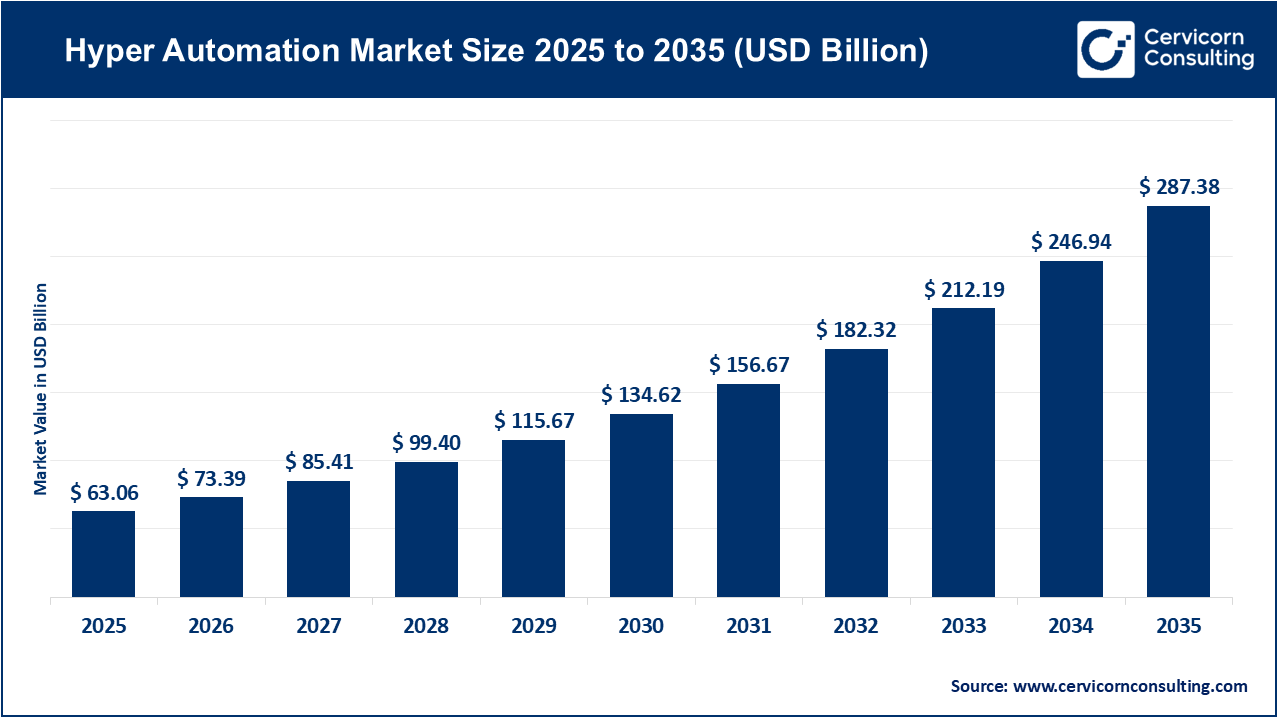
Additionally, the rising demand for high power density in OBC chargers- typically above 95% stems from the fact that higher efficiency allows manufacturers to reduce the size of cooling systems and vehicle weight without compromising battery cycling and driving range. Another significant growth factor in the hyper-automation market is the rapid expansion of AI adoption and enterprise digital transformation initiatives. According to Gartner, hyper-automation is a priority for 90% of large enterprises, highlighting its growing importance for streamlining processes using AI. Furthermore, 70% of organizations aim to minimize manual processes within their digital strategies, and AI investments are projected to exceed USD 300 billion by 2026.
Report Highlights
- North America leads the region, capturing around 36% of the global hyper automation market share, driven by early adoption of AI, and the presence of major technology providers.
- Hardware is the dominant component segment, holding at 48% market share, as organizations increasingly invest in AI-powered platforms.
- Cloud deployment accounts for the largest share at 52%, supported by scalable infrastructure, cost efficiency, and rapid adoption of cloud-native automation tools.
- Robotic Process Automation (RPA) leads the technology segment with around 25% share, as it serves as the primary entry point for enterprise automation with quick ROI and ease of integration.
- Computer Vision is the fastest-growing technology segment with a growth rate of around 14% share, supported by rising applications in smart manufacturing, healthcare imaging, and retail analytics.
- Finance & Accounting dominates the functional segment with nearly 30% share, due to highly repetitive and increasing demand for compliance and fraud detection.
- Marketing & Sales is the fastest-growing function with a growth rate of around 16%, fueled by demand for real-time personalization and AI-driven customer engagement.
- Large enterprises hold the majority share at 65%, as they invest heavily in digital transformation and automation of complex legacy systems.
- Retail is the fastest-growing end-use sector, with growth of around 12%, driven by e-commerce expansion, AI chatbots, and automated supply chain systems.
Hyperautomation Market Evolution: Rapid Adoption with Emerging Integration Maturity
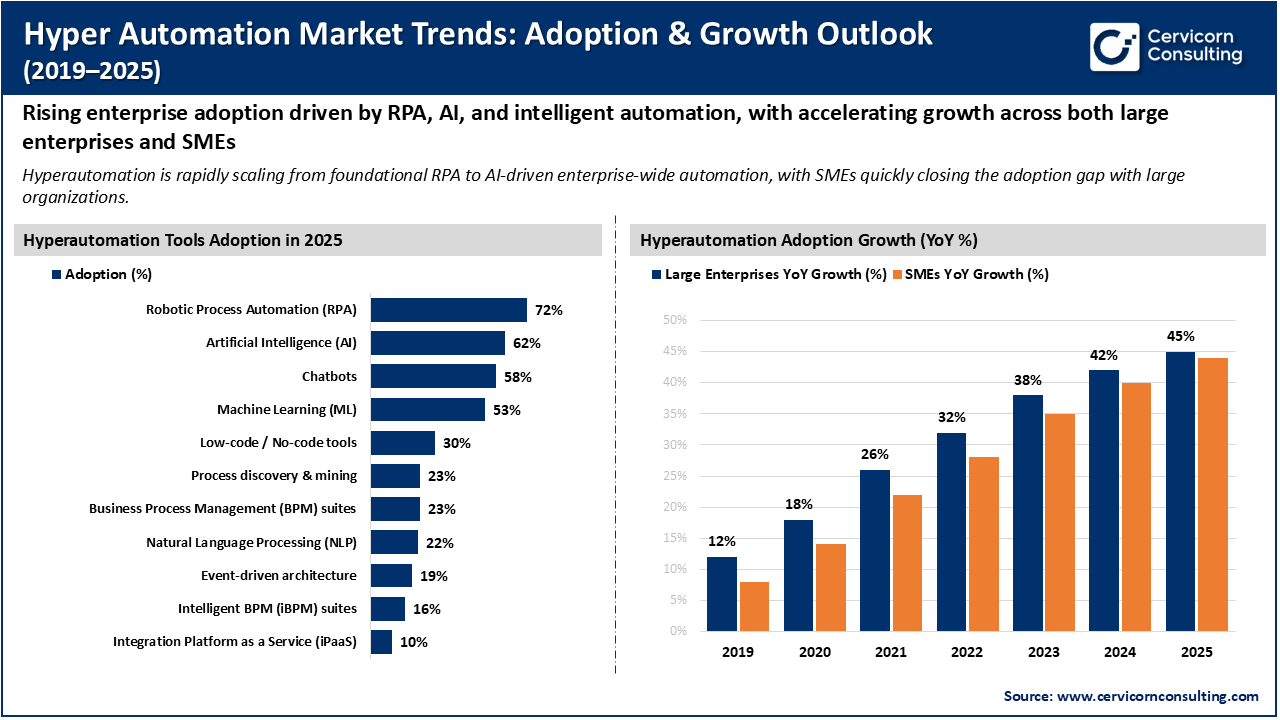
The chart shows a strong and accelerating shift toward hyperautomation across organizations, mainly driven by technologies such as RPA (72%), AI (62%), and chatbots (58%). These tools are expected to dominate adoption in 2025, as most enterprises continue to build their automation base around task execution and customer interaction. Year-over-year growth trends indicate steady and rapid expansion in both large enterprises and SMEs, with SMEs nearly matching enterprise growth by 2025 at 44% compared to 45%. This trend is supported by improvements in accessibility, such as cloud platforms and low-code tools, which are reducing barriers to adoption. However, the relatively lower adoption rates of advanced orchestration tools like iPaaS (10%) and iBPM (16%) show that many organizations are still in the early to mid stages of hyperautomation maturity, focusing more on isolated automation rather than fully integrated, end-to-end workflows.
The Integration of AI-Driven Decision Making with Robotic Process Automation
The integration of AI-driven decision-making with robotic automation, often referred to as cognitive automation, is a significant trend in the hyper automation market. This combination of technology move towards a more knowledgeable interpretation of context and intent. By using machine learning algorithms and natural language processing, these advanced automated systems can handle exceptions and adapt to variations.
According to Value Innovation Lab, industry data highlights the scale of this transformation. Over 80% of enterprises are already combining AI with RPA to improve decision-making capabilities, while organizations adopting cognitive automation have reported up to 40% better fraud detection. This integration is enabling businesses to automate and handle complex, end-to-end workflows, which require human-like judgment, such as validating the disposition of an insurance claim, interpreting the sentiment of customer satisfaction feedback, and triggering a service response based on this interpretation.
Operational Efficiency Gains through SAP Automation Solutions across Industries
| Company |
Industry |
Region |
Key Impact |
Efficiency Gain |
Partnered |
| Telefonica |
Telecommunications |
Madrid, Spain |
Combine personalized data for 8,000 employees in a single instance. |
Reduction in complexity of payroll schema. |
Telefónica Global Technology and Zalaris ASA |
| Blue Diamonds |
Consumer products |
Sacramento, California |
30 process improvements delivered. |
2,000 hours saved annually in freight process. |
The Silicon Partners Inc. |
| De Agostini’s |
Consumer products |
Milan, Italy |
91% of invoices automation |
500 hours saved per month. |
Digix Plus |
What is the Scope and Definition of the Hyper Automation Market?
The hyper automation market refers to a multi-technology framework designed to automate and optimize business processes at scale by integrating technologies such as RPA, AI, machine learning, and process discovery tools. At its core, hyper automation follows the continuous lifecycle of "discover, design, automate, and measure," where process mining tools analyze existing workflows to identify the most suitable opportunities for automation, which are executed by AI-powered bots across multiple software environments. In addition, automation, which typically refers to the automation of a single task, hyper automation creates a "cohesive automation fabric" that provides for the seamless flow of data across departmental boundaries and facilitates the optimization of end-to-end business processes.
Top 5 Trends & Technologies
- Robotic Process Automation (RPA): Increases the ability to eliminate repetitive, rule-based manual tasks while improving accuracy.
- Integration of Wireless Charging Systems: Increasing demand for the convenience of autonomous vehicle charging, wireless OBCs utilizing magnetic resonance have achieved 90-92% efficiency.
- Development of Multi-Functional Electronics: Manufacturers are now proposing the development of 3-in-1 or 8-in-1 systems that integrate the onboard charger, DC/DC converter, and PDU, with claimed total weight savings of more than 15%.
- Edge Automation: The requirement for low-latency responses in manufacturing and transportation is a driving force for automation to move to the "edge" of the network, where data is processed near its origin and not in the cloud.
- Optical Character Recognition (OCR): The shift from paper-based legacy systems to prioritize digital-first data environments.
Recent Major Milestones
1. Strategic Corporate Consolidation and Ecosystem Expansion
The hyper automation market has recently entered a phase of highly active strategic consolidation, involving high-value mergers and acquisitions aimed at creating an "end-to-end" automation suite. The Salesforce and MuleSoft ecosystem exemplifies this, where integration of API capabilities with Einstein AI has formed a unified platform for data integration and processing. In 2025, Salesforce announced a USD 8 billion acquisition of Informatica to improve data integration. Additionally, the AI and automation sector has seen 30 major acquisitions worth around USD 157 billion. The increasing shift toward platform-based solutions is strongly influencing buyer preferences.
2. Government Digital Transformation Initiatives and Policy Frameworks
Government mandates and digital regulatory initiatives mark major milestones for the adoption of hyper automation technologies. In the U.S., the Development and Use of Artificial Intelligence Executive Order on the Safe, Secure, and Trustworthy AI has contributed to this progress. This policy framework has led to a 40% increase in federal agency spending on automated workflow solutions, as public sector organizations aim to modernize citizen services and address decades of administrative backlogs. The EU AI Act has established benchmarks of "transparency by design" that require hyper automation providers to incorporate ethical safeguards and explainable AI (XAI) into their core product roadmaps.
3. Integrating Generative AI and Autonomous Process Discovery
During 2023-2024, the integration of Generative AI (GenAI) into core automation platforms represents the most significant driver in the hyper-automation market. Frameworks such as UiPath Autopilot and Microsoft Copilot enable users to interact with automation systems through natural language, allowing even non-technical users to describe workflows using plain English, and the system will generate its own code and logic. GenAI accelerated the development of complex automation by nearly 70% in pilot projects, reducing the barriers to entry in automation for non-technical employees. Furthermore, GenAI has unlocked autonomous process discovery tools, enabling analysis of millions of event logs and user interactions to identify hidden bottlenecks and provide optimization recommendations.
4. Scalability Breakthroughs in Enterprise-Wide Automation Deployment
The hyper-automation market is experiencing a major transformation, mainly driven by scalability breakthroughs in enterprise-wide automation, supported by the rise of sovereign AI initiatives and large-scale national strategies. For enterprise adoption, according to Gartner, by 2026, 30% of enterprises will automate more than half of their network activities, up from under 10% in mid-2023. Government investments increasingly support the adoption of hyper-automation to address challenges like an aging workforce and to boost operational efficiency. Across multiple countries, billions of dollars are shifting toward AI-driven infrastructure, smart cities, and digital governance. For example, India’s Smart Cities project involved investments exceeding 2 lakh crore across urban initiatives, while Brazil's national AI plan outlines funding of over USD 54 billion to expand AI capabilities.
Hyper Automation Market Regional Analysis
The Hyper automation market is segmented into various regions, including North America, Europe, Asia-Pacific, and LAMEA. Here is a brief overview of each region:
Why is Asia-Pacific fastest growing region in the hyper automation market?
The Asia-Pacific hyper automation market size was estimated at USD 18.92 billion in 2025 and is projected to hit around USD 86.21 billion by 2035. The Asia Pacific region is undergoing rapid industrial digitalization and integrating new "Smart Factories" to secure manufacturing primacy. In countries like China, Japan, and South Korea, hyper automation is the backbone of advanced manufacturing through supply chain synchronization and production line optimization using real-time data. This region is focused on the highest possible efficiency and liquidity within trade networks, as effective working capital management is essential to the region's economic stability. Additionally, the use of machine learning algorithms for market segmentation and pricing analysis is becoming common in the region's high-tech manufacturing.
China, Japan, and India Hyper Automation Market: Key Data Points
- Businesses across the Asia-Pacific region are achieving up to 94% faster document processing, driven by the integration of RPA, OCR, and advanced Large Language Models (LLMs).
- Japan has one of the highest robot densities globally, with over 400 robots per 10,000 employees in manufacturing.
- Currently, around 58% of companies have limited adoption of physical AI, but this is expected to rise to nearly 80% within the next two years, with Asia-Pacific leading the way in implementation.
Why does North America leads in the hyper automation market?
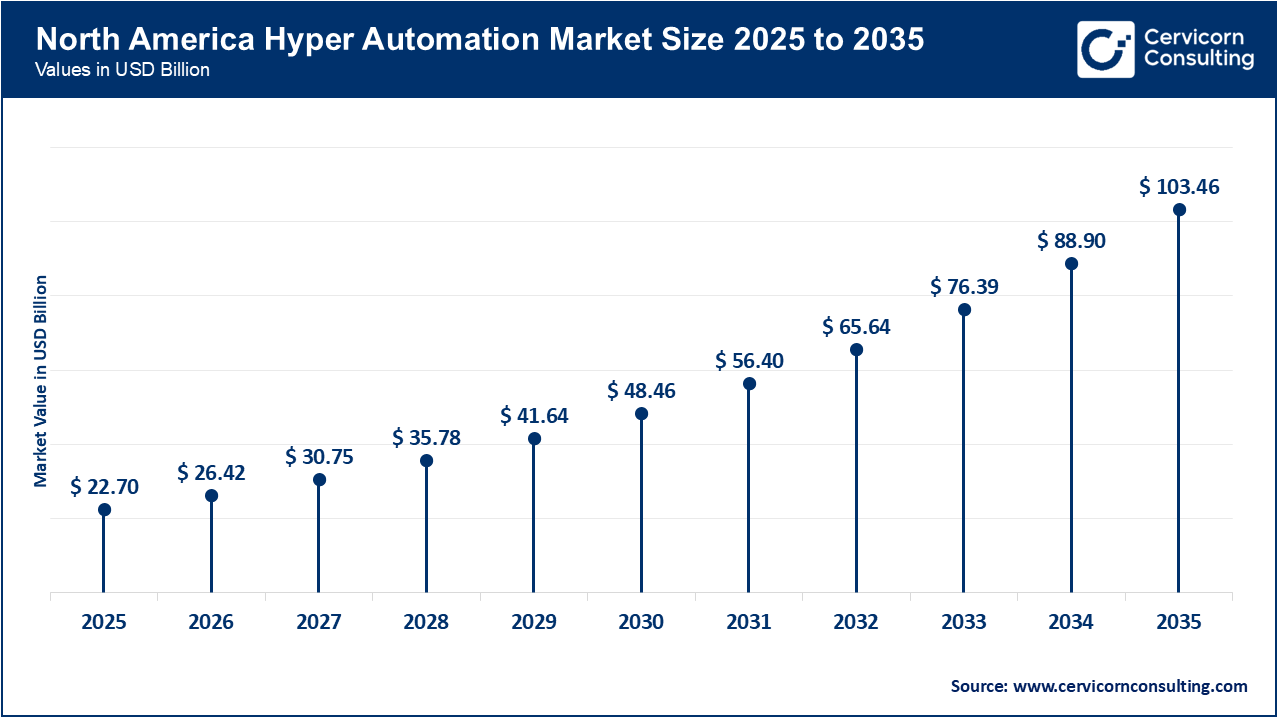
The North America hyper automation market size was valued at USD 22.70 billion in 2025 and is predicted to hit around USD 103.46 billion by 2035. North America is the leading region in the hyper automation market, mainly due to an aggressive "AI-First" strategy to address both high labor costs and an ongoing shortage of specialized engineers and technical talent. Regional enterprise modernization is increasing focus on "Agentic AI" systems, in which autonomous agents navigate software environments intuitively to automate multi-step workflows with minimal human intervention. North America's mature venture capital ecosystem supports the needs of hyper automation providers to develop in a zero-to-low-code "orchestration" layer niche startups.
U.S and Canada Hyper Automation Market: A Quantitative Perspective
- Enterprise users are increasingly adopting advanced automation platforms such as UiPath, with over 250,000 AI-driven tasks already executed, highlighting strong real-world usage of agent-based automation.
- Over 75% of Fortune 500 companies in the U.S. have adopted RPA or AI-driven automation in at least one business function.
- According to Gartner, more than 80% of enterprises are expected to adopt Generative AI—either through APIs or integrated applications by 2026, indicating rapid mainstream adoption.
What are the driving factors of Europe hyper automation market?
The Europe hyper automation market size was estimated at USD 17.66 billion in 2025 and is forecasted to grow around USD 80.47 billion by 2035. The hyper automation ecosystem in Europe is heavily regulated and influenced by sustainability. Regulations originating from the EU AI Act and General Data Protection Regulation (GDPR) have led European enterprises to focus on process transparency and auditability. Thus, hyper automation is being granted a parallel position in the compliance landscape, with enterprises able to provide paid proof-of-documentation that their processes are designed ethically, in line with an energy-efficient mandate. This parallel position of hyper automation can be noted through "Sovereign Automation", which highlights the localized process data for the protection of the process data and maintaining optimal resource consumption in alignment with Environmental, Social, and Governance (ESG) reporting.
Germany and UK: Market Highlights
- Germany’s industrial automation density exceeds 350+ robots per 10,000 workers, positioning it among the most automated manufacturing economies globally.
- Implementation of the EU AI Act in 2025 increased demand for "Compliant Automation" software by 40%.
- Financial firms in the UK saved approximately GBP 2 billion in 2025 by automating fraud detection and regulatory reporting.
Hyper Automation Market Share, By Region, 2025 (%)
| Region |
Revenue Share, 2025 (%) |
| North America |
36% |
| Asia Pacific |
30% |
| Europe |
28% |
| LAMEA |
6% |
LAMEA Hyper Automation Market: Driven by Economic Diversification and Financial Inclusion
The LAMEA hyper automation market was valued at USD 3.78 billion in 2025 and is anticipated to reach around USD 17.24 billion by 2035. The LAMEA region represents a high-growth frontier for hyper automation, primarily driven by financial inclusion and the modernization of legacy infrastructure. In the Middle East, and specifically the Gulf Cooperation Council (GCC) countries, automation has been deployed the energy sector to optimize extraction processes and advance the transition to green energy through predictive maintenance. These initiatives are part of wider national visions to reduce dependence on fossil fuels and build diversified, technology-enabled economies. In Latin America and Africa, the driver is scalable banking and financial services. Hyper automation allows financial institutions to skip the development of traditional physical branch networks and move straight to autonomous AI-powered and digital banking platforms.
Brazil, UAE's of the Hyper Automation Market: Recent developments
- The Brazilian banking sector is still a leader, processing 85% of all banking transactions via automated AI systems by 2025.
- The telecommunications sector in South Africa experienced a 20% reduction in customer churn in 2025 through AI-driven retention programs.
- According to PwC estimates, AI could contribute USD 96 billion to the UAE's GDP by 2030, representing about 13.6 of the country's total GDP.
Hyper Automation Market Segmental Analysis
The hyper automation market is segmented into component, deployment, technology, function, enterprise, end user, and region.
Component Analysis
The hardware holds the largest share of the component in the market, primarily due to increasing demand for significant initial capital investments in AI-ready infrastructure. It is at the core of the "automation engine," mainly for enterprises that require high computing power to process real-time data or train machine learning models. Additionally, when protecting digital data from cyber-attacks with complex encryption methods, hyper-automation must operate on hardware capable of trillions of operations per second.
Software emerges as the fastest-growing part of the hyper-automation ecosystem, mainly driven by the development of the "brain" of hyper-automation or the working models for the automation system. Software packages also add the intelligence layers to hyper-automation that enable hardware to run autonomously. More importantly, as software learns from data features through augmentation, it becomes increasingly valuable for improving ROI across various industries and use cases.
Deployment Analysis
Cloud segment holds the largest market share because it offers scalability, decentralized AI, and hyper-automation decision-support systems. Most of the newest hyper-automation platforms will be "cloud-native," enabling organisations with multiple operational environments to deploy bots and models across global operations with minimal on-device infrastructure required for Industry 4.0 purposes.
Hyper Automation Market Share, By Deployment, 2025 (%)
| Deployment |
Revenue Share, 2025 (%) |
| Cloud |
52% |
| On-premise |
48% |
On-premise is experiencing the fastest growth in the market due to the high demand for "Edge AI" and local data processing. Defense, healthcare, and high-tech manufacturing are investing heavily in more advanced enterprise on-premise automation controllers to meet data sovereignty requirements and ensure low-latency execution. This growth has been driven by the demand for specialized hardware that allows complex AI models to run locally, providing greater security for firms that cannot risk migrating critical operational data to the public cloud.
Technology Analysis
Robotic Process Automation (RPA) is the leading technology segment in the hyper-automation market, primarily due to its "entry point" for automation for the majority of enterprises. Robotic process automation can be deployed alongside legacy systems without completely changing their IT architecture. RPA generates a high Return on Investment (ROI) and provides the advantages of immediate efficiency gains. RPA continues to evolve from simple screen scraping to intelligent process automation, which maintains its relevance, even as more advanced technologies continuously emerge.
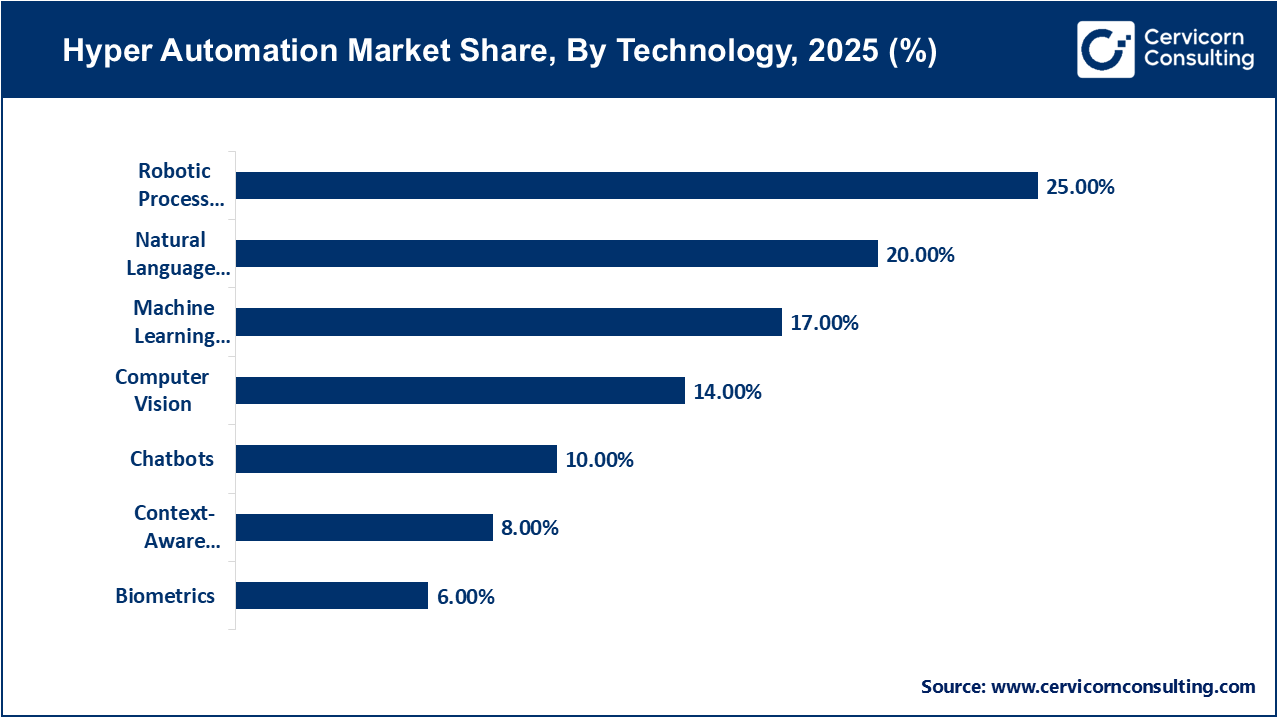
Computer Vision (CV) is the fastest-growing technology segment in the market, mainly due to its ability to allow machine learning systems to understand and act upon visual data in real-time. Transportation systems (ITS) provide transformative opportunities to monitor traffic conditions, learn about incidents, and monitor conditions of the roadways. Additionally, research on CNNs, a form of computer vision for understanding medical images, is underway, particularly to improve the accuracy of medical diagnosis. The ability to "see" and act in complex environments is a significant frontier, rapidly driving new market growth and enabling autonomous applications.
Function Analysis
Finance and Accounting functional area is the dominant segment in the hyper-automation market, due to its involvement in a large volume of repetitive tasks based on transactions that have a perfect fit for hyper-automation. The global financial services market has undergone a major transformation, example such as the rise of neo banking and the digital transformation of the banking sector. Automating accounts payable, accounts receivable, and financial reporting will reduce errors and give the organization visibility into its financial health in the moment. The high degree of standardization of financial regulations helps facilitate the deployment of automation in this segment.
Hyper Automation Market Share, By Function, 2025 (%)
| Function |
Revenue Share, 2025 (%) |
| Finance & Accounting |
30% |
| Operations & Supply Chain |
24% |
| Information Technology (IT) |
20% |
| Marketing & Sales |
16% |
| Human Resources (HR) |
10% |
Marketing and Sales is the fastest-growing functional segment, driven by the increasing demand for hyper-personalization and experience engagement in real-time by customers. AI-enabled chatbots and recommendation engines have become embedded within the e-commerce experience, and lead to influencing how the customer feels, thinks, and behave during the course of the experience engagement.
Enterprise Analysis
The primary segment in the hyper-automation enterprise is large enterprises due to their financial investment and complex, siloed legacy systems, which deliver the highest ROI. These types of organizations often lead in implementing Industry 4.0 initiatives in developed economies like Germany and Singapore. Large enterprises introduced hyper-automation to orchestrate global supply chains, coordinate a multi-national prospective workforce, and maintain their competitive advantage through ongoing technological innovations.
Hyper Automation Market Share, By Enterprise, 2025 (%)
| Enterprise |
Revenue Share, 2025 (%) |
| Large-size Enterprises |
65% |
| Small & Medium-sized Enterprises (SMEs) |
35% |
Small and Medium-Sized Enterprises (SMEs) represent the fastest-growing segment of the market because they generate a major outcome of the democratization of technology that is made possible by SaaS-based hyper-automation tools as well as low-code platforms. As SMEs leverage automation, they are often able to compete effectively with larger rivals by achieving operational low-cost. The availability of "plug-and-play" AI and RPA solutions has significantly lowered the entry barrier for smaller firms to automate back-office functions and improve customer service without incurring high upfront costs.
End User Analysis
The IT and Telecommunication industry is a dominant end-use industry of hyper-automation because these companies are both the suppliers and early adopters of hyper-automation technology. These "digital native" companies leverage hyper automation to manage extensive network infrastructures, automate complex billing cycles, and provide AI-driven customer support. Industries such as IT and Telecommunications facilitate the highest density of automated processes because their business is built on large volumes of data usage, and they are inherently technical.
Hyper automation Market Share, By End user, 2025 (%)
| Enterprise |
Revenue Share, 2025 (%) |
| IT & Telecommunication |
22% |
| BFSI |
20% |
| Manufacturing |
16% |
| Retail |
12% |
| Automotive |
10% |
| Healthcare |
8% |
| Transportation & Logistics |
7% |
| Others |
5% |
Retail is the fastest-growing end-use sector in the market, primarily driven by the increasing need to manage omni-channel supply chains and evolving consumer demands. Retailers are beginning to adopt hyper-automation for inventory management, dynamic pricing, and automated return processing. The use of AI chatbots as "new shop assistants" offers an opportunity to immediately enhance customer satisfaction and loyalty in retail. Hyper-automation in retail broadens the customer experience on the front end and extends into back-end logistics, inventory management, and supply chain operations.
Hyper Automation Market Top Companies
Recent Developments by Major Companies
- In September 2025, Automation Anywhere partnered with Amazon Web Services (AWS) to strengthen its cloud-native automation offerings, enabling scalable deployment of intelligent automation solutions.
- In August 2025, IBM partnered with Microsoft Azure to expand AI-driven automation solutions through its Watsonx platform, targeting hybrid cloud and enterprise AI use cases.
- In October 2025, ServiceNow launched new generative AI-powered workflow automation features in collaboration with NVIDIA, improving enterprise productivity and decision-making.
Market Segmentation
By Component
- Hardware
- Software
- Services
By Deployment
By Technology
- Robotic Process Automation (RPA)
- Natural Language Generation (NLG)
- Machine Learning (ML)
- Computer Vision
- Chatbots
- Context-Aware Computing
- Biometrics
By Function
- Finance & Accounting
- Operations & Supply Chain
- Information Technology (IT)
- Marketing & Sales
- Human Resources (HR)
By Enterprise
- Large-size Enterprises
- Small & Medium-sized Enterprises (SMEs)
By End Use
- IT & Telecommunication
- BFSI
- Manufacturing
- Retail
- Automotive
- Healthcare
- Transportation & Logistics
- Others
By Region
- North America
- APAC
- Europe
- LAMEA