Generative AI 2.0 Market Size and Growth 2026 to 2035
The global generative AI 2.0 market size was valued at USD 12.38 billion in 2025 and is expected to be worth around USD 318.94 billion by 2035, exhibiting at a compound annual growth rate (CAGR) of 38.7% over the forecast period from 2026 to 2035.
Generative AI 2.0 market is continuously growing propelled by the increasingly rapid growth of foundation and multimodal models that eventually allow a system to generate and understand text, image, audio, video, and code in one model. Compared to the earlier generation of GenAI, GenAI 2.0 has a broader understanding of the context surrounding a user request, can adapt to it in real-time, and possesses performance capabilities at the enterprise level. This multi-faceted capability has led to a rapid increase in utilization for content creation, conversational AI, software development, and data synthesis. With an increasing amount of high-performance computing resources being available via cloud computing platforms, along with new specialized AI acceleration devices. The ability to develop and deploy advanced generative capabilities will become less expensive to operate at scale, spreading these capabilities for use across enterprises of all sizes.
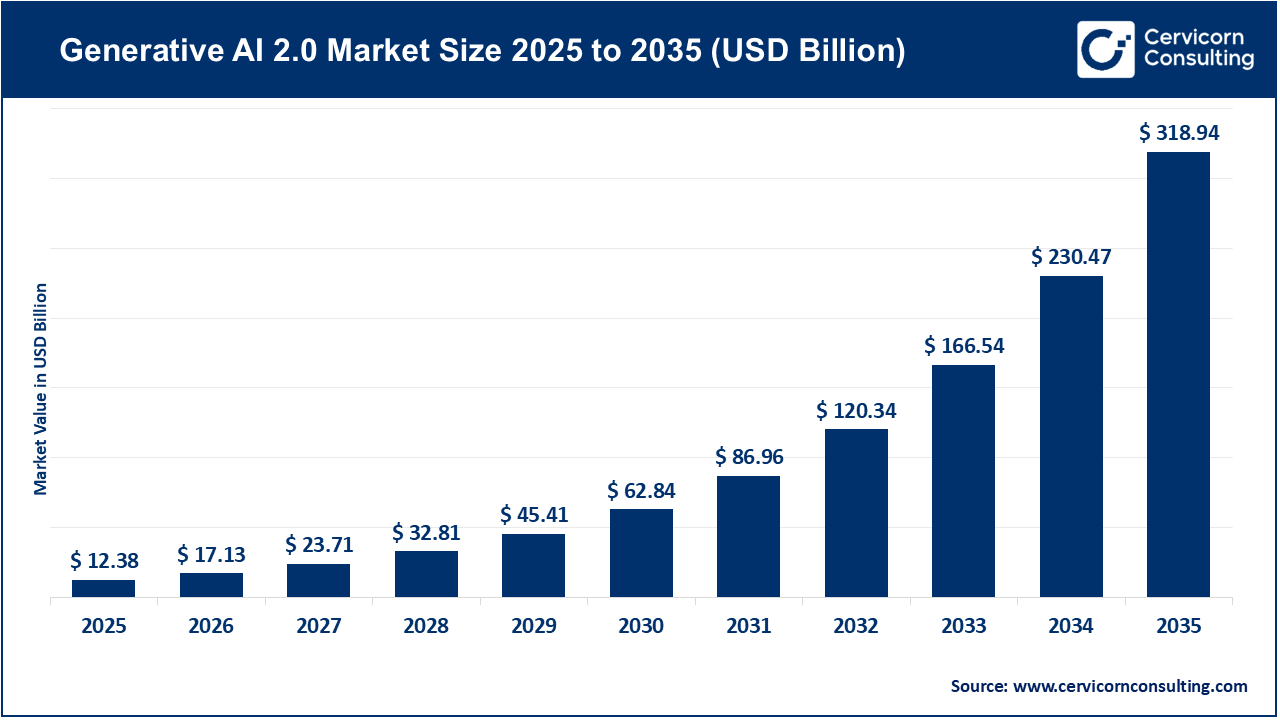
Another significant driver of growth is the increased demand for enterprise automation, personalization, and productivity improvements across many different types of businesses, including media & entertainment, healthcare, BFSI, retail, and marketing. Organizations are increasingly adopting Generative AI 2.0 into their core operational processes, like customer engagement, customizing products, and discovering new medicines through drug development, and creating accurate patient documentation to help reduce costs while speeding up their ability to make informed decisions. Additionally, there is a large influx of capital investments into the AI sector from large global technology companies, creating large ecosystems of AI suppliers, as well as government-sponsored grant programs aimed at accelerating the pace of digital transformation through AI innovation.
Report Highlights
- North America leads the Generative AI 2.0 market with a 43% share, driven by early AI adoption, hyperscale cloud infrastructure, and strong enterprise investment.
- Software dominates the offering segment with a 56% share, supported by scalable AI platforms, foundation models, and enterprise SaaS adoption.
- Text-based models hold the largest data modality share at 32%, driven by widespread chatbot usage, content automation, and document processing demand.
- Content creation represents the leading application segment 35% share, supported by high demand for fast, low-cost digital content generation.
Rapid Expansion of Cloud and AI Infrastructure Accelerating Generative AI 2.0 Market Growth
Cloud and AI are growing rapidly and are essential drivers of the Generative AI 2.0 market because the combination of the scalable infrastructure offered by cloud platforms along with the very high-performance AI hardware will allow organizations to train, deploy, and operate enormous, multimodal AI models in real time. Large cloud providers are making significant investments in both AI hardware, such as high-performance GPUs and other accelerators, developing optimized AI-as-a-Service platforms that provide ease of access to enterprises and new start-ups entering the market. The growth of these infrastructures supports the use of generative AI models for a wider range of enterprise-wide and mission-critical applications through faster inference, reduced latency, and reduced costs associated with scaling. As a result, businesses can now provide employees with access to the capabilities of Generative AI 2.0 in various ways through embedding these tools within their day-to-day work processes such as content creation, conversation agents, health care analysis, and software development. This will lead to further substantial expansion of the GenAI 2.0 market.
Recent Trends
1. Microsoft Expands Multibillion-Dollar AI Infrastructure with OpenAI Partnership
Microsoft has greatly increased its partnership with OpenAI and committed multibillion-dollar investments to develop an AI supercomputing infrastructure on Azure. The goal of this investment is to develop advanced data centers, create new AI accelerator technology, and support large multi-modal foundational models. This investment is a key driver in the market for enterprise-level generative AI 2.0 applications across several sectors. The support of U.S. governmental policies promoting cloud-based innovations and AI technologies will help to grow the nation's leadership in AI through the strengthening of commercial AI adoption.
2. Google Launches Gemini Multimodal AI with Government-Backed AI Research Support
Google has introduced its Gemini multimodal AI models, which can understand and generate text, images, videos, and code from within one system. This major step forward for Generative AI 2.0 allows more organizations to implement its use in different fields such as healthcare, education, and enterprise productivity. Additionally, the launch of Gemini with government support for AI research and funding digital transformation initiatives for the U.S. and Europe. By the integration of Gemini into Google Cloud and Google Workspace, these initiatives are designed to support innovation, workforce productivity, and the responsible development of AI.
3. NVIDIA Accelerates Sovereign AI Programs with Government Partnerships
NVIDIA expanded its sovereign AI initiatives by partnering with governments across North America, Europe, and Asia to build national AI infrastructure. These initiatives are focused on deploying high-performance GPUs and AI platforms to support domestic development of generative AI. This milestone creates a demand for Generative AI 2.0 by providing solutions for both compute availability and data sovereignty concerns, while government participation helps sustain the long-term funding for infrastructure, promotes the establishment of local AI ecosystems, and accelerates the implementation of advanced generative models across both the public and private sectors.
4. European Union Launches Large-Scale Public Funding for Generative AI and Responsible AI Frameworks (2024)
The European Union has established extensive public funding initiatives such as AI research centers, startup companies, and enterprise implementations. The on-going funding efforts, along with their regulatory framework to promote ethical and safe usage of generative AI technologies. These initiatives help drive the adoption of generative AI in many industries, including health, veterinary medicine, financial services, manufacturing, and public services. The support provided by governments will help support the on-going development of the generative AI ecosystem and create a more robust and inclusive environment for innovative business growth.
Market Dynamics
Market Drivers
- Strong Investments by Tech Giants and Startups: Generative AI 2.0 has seen an influx of investment from both large technology companies and smaller companies focused on incorporating generative AI into their products. Research and development, model training, infrastructure building, and product launches are all receiving investments. More venture capitalists and government-sponsored initiatives are investing their efforts in developing better generative AI. This amount of capital that can be used to develop new technologies and improve performance including increased speeds to market continues to grow. Additionally, as more capital becomes available for AI ecosystems, companies will adopt AI at a faster rate, expanding the total AI market size.
- Rising Demand for Personalized Digital Experiences: Customers are seeking personalized content, recommendations, and interactions across multiple digital platforms. Therefore, many companies are investing in Generative AI 2.0 to help enhance their marketing, e-commerce, entertainment, and customer support activities by providing highly tailored experiences. Using AI models to understand user behavior, businesses are able to create tailored content and respond to users' needs in real time. Increased customer engagement leads to increased customer satisfaction and drives businesses to spend more money on advanced generative AI technology, which will result in increased growth in the market.
Market Restraints
- High Implementation and Infrastructure Costs: The cost of using Generative AI 2.0 is high because of the need for expensive computers, the cloud platform, and trained professionals to run them. Most small to medium businesses cannot afford to buy expensive AI hardware, pay cloud usage fees, or pay for system setup costs. The ongoing costs of maintenance and upgrades also contribute to the overall costs associated with using Generative AI 2.0. These costs are being delayed or avoided by most businesses in the marketplace, which is slowing the growth of the entire market for Generative AI 2.0, particularly for developing nations.
- Data Privacy and Security Concerns: Generative AI 2.0 uses large amounts of information, creating challenges for data protection and the privacy of individual businesses. Companies fear their private or business information could be leaked, misused, or accessed without permission. Increased regulation on how to store data also adds to the difficulty for companies to utilize AI, resulting in a higher degree of complexity and risk of utilizing artificial intelligence (AI) technology. Such uncertainty creates added concern in specific industries like health care and financial institutions, resulting in a delay in many of these industries.
Market Opportunities
- Rising Adoption in Healthcare and Life Sciences: Generative AI 2.0 provides tremendous prospects for healthcare with support for drug discovery, medical imaging analysis, clinical documentation, and patient engagement. AI enables users to analyze more complicated forms of medical data in a shorter amount of time, allowing physicians to arrive at better-informed decisions regarding their patients’ treatment plans. As healthcare organizations increasingly adopt digital transformation strategies and work towards achieving greater levels of operational effectiveness, which expect that the adoption of advanced generative AI technologies will continue to grow quickly and create numerous long-term market opportunities in healthcare.
- Expansion of AI-as-a-Service and Cloud Platforms: The growth of cloud-based AI platforms allows businesses to access Generative AI 2.0 without building their own infrastructure. With the introduction of AI as a Service (AIaaS) business models, advanced AI tools are now more affordable, easily scalable, and easy to deploy. This creates significant opportunities for new startups, small and medium-sized businesses, and developing countries and regions. As cloud providers expand the number of services offered using AI, it increases adoption across a variety of industries and geographic locations.
Market Challenges
- Shortage of Skilled AI Professionals: The lack of trained experts in Generative AI 2.0 will create a large barrier for the growth of the market. Advanced generative AI models require trained users with advanced knowledge and expert skills in areas such as machine learning, data science, cloud computing, and system architecture to develop and deploy them. Organizations are currently struggling to find and keep qualified personnel for these positions because of the demand for these individuals and the associated high cost of salary. The skills gap currently found in AI experts is slowing down the schedule of implementation and preventing organizations from scaling Generative AI 2.0 solutions to their potential.
- Complexity in Integrating AI with Existing Enterprise Systems: One of the challenges faced by companies trying to implement Generative AI 2.0 within their organization is integrating it into their existing enterprise IT infrastructure. Companies are still using legacy infrastructures that do not support the use of cloud-based platforms or other advanced AI technologies. The integration of Generative AI 2.0 with existing enterprise IT systems will typically require upgrades, restructuring of data, and changes to how the company operates. These factors will increase both the time and cost associated with getting Generative AI 2.0 implemented. The complexity of these types of technology makes it difficult for companies to deploy them and operate effectively on a large scale.
Regional Analysis
The GenAI 2.0 Market is segmented into various regions, including North America, Europe, Asia-Pacific, and LAMEA. Here is a brief overview of each region:
North America Generative AI 2.0 Market: Driven by Strong AI Innovation and Enterprise Adoption
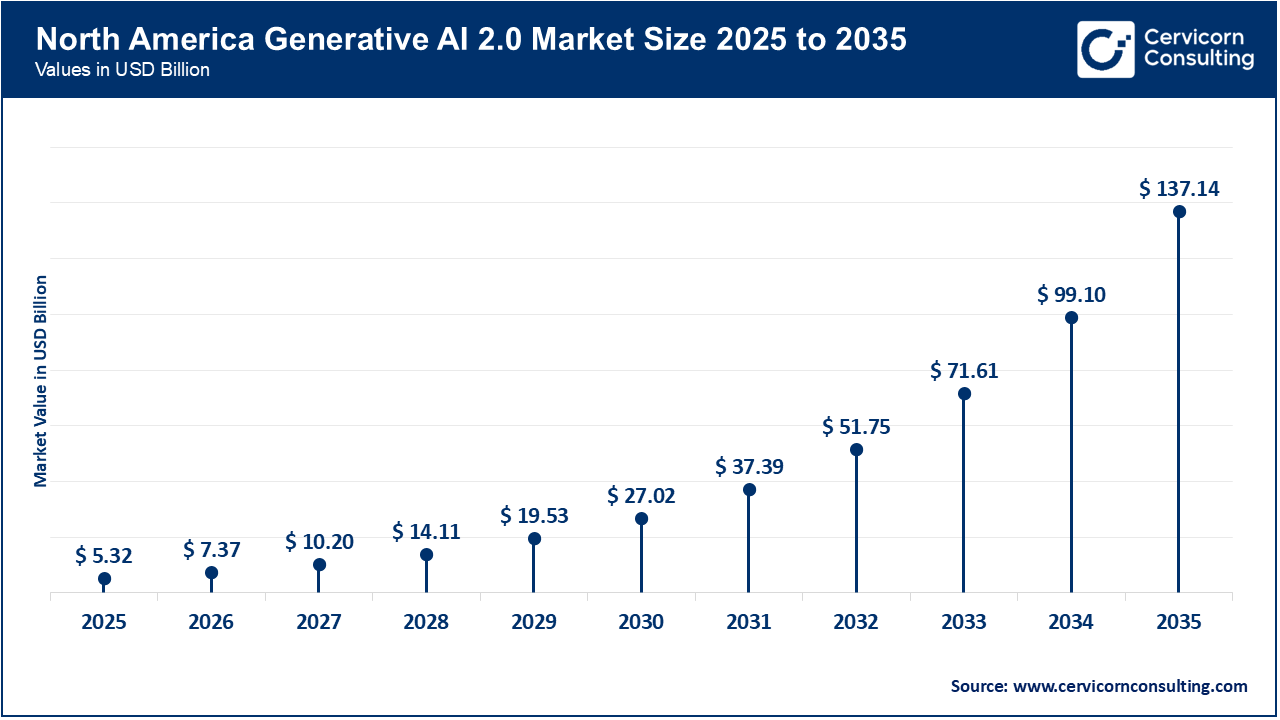
The North America generative AI 2.0 market size was valued at USD 5.32 billion in 2025 and is expected to reach around USD 137.14 billion by 2035. North America leads the market due to the early adoption of advanced AI technologies, a solid cloud-supporting infrastructure, and a high number of enterprise investments in digital transformation. The presence of significant AI companies, hyper-scale cloud providers, and a robust supply of venture capital-backed funding enables the rapid development and launch of new products. Additionally, as generative AI is used extensively within the industry of producing content, building software applications, and providing customer service as well as health care, the demand for AI has increased and therefore has driven growth within the market. In addition, supportive government programs also contribute to further solidifying the region's position in the marketplace.
Recent Developments:
- Copilot and Azure AI have been enhanced through Microsoft’s integration of their AI capabilities in their many enterprise productivity applications.
- OpenAI completed work on creating advanced models for larger scale deployment and formed partnerships with businesses in United States.
Asia-Pacific Generative AI 2.0 Market: Driven by Growth Digitalization and Government Support
The Asia-Pacific generative AI 2.0 market size was estimated at USD 3.71 billion in 2025 and is forecasted to hit around USD 95.68 billion by 2035. Asia Pacific is the fastest-growing region because of the rapid pace of digital transformation, increased use of cloud computing technology, and governmental policies to support AI activities and applications. Major countries in Asia, including China, India, Japan, and South Korea, have also invested heavily in AI research and development and the delivery of smart manufacturing and digital services through technology-enabled solutions. In addition, there is a growing need for AI-based customer engagement, e-commerce personalization, and healthcare solutions, which increases the adoption and utilization of generative AI in both existing enterprises and new startups.
Recent Developments:
- Baidu has developed generative AI solutions for both Businesses and Consumers within China.
- Many Governments have launched their own National AI Strategy and provide funding for businesses, researchers and technologists developing the next generation of AI solutions in their countries.
Europe Generative AI 2.0 Market: Driven by Growth Supported by Responsible AI and Enterprise Use Cases
The Europe generative AI 2.0 market size was reached at USD 2.48 billion in 2025 and is predicted to surpass around USD 63.79 billion by 2035. Europe is expected to continue growing steadily in the market with an increase in enterprise adoption of generative AI and a growing awareness of the need for responsible and ethical use of AI technology. Europe has a strong advantage with multiple leading research facilities in addition to the expanding use of artificial intelligence in tasks within BFSI, Manufacturing, healthcare, and robust regulatory framework that allow for building confidence among European businesses. European companies are looking to adopt generative AI for automate tasks, analyze data, and create content, while adhering to data protection regulations.
Recent Developments:
- SAP has added Generative AI functionalities to its traditional Enterprise Solutions to enhance the user experience.
- Several European governments are creating new centres of funding for artificial intelligence research and innovation centres.
Generative AI 2.0 Market Share, By Region, 2025 (%)
| Region |
Revenue Share, 2025 (%) |
| North America |
43% |
| Asia-Pacific |
30% |
| Europe |
20% |
| LAMEA |
7% |
LAMEA (Latin America, Middle East & Africa) Generative AI 2.0 Market: Driven by Increasing cloud and data center investments
The LAMEA generative AI 2.0 market was valued at USD 0.87 billion in 2025 and is anticipated to reach around USD 22.33 billion by 2035. Latin America and the Middle East & Africa, are potential opportunities for Generative AI 2.0 due to their increased availability of cloud storage, more developed digital banking services, and greater focus on smart cities. Companies in oth areas are starting to embrace AI technology to better serve customers and automate processes and offer better services. Although the adoption rates of Generative AI 2.0 are still coming into play, investments continue to increase, and market accessibility continues to improve the ability to access Generative AI.
Recent Developments:
- Cloud providers began offering artificial intelligence and data center services throughout the region of the Middle East.
- The governments in Latin America also began increasing their investment in digital transformation and artificial intelligence adoption.
Segmental Analysis
The genAI 2.0 market is segmented into offering, data modality, application, industry, and region.
Offering Analysis
Software holds the largest share in the Generative AI 2.0 market because of the value being generated by AI models, platforms, and applications. Enterprise software tools, generative AI platforms, and foundation models offer the most extensive content creation, automation, and analytic capabilities. Businesses prefer software products, to a significant extent, because they can more easily be scaled and updated than hardware or other types of products. Additionally, the speed at which many businesses are adopting AI-based solutions enables software to be the most dominant source of revenue.
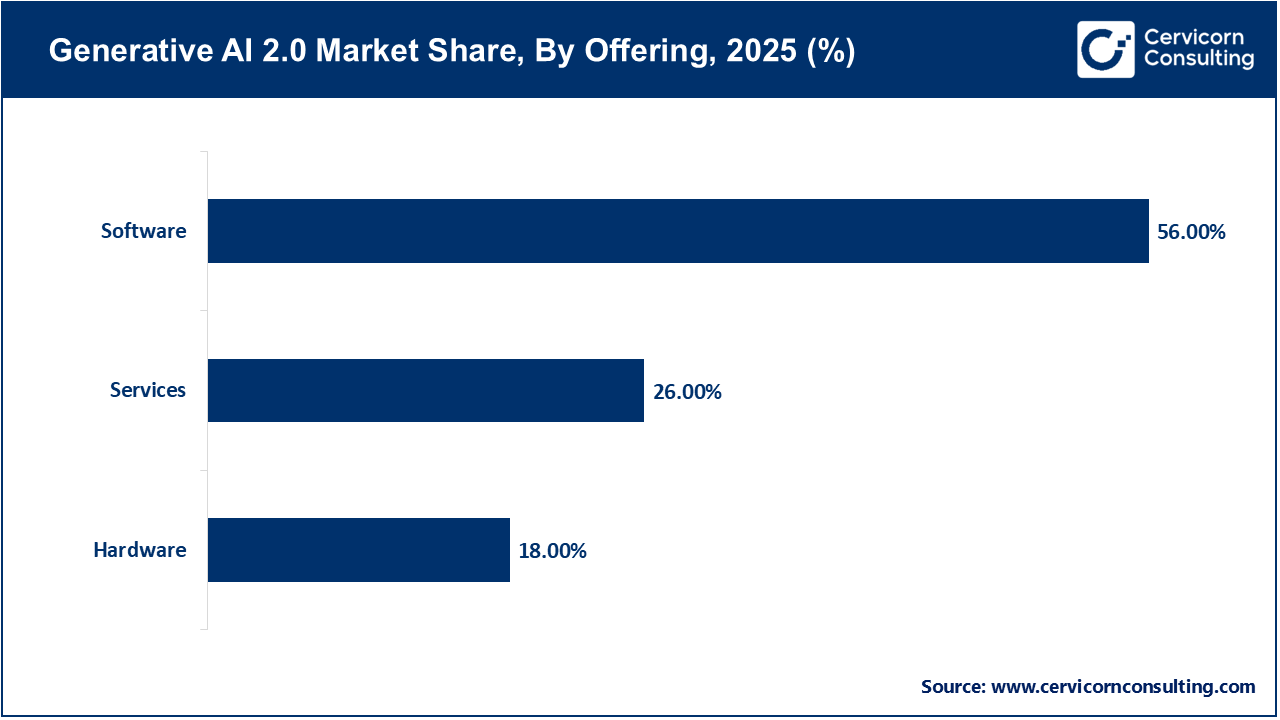
Services are the fastest-growing segment to support companies in successfully implementing Generative AI 2.0 effectively. Many companies require consulting, systems integration, customization of models, and ongoing maintenance services. As AI systems become increasingly complicated, businesses turn to service providers for the safe and efficient deployment and compliance with regulatory requirements. This growing need for the expertise of service providers has resulted in a rapid growth of AI-based service business opportunities.
Data Modality Analysis
Text-based generative AI segment dominates the current Generative AI 2.0 marketplace as a result of early adoption and wide use in chatbots, content generation, document analysis, and customer service applications. Text models require significantly less training and deployment than other types of generative AI models. Additionally, many companies have incorporated text-based AI into their day-to-day operations, thereby establishing text models as the predominant source of revenue generation in the Generative AI 2.0 market.
Generative AI 2.0 Market Share, By Data Modality, 2025 (%)
| Data Modality |
Revenue Share, 2025 (%) |
| Text |
32% |
| Multimodal |
26% |
| Image |
18% |
| Video |
12% |
| Audio & Speech |
8% |
| Code |
4% |
Multimodal AI is the fastest-growing segment because it has the capability of understanding and creating written content, visual content, audio content, and video content. Therefore, multimodal AI has the opportunity to be extremely beneficial in real-world applications such as healthcare diagnosis, digital marketing, and product creation. As companies seek to implement more sophisticated and engaging forms of artificial intelligence, they are increasingly turning to multimodal AI for increased growth and development in the sector.
Application Analysis
Content creation is the leading segment, as Generative AI 2.0 is widely used to create content such as articles, images, videos, marketing messaging, and social media campaigns. Various types of media companies, marketers, and enterprises utilize AI to produce content faster and at lower costs. The ability to provide quality digital content so rapidly is one of the dominant revenue sources within the Generative Artificial Intelligence marketplace.
Generative AI 2.0 Market Share, By Application, 2025 (%)
| Application |
Revenue Share, 2025 (%) |
| Content Creation |
35% |
| Conversational AI |
25% |
| Product Discovery & Personalization |
18% |
| Code Generation |
12% |
| Synthetic Data |
10% |
Conversational AI is the fastest-growing segment due to the increasing use of AI chatbots, virtual assistants, and customer service solutions in the B2C space. Additionally, companies leverage conversational AI to enhance customer service, provide 24x7 supports, and eliminate much of the work done by humans for their customers. Additionally, continued advancements in language understanding and context awareness for Generative AI 2.0 continue to create new opportunities for conversational AI to further infiltrate other industries as well.
Industry Analysis
Media and entertainment dominate the Generative AI 2.0 market because the industry widely uses AI technologies to create content, video editing, music generation, animation, and special effects. Generative AI allows businesses to quickly generate high-quality creative content while at the same time lowering production costs and manual efforts. The growth of streaming platforms, social media, and digital advertising has produced a growing need for ongoing content creation and has resulted in this industry being the largest and most active user of generative AI technologies.
Generative AI 2.0 Market Share, By Industry, 2025 (%)
| Industry |
Revenue Share, 2025 (%) |
| Media & Entertainment |
31% |
| Healthcare |
19% |
| BFSI |
17% |
| E-commerce & Retail |
13% |
| Automotive |
9% |
| Marketing & Advertising |
8% |
| Others |
3% |
Healthcare is the fastest-growing industry in the Generative AI 2.0 market due to the adoption of Artificial Intelligence (AI) for digital healthcare applications, such as image analysis, discovery and development of drugs, clinical documentation, and virtual patient support. With the implementation of generative AI, doctors and medical staff can work more efficiently, make fewer mistakes, and make more informed treatment decisions. The growing investment in digital healthcare, combined with the increasing need for accuracy and speed in providing efficient and effective medical solutions, has led to a high level of growth in the healthcare sector.
Generative AI 2.0 Market Top Companies
Recent Developments by Major Companies
OpenAI
- Multimodal GPT expansion with advanced capabilities of reasoning, vision, and enterprise use.
- Increase in collaborations with enterprises to implement generative AI within the business workflows.
- Strengthened concentration on AI's safe and responsible governance and deployment frameworks.
Google (Alphabet)
- The launch and development of Gemini’s multimodal models, available on both Google cloud and Google workspace.
- The introduction of generative AI to search, ads, and productivity tools improved user experience.
- Government and enterprise collaborations for artificial intelligence research and cloud adoption increased.
Microsoft
- Microsoft has increased the availability of Copilot to all Microsoft 365, Dynamics, and GitHub enterprise customers.
- Microsoft has invested significant resources into Azure AI development that provides infrastructure for large-scale generative AI solutions.
- Microsoft has deepened its partnership with Open AI to help accelerate AI innovations around the world.
Market Segmentation
By Offering
- Software
- Services
- Hardware
By Data Modality
- Text
- Multimodal
- Image
- Video
- Audio & Speech
- Code
By Application
- Content Creation
- Conversational AI
- Product Discovery & Personalization
- Code Generation
- Synthetic Data
By Industry
- Media & Entertainment
- Healthcare
- BFSI
- E-commerce & Retail
- Automotive
- Marketing & Advertising
- Others
By Region
- North America
- APAC
- Europe
- LAMEA