eVTOL Aircraft Market Size, Growth, Forecast 2026 to 2035
The global eVTOL aircraft market size reached at USD 2.8 billion in 2025 and is expected to exceed around USD 51.21 billion by 2035, growing at a compound annual growth rate (CAGR) of 37% from 2026 to 2035. The eVTOL aircraft market is experiencing rapid growth due to advancements in battery technology, electric propulsion systems, and regulatory developments. As urban congestion continues to rise, the demand for efficient, on-demand air transport is expected to increase. From a deployment perspective, industry datasets indicate active development momentum, with 500+ eVTOL companies globally engaged in design, testing, or certification programs. Prototype progress is measurable through flight validation milestones, including hundreds of scheduled test flights per aircraft program prior to certification, and early production tracking showing approximately 183 aircraft deliveries recorded in recent operational phases, signaling transition from prototype to pre-commercial deployment.
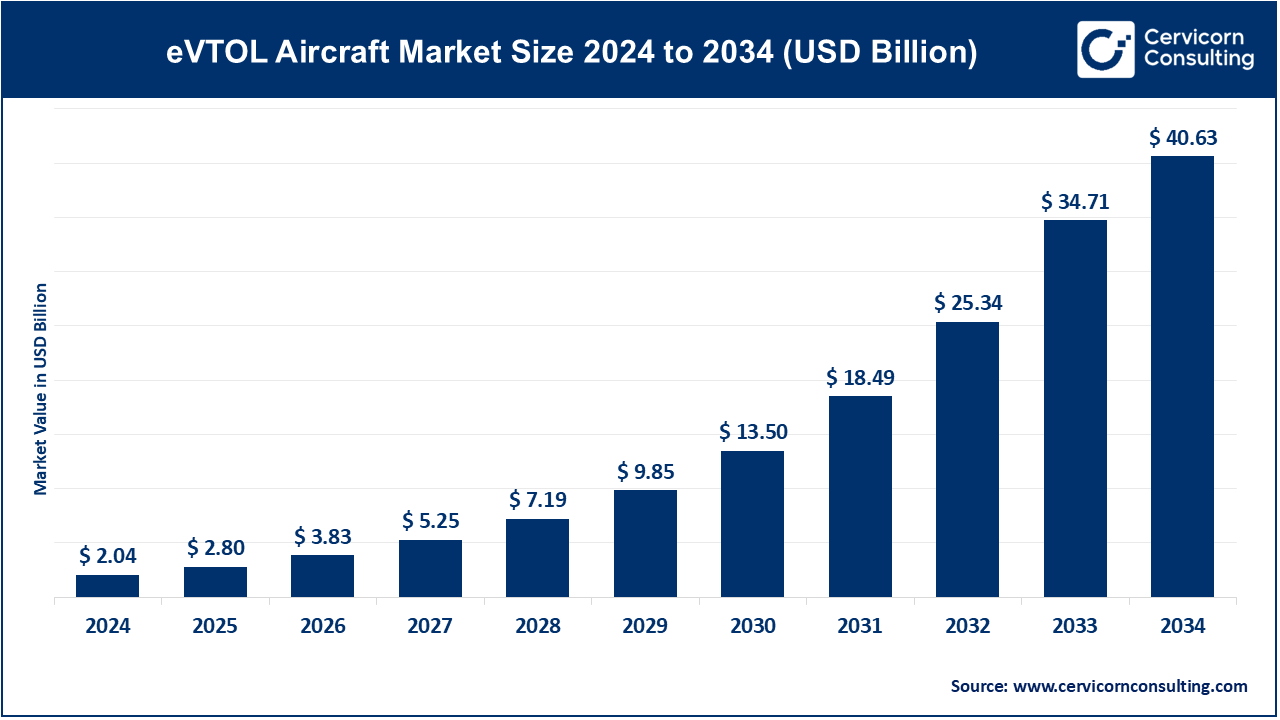
Leading aerospace companies and startups are heavily investing in eVTOL development, with a goal to commercialize these aircraft for air taxi services in major metropolitan areas. The market is expected to expand significantly over the next decade, driven by growing interest from investors, governments, and urban planners seeking innovative solutions to improve mobility. In addition, as eVTOLs promise to reduce carbon emissions and alleviate traffic congestion, they are gaining traction among policymakers and environmental advocates. Government incentives, regulatory frameworks, and public acceptance are also key factors influencing the growth of the eVTOL aircraft market. The UAE is actively pursuing eVTOL operations, with plans for air taxi services in Dubai by early 2026. Archer Aviation has signed agreements to launch commercial air taxi operations in the UAE, including in-country manufacturing and training.
An eVTOL (Electric Vertical Take-Off and Landing) aircraft is a type of electric-powered aircraft designed to take off, land, and hover vertically. Unlike traditional airplanes or helicopters, eVTOLs do not require long runways for takeoff and landing, making them ideal for urban environments. They use electric motors to power rotors or fans, enabling them to fly quietly and with minimal environmental impact compared to conventional aircraft. These aircraft are designed for short-range, urban air mobility (UAM) purposes, including air taxis, cargo delivery, and other forms of transport. eVTOLs promise to revolutionize the transportation industry by reducing congestion and offering fast, efficient, and sustainable options for travel in cities.
Report Highlights
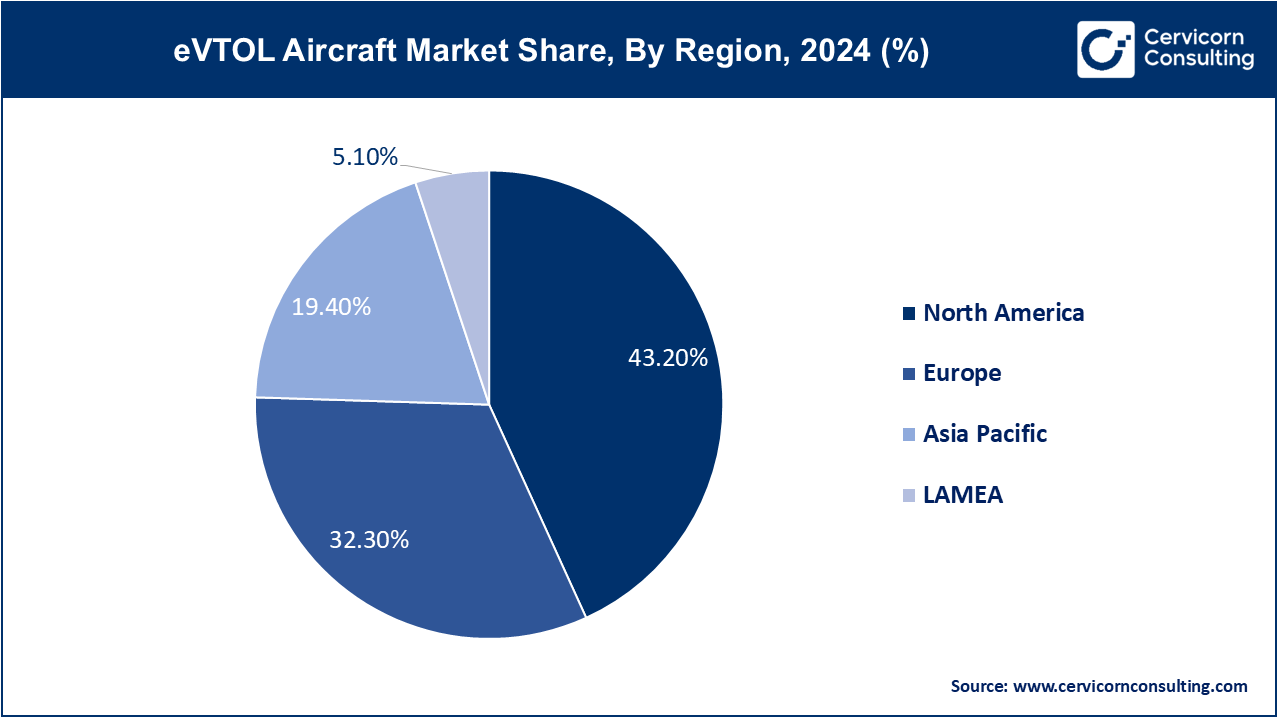
- By region, North America has reported dominating revenue share of 43.2% in 2025. This is because of early adoption of advanced aerospace technologies, strong regulatory support from aviation authorities and high investment in urban air mobility infrastructure.
- By region, Asia Pacific experiencing significant growth in the market by generating revenue share of 19.4% in 2025. Rapid urbanization, growth of smart cities initiatives and rising government investment in next generation transportation systems contribute to this.
- By propulsion type, the fully electric segment secured the highest share of 61% in 2025. The sector is benefiting from high energy efficiency, low operating costs than hybrid systems and alignment with zero-emission aviation objectives.
- By system, the hardware led the market by accounting for a market revenue share of 57% in 2025 due to component complexity, extensive use of avionics, battery packs, propulsion units and structural components for eVTOL.
- By mode of operations, semi-autonomous systems held significant share of 40% in 2025 due to ongoing regulatory restrictions on fully autonomous capabilities and reliance on pilots in critical phases of flight take-off and landing.
eVTOL Aircraft Infrastructure and Deployment Data
- There are approximately 90 to 100 vertiport locations identified worldwide at operating, under construction and planned stages, indicating the early infrastructure development stage of Urban Air Mobility.
- North America tops infra-development in the number of vertiports, having 30+ locations, thus most mature in physical deployment to accommodate eVTOL operations.
- Asia Pacific commands about 25 to 30 vertiports on the back of smart city initiatives and mounting urban congestions coupled with government mobility upgrade schemes.
- Europe accounts for around 15 to 20 vertiports on account of coherent regulatory policies and integration of existing heliport structures.
- The Middle East comprises about 10 to 15 vertiports mostly within smart city precincts aiming towards air taxi and premier urban mobility solutions. The major eVTOL operators aim for deployment of 10 to 25 vertiports in respective city clusters.
- The infrastructure entails usually two to six pads per site along with charging and passenger amenities, including automated traffic coordination.
- The estimated approval timeframe for infrastructure usually falls between three to twelve months for every site, depending upon varying regulatory conditions and urban integration.
- Early infrastructure development initiatives are centered on approximately 10 to 12 pilot cities including urban centers from U.S., Europe, the Middle East and Asia.
Top Government Initiatives for eVTOL Aircraft (2026)
| Country |
Government Initiatives |
Key Focus |
| United States |
eVTOL Integration Pilot Program (eIPP) |
Real-world testing of eVTOL aircraft in controlled airspace |
| United Kingdom |
Civil Aviation Authority (CAA) Advanced Air Mobility Program |
Regulation of air taxis, vertiports, and pilot licensing |
| China |
CAAC eVTOL Certification & Low-Altitude Economy Program |
Fast-track certification and urban air mobility integration |
| India |
DGCA Drone & Urban Air Mobility Framework Expansion |
Regulatory development for eVTOL and drone-based mobility |
| Singapore |
CAAS Urban Air Mobility Sandbox |
Controlled testing of autonomous and electric aircraft |
Growth Factors
- Urban Air Mobility Demand: The growing need for efficient and sustainable transportation solutions in congested urban areas is driving the demand for eVTOL aircraft. These vehicles offer a promising alternative to ground transportation, reducing traffic congestion and travel time in cities.
- Technological Advancements: Rapid advancements in battery technology, electric propulsion systems, and lightweight materials are enabling the development of efficient and reliable eVTOL aircraft. These innovations are critical in making eVTOLs commercially viable and operationally efficient.
- Environmental Sustainability: Increasing emphasis on reducing carbon emissions and promoting green transportation solutions is a key driver for eVTOL aircraft. As fully electric vehicles, eVTOLs offer a sustainable alternative to traditional aircraft and ground vehicles, aligning with global environmental goals.
- Regulatory Support and Infrastructure Development: Governments and aviation authorities are increasingly supporting the development of eVTOLs through regulatory frameworks, certifications, and infrastructure investments. The establishment of vertiports and air traffic management systems for urban air mobility is crucial for the market’s growth.
Recent Trends
- Investment and Collaboration: The eVTOL aircraft market is witnessing significant investment from major aerospace companies, tech firms, and venture capitalists. Collaborations between established aerospace manufacturers and innovative startups are accelerating the development and commercialization of eVTOL technologies, driving the market forward.
- Public and Private Sector Initiatives: Governments and private companies are increasingly backing initiatives to promote urban air mobility (UAM). Public transportation agencies are exploring eVTOL integration into existing transport systems, while private sector investments focus on developing pilot programs and demonstration flights.
- Emerging Markets: Developing regions with rapid urbanization and inadequate infrastructure present significant opportunities for eVTOL aircraft. These markets can adopt eVTOLs as a solution to bypass traditional transportation challenges, leading to faster adoption and deployment in regions like Southeast Asia, Africa, and Latin America.
- Passenger and Cargo Services: The expansion of eVTOL applications beyond passenger transport to include cargo services offers substantial growth potential. Companies are exploring the use of eVTOLs for last-mile delivery and logistics, especially in areas with limited road access or challenging terrain, creating new revenue streams and business models.
Report Scope
| Area of Focus |
Details |
| Market Size in 2026 |
USD 3.83 Billion |
| Market Growth Rate |
CAGR of 37% from 2026 to 2035 |
| Market Size by 2035 |
USD 51.21 Billion |
| Largest Market |
North America |
| Fastest Growing Market |
Asia Pacific |
| Segment Coverage |
By Lift Technology, Propulsion Type, System, Mode of Operations, Range, Maximum Take-off Weight (MTOW), Application and Regions |
Market Dynamics
Drivers
- Advancements in Autonomy and AI: The integration of autonomous flight systems and artificial intelligence is driving the eVTOL market forward. These technologies enhance the safety, efficiency, and scalability of eVTOL operations, reducing the need for skilled pilots and enabling autonomous air taxi services, which can significantly lower operational costs and expand accessibility.
- Consumer Demand for On-Demand Mobility: The growing preference for on-demand mobility services, such as ride-sharing and air taxi services, is driving interest in eVTOL aircraft. Consumers are increasingly seeking faster, more convenient transportation options, and eVTOLs offer the potential to meet this demand by providing quick, point-to-point air travel within urban environments.
Restraints
- Regulatory and Certification Challenges: eVTOL aircraft face complex and stringent regulatory and certification processes. These requirements, set by aviation authorities like the FAA and EASA, can delay development and increase costs. Navigating these regulations involves extensive testing, certification, and compliance measures, which can impede market entry and scalability.
- High Development and Operational Costs: The development of eVTOL aircraft involves substantial investment in research, technology, and infrastructure. High costs for advanced materials, propulsion systems, and battery technology, along with ongoing maintenance and operational expenses, pose significant financial barriers for manufacturers and operators, potentially limiting market growth.
Opportunities
- Tourism and Leisure: The eVTOL market presents a unique opportunity in the tourism and leisure sector. Companies can develop eVTOL services for scenic flights, island hopping, and luxury air travel experiences, offering travelers new and exciting ways to explore destinations. This niche market could be particularly lucrative in regions with scenic landscapes or tourist hotspots.
- Disaster Relief and Emergency Services: eVTOL aircraft offer significant potential in disaster relief and emergency response. Their ability to take off and land vertically in confined spaces makes them ideal for delivering medical supplies, conducting search and rescue operations, and providing rapid transport in emergency situations, especially in areas with damaged or inaccessible infrastructure.
Challenges
- Air Traffic Management and Integration: Integrating eVTOL aircraft into existing air traffic management systems poses a significant challenge. The need to safely manage the increased air traffic in urban environments, along with coordination between traditional aircraft and eVTOLs, requires the development of new air traffic control technologies, regulations, and infrastructure, which can be complex and time-consuming.
- Public Acceptance and Safety Concerns: Gaining public trust and acceptance of eVTOL aircraft is a major hurdle. Concerns about safety, noise pollution, and the potential impact on privacy may slow the adoption of eVTOLs. Addressing these issues through rigorous safety testing, transparent communication, and community engagement is crucial for widespread acceptance.
Regional Analysis
Why North America is leading in the eVTOL aircraft market?
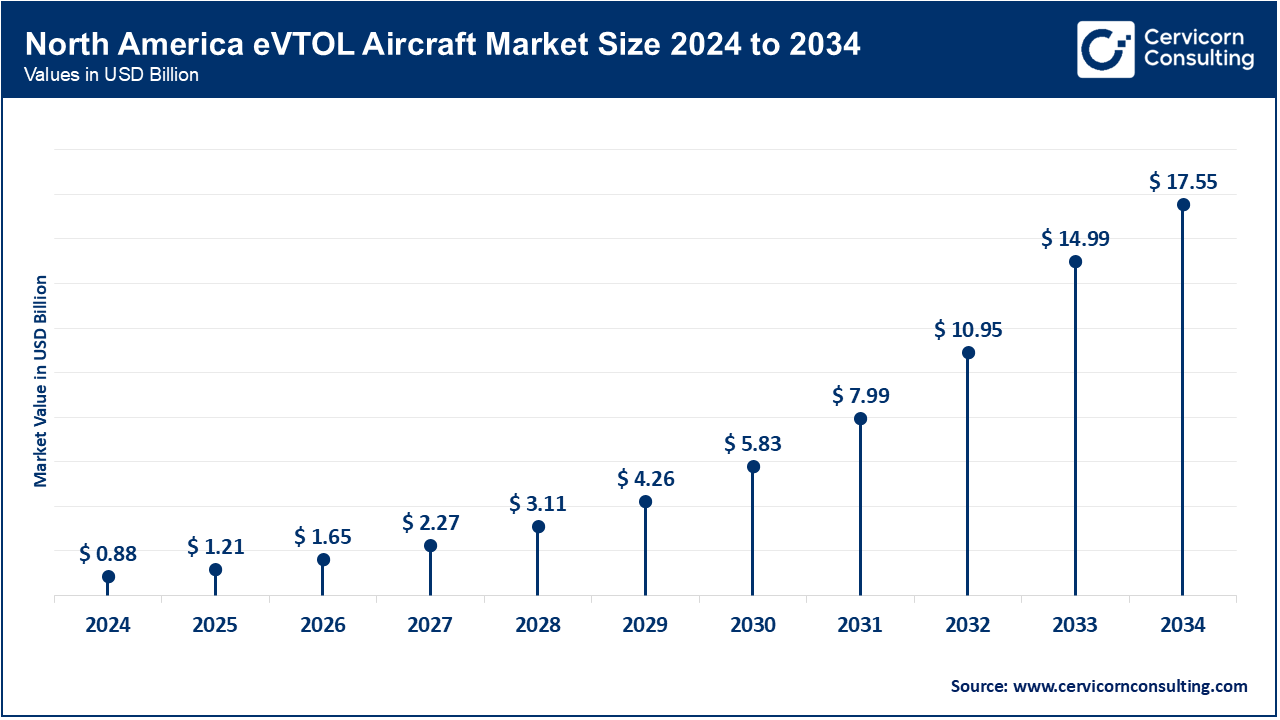
North America market size is expected to reach around USD 22.02 billion by 2035 increasing from USD 1.20 billion in 2025 with a CAGR of 38.2%. North America is leading in eVTOL development due to substantial investments, advanced technological infrastructure, and supportive regulatory environments. The U.S. and Canada are seeing increasing interest from major aerospace companies and startups. Key trends include the rapid advancement of air taxi prototypes, urban air mobility initiatives, and integration of eVTOLs into existing transportation systems. Regulatory frameworks are being actively developed to accommodate eVTOL operations.
U.S. eVTOL Aircraft Market Trends
U.S. held the most mature ecosystem for eVTOLs. Fueled by the highest aerospace innovation capability, the U.S. demonstrates early movement of regulators toward establishing approval pathways. The U.S. takes a large share of testing activity, as FAA-approved certifications are being conducted through 13 different AAM demonstration projects and several pilot programs for 5 different platforms, with programs located across the main urban corridors such as Dallas, New York, and Los Angeles. High level of tech readiness, more than 40 AAM startups, several big aviation players, with their programs testing actively in flight hours with advanced autopilot capabilities.
Why is Asia Pacific experiencing significant growth in the eVTOL aircraft market?
Asia Pacific market size is calculated at USD 0.56 billion in 2025 and is projected to grow around USD 10.24 billion by 2035 with a CAGR of 42.7%. Asia-Pacific is seeing rapid growth in eVTOL adoption due to high urbanization rates, increasing infrastructure investments, and government support for innovative transportation solutions. Countries like China, Japan, and India are exploring eVTOLs for both passenger and cargo applications. Trends include the development of eVTOL prototypes tailored to high-density urban environments, and collaborations with technology companies to address specific regional needs such as air traffic congestion and logistics challenges.
India eVTOL Aircraft Market Trends
With a rising urban population, robust smart city programs and mounting pressure on existing transport networks, India poses a huge market opportunity for eVTOL aircraft in the coming future. The challenge of urban mobility in India is substantial, as traffic speed in cities such as New Delhi, or Mumbai averages around 17-25 kilometers per hour, especially during peak times; this implies a high market potential.
Furthermore, initiatives being undertaken by the government like smart mobility corridor and drone policy framework indirectly encourage the eVTOL ecosystem’s future growth, and the increased activity around Electric aviation and drone startups, with over 100 companies in this domain, will further bolster its future in India.
Europe eVTOL Aircraft Market Trends
Europe market size is measured at USD 0.90 billion in 2025 and is expected to grow around USD 16.39 billion by 2035 with a CAGR of 39.1%. Europe is experiencing significant growth in the eVTOL market driven by ambitious urban air mobility projects and strong environmental regulations. Countries like the UK, Germany, and France are at the forefront, with numerous pilot projects and collaborations between startups and established aerospace firms. Trends include a focus on sustainability and green technologies, and significant investments in infrastructure development such as vertiports and advanced air traffic management systems.
LAMEA eVTOL Aircraft Market Trends
LAMEA market size is forecasted to reach around USD 2.56 billion by 2035 from USD 0.14 billion in 2025 with a CAGR of 31.7%. The LAMEA(Latin America, Middle East, and Africa) region is beginning to explore eVTOL technology, with a focus on addressing transportation challenges in urban and remote areas. Initial trends include pilot programs in the Middle East and South America aimed at demonstrating the viability of eVTOLs in diverse environments. Challenges include the need for infrastructure development and regulatory frameworks, but there is growing interest in leveraging eVTOLs for regional connectivity and logistics in developing markets.
Segmental Analysis
Therapy Type Analysis
Vectored Thrust: Vectored thrust eVTOLs use rotating engines or rotors to transition between vertical lift and forward flight. This technology allows for efficient aerodynamic performance and faster speeds during horizontal flight. Vectored thrust is gaining traction for its versatility in urban air mobility and longer-range missions. Companies like Joby Aviation and Lilium are leading in this segment, focusing on high-speed, longer-range eVTOLs that can efficiently serve both urban and regional markets.
Multirotor: Multirotor eVTOLs are equipped with multiple rotors that provide vertical lift, similar to drones. They are often simpler in design and are ideal for short-range, low-altitude flights. Multirotor designs are popular for urban air mobility due to their simplicity, safety, and ease of control. These eVTOLs are well-suited for short-distance air taxi services within cities. Companies like EHang are pioneering this segment, emphasizing autonomous flight capabilities for cost-effective operations.
Lift Plus Cruise: Lift plus cruise eVTOLs utilize separate sets of rotors for vertical lift and forward propulsion, offering a balance between the efficiency of vectored thrust and the simplicity of multirotor designs. This technology is emerging as a viable option for mid-range urban and suburban transportation. It provides increased safety and reliability by separating lift and cruise functions. Companies such as Airbus with its CityAirbus NextGen are exploring this design to achieve optimized performance for passenger transport over medium distances.
Propulsion Type Analysis
Fully Electric: The fully electric segment has reported highest market share of 61% in 2025. Fully electric eVTOL aircraft are powered entirely by battery systems, offering zero-emission flights. These aircraft are designed for short to medium-range urban air mobility. The push for sustainability is driving significant investment in fully electric eVTOLs. Advancements in battery technology, such as increased energy density and faster charging, are enhancing range and efficiency.
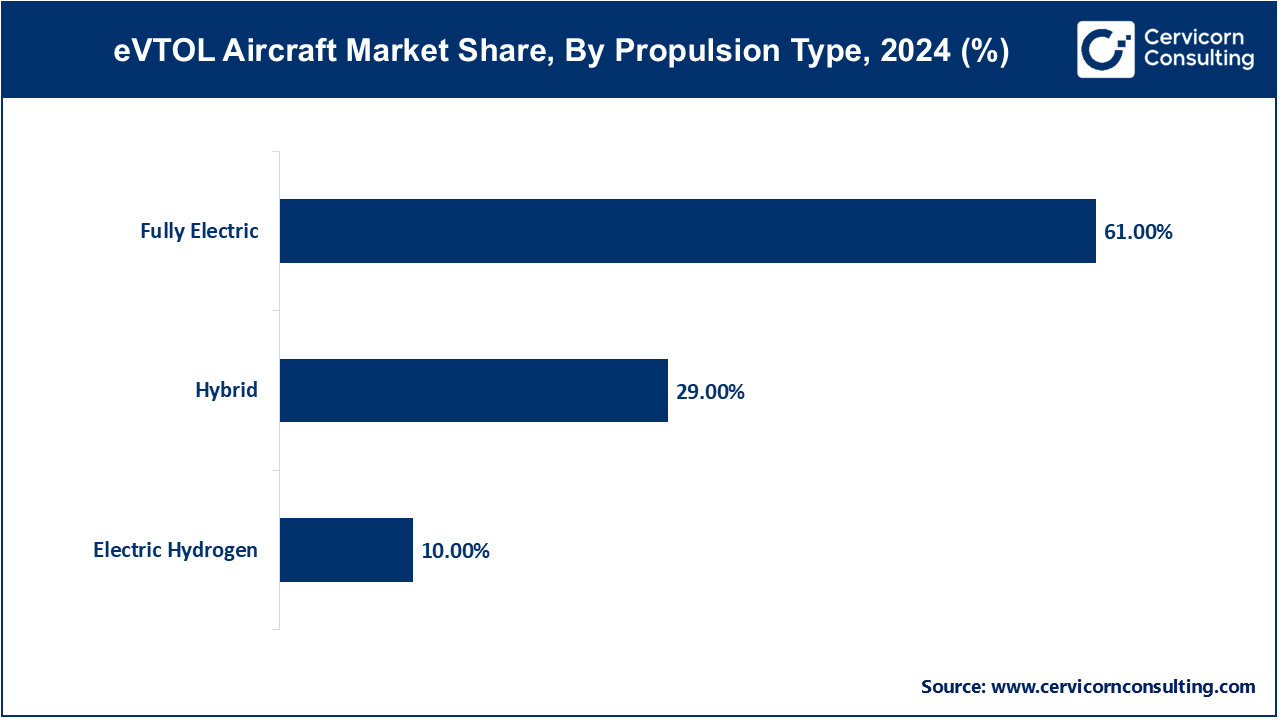
Hybrid: The hybrid segment has recorded market share of 29% in 2025. Hybrid eVTOL aircraft utilize a combination of electric power and traditional fuel (e.g., combustion engines) to extend range and operational flexibility. Hybrid propulsion systems are gaining traction as a transitional technology, offering extended range compared to fully electric models. This approach reduces the reliance on battery technology while maintaining lower emissions.
Electric Hydrogen: The electric hydrogen segment has registered market share of 10% in 2025. Electric hydrogen eVTOL aircraft use hydrogen fuel cells to generate electricity, providing a clean energy alternative with the potential for longer flight durations. Hydrogen fuel cell technology is emerging as a promising solution for eVTOLs, offering higher energy density and faster refueling compared to batteries. This technology is gaining interest for its potential to enable long-range, zero-emission flights.
System Analysis
Batteries & Cells: Batteries and cells are the core power sources for eVTOL aircraft, providing the necessary energy to operate electric motors and other systems. Advancements in battery technology, such as increased energy density and faster charging times, are crucial for extending the range and flight time of eVTOLs.
Electric Motors/Engines: Electric motors or engines convert electrical energy from batteries into mechanical energy to power the propulsion systems of eVTOL aircraft. The trend towards lightweight, high-efficiency electric motors is driving the development of more powerful and reliable propulsion systems.
Aerostructure: Aerostructure refers to the physical components of the eVTOL aircraft, including the airframe, wings, fuselage, and landing gear. Lightweight composite materials and advanced manufacturing techniques are being increasingly used to reduce the weight and improve the aerodynamic efficiency of eVTOL aerostructures.
Avionics: Avionics encompasses the electronic systems used for communication, navigation, and control of eVTOL aircraft. The integration of advanced avionics, including autonomous flight control systems, GPS navigation, and collision avoidance technologies, is critical for the safe operation of eVTOLs in urban environments.
Software: Software systems in eVTOLs manage flight operations, including navigation, propulsion control, and onboard diagnostics, as well as passenger interfaces and fleet management. Software development is focused on improving the reliability and functionality of eVTOL systems. Innovations include AI-driven flight control, predictive maintenance algorithms, and real-time data analytics, which enhance safety, efficiency, and the overall passenger experience. The software segment has generated market share of 43% in 2025.
Others: This category includes additional systems and components, such as sensors, actuators, lighting, and environmental control systems, that contribute to the overall operation of eVTOL aircraft. The integration of advanced sensors and environmental control systems is improving the safety and comfort of eVTOL flights.
Mode of Operations Analysis
Autonomous: Autonomous eVTOL aircraft operate without human pilots on board, utilizing advanced AI and automation systems to manage flight operations and navigation. These vehicles are designed for fully automated, on-demand air transportation services. The trend toward autonomous eVTOLs is driven by advancements in AI and sensor technology, which enhance safety and efficiency. Autonomous segment has accounted market share of 33% in 2025.
Piloted: Piloted eVTOL aircraft are operated by human pilots who manage flight operations. These vehicles are typically used in early market phases to ensure safety and operational reliability before fully autonomous systems are deployed. Piloted eVTOLs are seeing growing adoption as they offer a transitional solution for urban air mobility. This segment has calculated market share of 27% in 2025.
Application Analysis
Passenger Transportation: eVTOL aircraft for passenger transportation focus on providing urban air mobility solutions, including air taxis and airport shuttles. They aim to offer a faster, more efficient alternative to ground transportation. The trend is towards integrating eVTOLs into urban transportation networks to alleviate traffic congestion. Advances in battery technology and regulatory support are accelerating the development of commercial air taxi services and improving the feasibility of urban air mobility.
Cargo Transportation: eVTOL aircraft designed for cargo transportation are used for parcel delivery, heavy cargo, and logistics. They offer solutions for moving goods quickly in urban and remote areas. Growing e-commerce and logistics demands are driving innovation in cargo eVTOLs. Companies are developing larger and more efficient cargo drones for last-mile delivery, focusing on reducing delivery times and costs while expanding service areas.
Emergency Services: eVTOL aircraft used for emergency services include medical evacuation, disaster relief, and search and rescue operations. They provide rapid response capabilities in urgent situations. The emphasis is on improving response times and access to remote or inaccessible areas. Advances in technology are enhancing the reliability and efficiency of eVTOLs in emergency situations, with a focus on integrating them into existing emergency response frameworks.
Military and Defense: eVTOL aircraft for military and defense applications are designed for tactical operations, reconnaissance, and logistics support. They provide vertical takeoff and landing capabilities in various operational environments. The military is exploring eVTOLs for versatile missions, including rapid troop deployment and logistical support. The focus is on developing robust, durable designs that can operate in challenging conditions and integrate with existing defense systems.
Recreational and Tourism: eVTOL aircraft for recreational and tourism purposes include scenic flights, luxury travel, and exclusive experiences. They offer novel ways to explore destinations and enjoy aerial views. The market is expanding with the development of high-end, luxury eVTOL services. Innovations are focused on enhancing passenger comfort and providing unique experiences, with potential growth in high-tourism regions and scenic destinations.
Others: This category includes various specialized applications of eVTOL aircraft not covered by the primary segments. It may include roles such as agricultural monitoring, infrastructure inspection, and more. Emerging uses are expanding the eVTOL market. Innovations in technology are enabling new applications, with companies exploring niche markets and specialized functions that leverage the unique capabilities of eVTOL aircraft.
Top Companies
Recent Developments
- In 2024, AutoFlight has secured a major deal with EVEFLY for over 200 eVTOL aircraft following a successful long-range flight of its Prosperity | model. Meanwhile, PowerCell signed a historic contract with ZeroAvia for the delivery of hydrogen fuel cell stacks, supporting zero-emission aviation.
- In 2022, Lilium has secured agreements with Air-Dynamic SA for up to five eVTOL aircraft to serve Switzerland and Italy, and with ASL Group for six Pioneer Edition Jets. These deals, part of an ongoing partnership, include plans for a network of landing sites across Belgium, Netherlands, Luxembourg, and Western Germany.
- In 2023, Volocopter and Safran Electrical & Power have partnered to develop a next-generation powertrain for eVTOL aircraft, focusing on the electric propulsion system, battery units, and power distribution. This collaboration, announced at the Paris Air Show, advances sustainable urban air mobility.
Market Segmentation
By Lift Technology
- Vectored Thrust
- Multirotor
- Lift Plus Cruise
By Propulsion Type
- Fully Electric
- Hybrid
- Electric Hydrogen
By System
- Hardware
- Batteries & Cells
- Electric Motors/Engines
- Aerostructure
- Avionics
- Software
By Mode of Operations
- Autonomous
- Semi-autonomous
- Piloted
By Range
- Intracity (20km-100km)
- Intercity (Above 100Km)
By Maximum Take-off Weight (MTOW)
- <250 Kg
- 250-500 Kg
- 500-1500 Kg
- >1500 Kg
By Application
- Passenger Transportation
- Air Taxi
- Airport Shuttle
- Urban Air Mobility
- Cargo Transportation
- Parcel Delivery
- Heavy Cargo
- Emergency Services
- Medical Evacuation
- Disaster Relief
- Military and Defense
- Recreational and Tourism
- Others
By Region
- North America
- APAC
- Europe
- LAMEA