EV Battery Recycling Market Size, Growth, Forecast 2026 to 2035
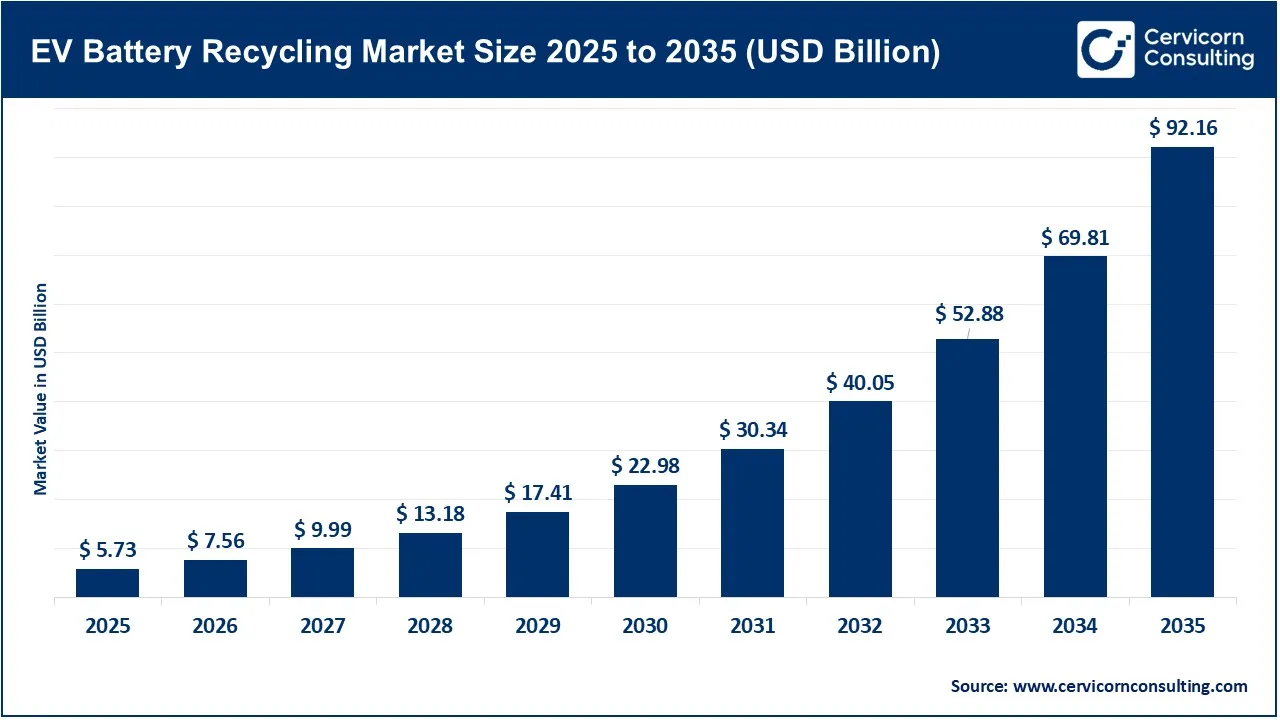
The global EV battery recycling market size was valued at USD 5.73 billion in 2025 and is expected to exceed around USD 92.16 billion by 2035, growing at a CAGR of 32% during the forecast period from 2026 to 2035. The worldwide increase in EV adoption, strong demand for critical battery materials, and evolving government guidelines are driving global market growth. Ongoing research is pioneering hydrometallurgical and direct recycling processes that significantly improve recovery rates and purity for high-value metals.
- Base Year Market Size (2025): $5.73 billion
- Current Year Market Size (2026): $7.56 billion
- Estimated Year Market Size (2035): $92.16 billion
- Forecast Period CAGR (2026-2035): 32%
Report Highlights
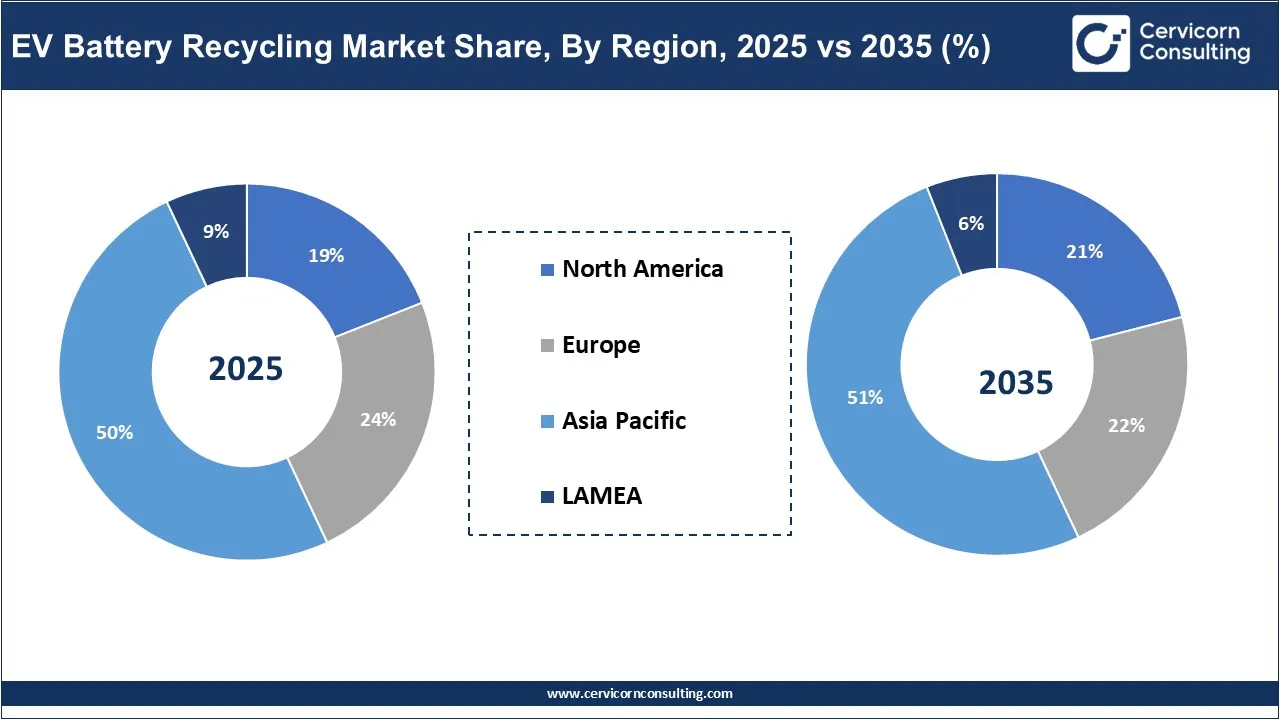
- By region, Asia-Pacific dominated the market in 2025 with revenue share of 50%, fueled by massive growth in EV deployment and rigorous environmental guidelines.
- By battery chemistry, Lithium Nickel Manganese Cobalt Oxide (NMC) led the market in 2025 with revenue share of 40%, supported by its premium recovered crucial metals and lowered reliance on raw materials.
- By recycling process, hydrometallurgical recycling accounted highest revenue share of 40% in 2025 because it offers higher metal recovery rates and consumes minimal energy.
- By battery source, manufacturing scrap dominated the market in 2025 with revenue share of 60%, driven by its vast material purity, reduced greenhouse gas emissions, and substantial economic benefits.
- By recovered material, nickel led the market in 2025, propelled by its reduced carbon footprint and growing demand for increased density and energy performance.
What are the Developing Efforts in the EV Battery Recycling Market?
The market is considered to be the process that collects, disassembles, and treats end-of-life electric vehicle (EV) lithium-ion batteries to gain critical raw materials, including lithium, cobalt, nickel, manganese, copper, and aluminium, and enable their reuse in new battery production. However, steady market growth is driven by increasing demand for critical battery materials, surging EV adoption, and enforcement of stringent government frameworks and rules. Consistent development solutions are seeking direct recycling, mainly for Lithium Iron Phosphate (LFP) chemistries that facilitate the lowest energy input. Besides this, global eminent automakers and raw material players are shifting towards extensive corporate mergers and long-term supply agreements in closed-loop recovery to ensure local access to major minerals.
Latest Steps Taken by Key Entities
- November 2026: The Battery Innovation Programme awarded £28.6m to 27 projects to empower UK production and lower dependency on overseas supply chains by enhancing national power.
- October 2026: Hydrovolt collaborated with the Icelandic Recycling Fund, aiming at end-of-life battery recycling solutions in Iceland.
- October 2026: Ultium Cells LLC and South Korea’s LG Energy Solution announced a strategy to develop lithium manganese-rich (LMR) prismatic battery cells at the GM manufacturing complex in Spring Hill, Tennessee.
- May 2026: India and the EU introduced a €15.2 Million/~₹169 crore joint initiative to reinforce EV battery recycling under the India-EU Trade and Technology Council (TTC) Working Group 2.
- April 2026: Altilium awarded £18.5 million in grant funding through the UK government’s DRIVE35 Scale-Up Fund to strengthen the construction of Altilium’s new ACT3 recycling facility, the UK’s first commercial refinery for recovery of critical battery materials from end-of-life EV batteries.
- April 2026: TSR Group and BASF joined forces to expand the recycling of electric vehicle batteries in Europe.
Market Dynamics
Growth Drivers
- Accelerating Demand for Critical Battery Materials: Day by day, the EV battery recycling market expansion is fueled by increasing demand for scarce and expensive raw materials, such as lithium, cobalt, nickel, and manganese, where the recycling approach offers these high-end metals and reduces reliance on new mining.
- Progressing End-of-Life Batteries & Scrap: The worldwide rising EV fleet and older vehicles push early production scrap from new battery gigafactories, which gives an instant, notable stream of recyclable material.
- Emerging Stricter Mandates: Many regional governments are enforcing intense environmental and waste management laws, like the European Union's Battery Regulation, China’s battery recycling mandates, and India's Battery Waste Management Rules (BWMR), supporting industry expansion.
Market Restraints
- Need for Huge Capital Expenditure: To execute modern recycling facilities, especially hydrometallurgical or direct recycling plants, necessitates vast initial investment for unique machinery, safety systems, and environmental compliance, which acts as a hurdle for small firms.
- Volatile Raw Material Costs: Globally, escalating fluctuations in raw material prices create competition for recycled materials with newly mined resources, which reduces profit margins and discourages infrastructure spending.
Market Opportunities
- Allowing Innovative Alliances: In 2026, automakers (OEMs), cell manufacturers, and recyclers are promoting direct strategic partnerships to establish closed-loop systems and ensure raw material offtake, and feed recovered cathode active materials (CAM) straight back into novel battery cell production.
- Broadening Second-Life Battery Indications: Retired EV batteries possess nearly 70%-80% capacity, which initiates commercial chances in reusing them for grid or commercial solar backup storage, along with remote state-of-health (SoH) diagnostics.
- Strengthening Local Supply Chain Measures: Specifically, North America, Europe, and India are encouraging domestic supply chain solutions that ultimately spur robust demand for domestic recycling plants and lower susceptibility to foreign mineral monopolies and raw material price volatility.
Market Challenges
- Restricted Battery Standardization: Eventually, broader use of massively distinct cell designs, chemistries, pack structures, and physical dimensions by various EV developers makes automated dismantling complex, pushing operations to depend on slow, expensive human labor.
- Safety & Thermal-Related Concerns: Generating micro-cracks, weak cells, or mechanical pressure during transport, storage, and crushing can cause short circuits and uncontrollable fires.
EV Battery Recycling Market Regional Analysis
How did Asia Pacific Dominate the Market in 2025?
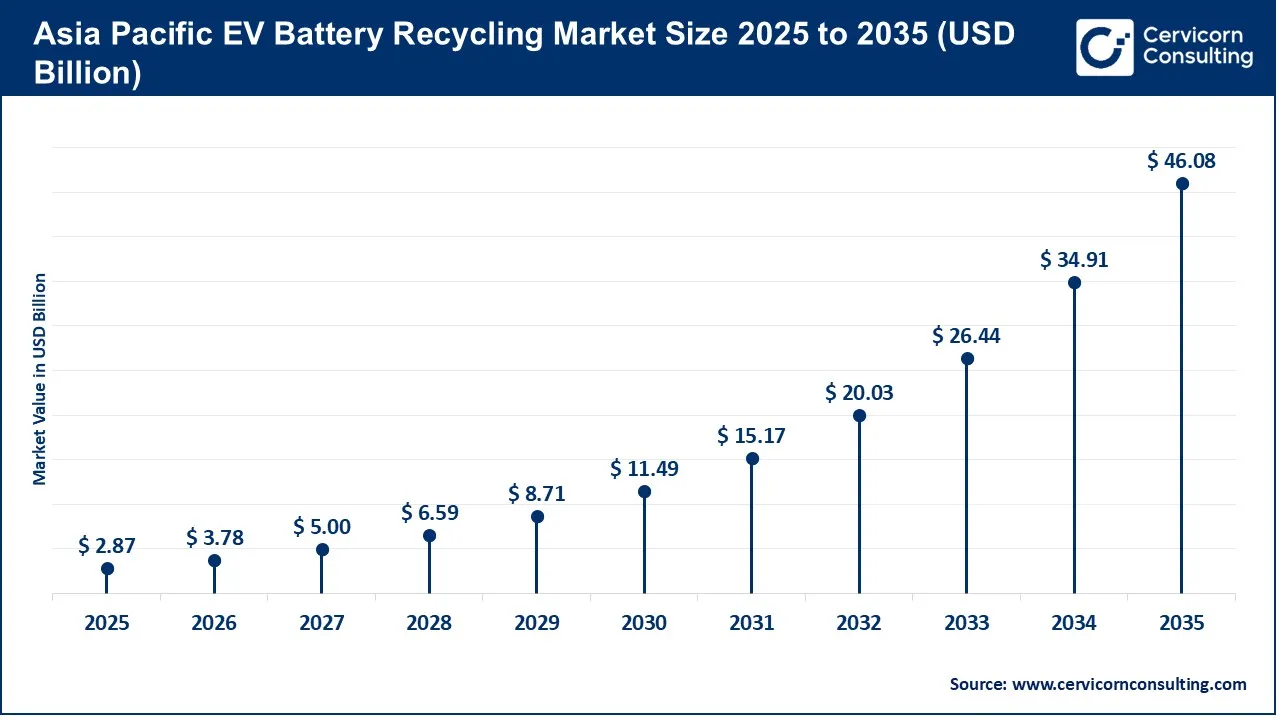
The Asia-Pacific EV battery recycling market size was estimated at USD 2.87 billion in 2025 and is projected to surpass USD 46.08 billion by 2035. Asia Pacific held a major share of the market in 2025, supported by the presence of a vast production base, emerging government regulations, and broader demand for advanced supply chain security. Across China, the Ministry of Industry and Information Technology (MIIT) and market oversight firms executed a full-lifecycle digital identity tracking system for every EV battery produced and sold in the nation. Meanwhile, Indian EV OEMs have expanded integration of digital battery passports and lifecycle tracking to monitor battery health, second-life repurposing, and material provenance.
India Market
- India was a key contributor to the market, which highly depends on imports for vital battery metals, including lithium, cobalt, nickel, and manganese. Alongside this, India’s well-established local hydrometallurgical and direct-recycling technologies that cover domestic battery-grade lithium and metal-refining facilities have expanded the recovery of high-purity battery-grade materials economically viable.
Which Region is Estimated to Grow Fastest in the EV Battery Recycling Market?
The North America EV battery recycling market size was valued at USD 1.09 billion in 2025 and is expected to hit around USD 17.51 billion by 2035. North America is anticipated to expand at a rapid rate in the predicted timeframe, fueled by broadening EV adoption, execution of federal incentives, and growing advances in recycling technology. Additionally, the region has been experiencing growth in manufacturing scrap and higher investments in giga-factories. However, Canadian innovations are transforming significant direct lithium extraction (DLE) deployments in Saskatchewan by Prairie Lithium and Aquatech to lower dependence on virgin mining inputs.
United States Market
- The U.S. market is seeking to speed up end-of-life battery volumes, rigorous regulations, and direct automaker partnerships. Recently, the nation’s key automakers have strengthened long-term supply agreements with primary local recyclers, such as Ascend Elements, Li-Cycle, Cirba Solutions, and Redwood Materials. On the other hand, New Jersey, Washington, and California have empowered extensive stewardship and disposal laws that ban propulsion and embedded-component batteries from standard landfills and mandate producer-funded collection trajectories.
EV Battery Recycling Market Segmentation Analysis
Battery Chemistry Analysis
Lithium Nickel Manganese Cobalt Oxide (NMC): The Lithium Nickel Manganese Cobalt Oxide (NMC) segment held a major share of the market in 2025, due to its higher financial advantages, expansive recovery of scarce metals, and wider use in long-range EVs. According to some demonstrations in 2025, lab- and pilot-scale direct recycling techniques achieved over 80% selective lithium leaching and produced regenerated NMC cathodes with capacity retention matching or surpassing commercial fresh NMC cells.
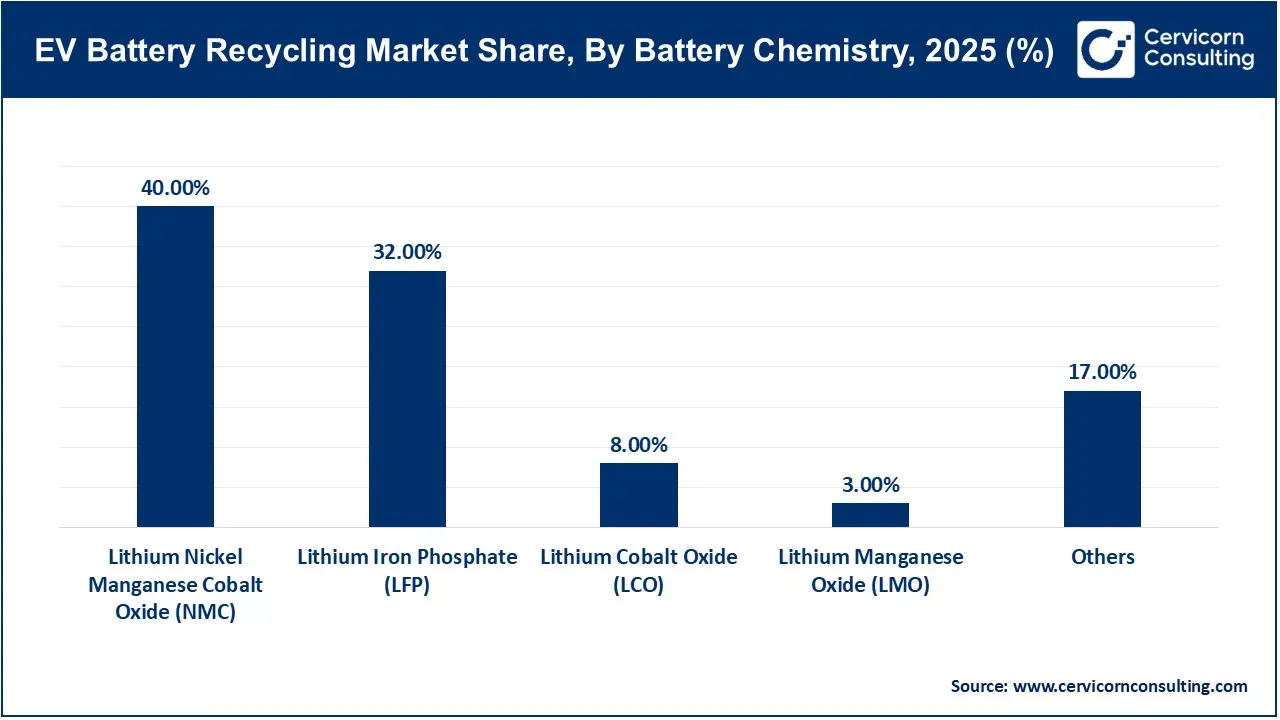
Lithium Iron Phosphate (LFP): The Lithium Iron Phosphate (LFP) segment is anticipated to grow fastest during the forecast period, supported by improved thermal & operational safety, broader adoption in EV vehicles, and favourability for second-life reuse. In particular, leading Chinese producers are boosting unified industrial parks, which advance joining of LFP recycling directly with upstream iron phosphate and cathode production to eliminate transportation and processing burden.
Recycling Process Analysis
Hydrometallurgical Recycling: The hydrometallurgical recycling segment accounted for the largest share of the market in 2025, propelled by its higher efficiency, great recovery & purity, and minimal energy consumption. Ongoing breakthroughs have elevated integrated real-time machine learning and AI control systems to improve pH, reaction flow rates, and lixiviant concentrations, which overcome historical slow-leaching concerns, eliminate CaPEx by around 30%, and reduce OPEX by 40%.
EV Battery Recycling Market Share, By Recycling Process, 2025 (%)
| Recycling Process |
Revenue Share, 2025 (%) |
| Hydrometallurgical Recycling |
58% |
| Pyrometallurgical Recycling |
22% |
| Direct Recycling |
12% |
| Mechanical Recycling |
6% |
| Others |
2% |
Direct Recycling: The direct recycling segment is expected to witness rapid expansion in the upcoming years, driven by its significant cathode functionality preservation, lowering material loss, and pivotal reduction in carbon footprint. Nowadays, certain firms and research organizations are emphasizing direct relithiation to replenish lost lithium ions inside degraded crystal lattices, restoring performance and avoiding the breakdown of transition metals.
Battery Source Analysis
Manufacturing Scrap: The manufacturing scrap segment captured a dominant share of the EV battery recycling market in 2025, due to its immediate availability, strengthened supply chain security, and minimized raw material expenses. With reduced GHG emissions, some research projects enable mixed or low-grade manufacturing and paid nickel-lean cathode scrap to be reshaped directly into high-performance single-crystal cathodes.
EV Battery Recycling Market Share, By Battery Source, 2025 (%)
| Battery Source |
Revenue Share, 2025 (%) |
| Manufacturing Scrap |
60% |
| End-of-Life Electric Vehicle Batteries |
26% |
| Damaged and Defective Batteries |
8% |
| Second-Life Battery Systems |
6% |
End-of-Life Electric Vehicle Batteries: The end-of-life electric vehicle batteries segment is predicted to be the fastest-growing during 2026-2035, fueled by its strong closed-loop circular economy, surge in retired EV fleets, and conversion into high-value sources. Global recyclers are widely adopting automated robotic systems and digital twins for safe discharge, sorting, and dismantling of complex high-voltage battery packs.
Recovered Material Analysis
Nickel: The nickel segment registered dominance in the market in 2025, supported by expanded high-nickel batteries, reduced environmental footprint, and perfect reintegration. In 2025, researchers at the University of Ulsan National Institute of Science and Technology (UNIST) rolled out an advanced process that recovers over 95% of nickel and cobalt from waste batteries with a purity exceeding 99% and eliminates wastewater and chemical use.
EV Battery Recycling Market Share, By Recovered Material, 2025 (%)
| Recovered Material |
Revenue Share, 2025 (%) |
| Lithium |
36% |
| Nickel |
24% |
| Cobalt |
21% |
| Manganese |
8% |
| Graphite and Other Materials |
11% |
Lithium: The lithium segment is projected to expand rapidly in the market, driven by rising technological advancements, its major waste savings, and lowering pressures in mining. 2026’s innovative approaches allow elimination of high-temperature pyrometallurgy and chemical-heavy acid leaching, which develop 96% pure lithium-ion recovery solutions with minimal energy usage. Certain regulatory mandates push new batteries to leverage minimum percentages of recycled lithium, cobalt, and nickel starting in FY 2027–28.
Recent Launches
- November 2026: Veolia unveiled a new plant in France to mine metals from EV batteries and focused on lowering exports of materials vital to Europe’s industrial sovereignty.
- November 2026: ACT-ion Battery Technologies, Inc. opened its pilot plant at 1200 Tappan Circle in Carrollton, Texas, to manufacture cathode active materials (CAM) in the United States, leveraging ACT-ion’s proprietary ACT-ivate™ process, reducing the expenditure, environmental impact, and production time of next-generation battery components.
- September 2026: General Motors (GM) rolled out a closed-loop battery recycling pilot in alliance with Cirba Solutions to produce new EV battery cells made with 100% recycled nickel, cobalt, and manganese.
- September 2026: Sumitomo Metal Mining explored Japan's first full-scale commercial EV battery recycling plant in Saijo, Ehime Prefecture, with an annual processing capacity of 10,000 metric tons of spent batteries that extract critical metals to create a local battery-to-battery supply chain.
- July 2026: Ather Energy, with LICO Materials, to establish a system for the collection, recycling, and recovery of materials from end-of-life lithium-ion EV batteries in Karnataka.
- June 2026: South Korea's Ministry of Climate, Energy and Environment introduced a pilot program for the "Battery Recycled Material Production Certification System," aiming at implementation by May 2027.
Key Players
Segments Covered
By Battery Chemistry
- Lithium Nickel Manganese Cobalt Oxide (NMC)
- Lithium Iron Phosphate (LFP)
- Lithium Cobalt Oxide (LCO)
- Lithium Manganese Oxide (LMO)
- Other Lithium-Ion Chemistries
By Recycling Process
- Hydrometallurgical Recycling
- Pyrometallurgical Recycling
- Direct Recycling
- Mechanical Recycling
- Other Recycling Processes
By Battery Source
- Manufacturing Scrap
- End-of-Life Electric Vehicle Batteries
- Damaged and Defective Batteries
- Second-Life Battery Systems
By Recovered Material
- Lithium
- Nickel
- Cobalt
- Manganese
- Graphite and Other Materials
By Region
- North America
- Europe
- Asia-Pacific
- Latin America
- Middle East and Africa
