Electronic Warfare Market Size and Growth 2026 to 2035
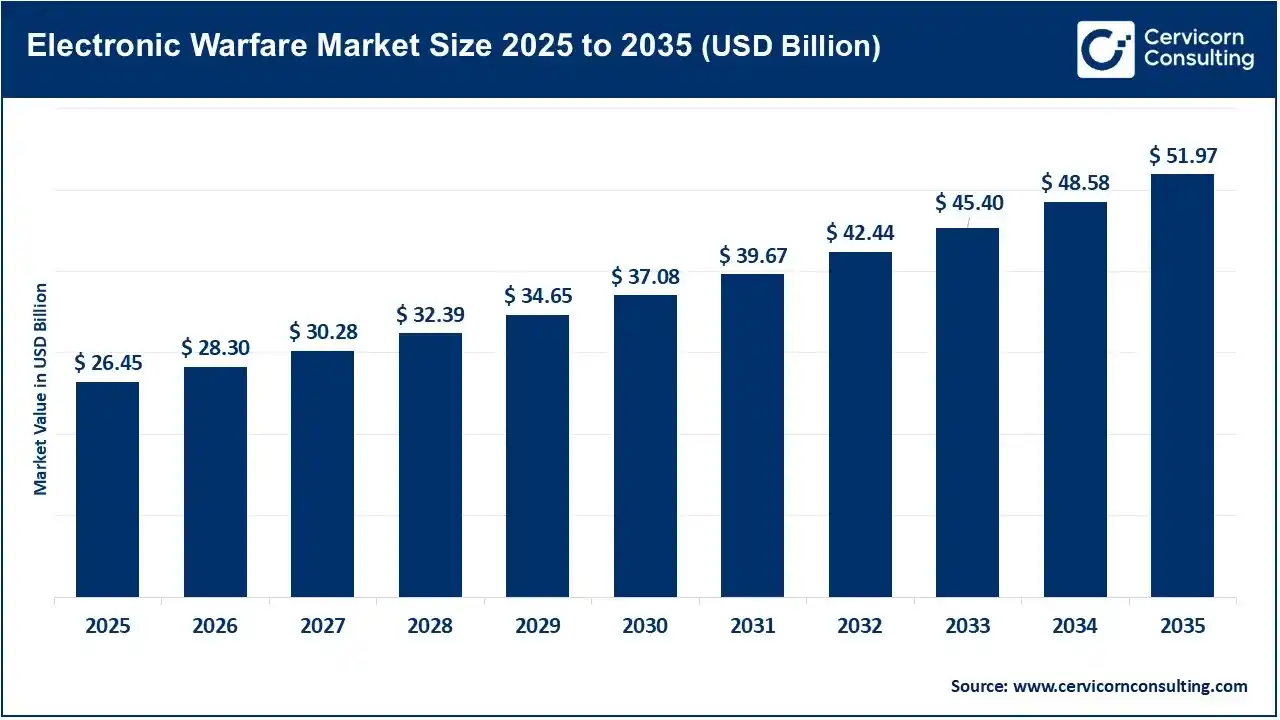
The electronic warfare market size was valued at USD 26.45 billion in 2025 and is projected to grow from USD 28.30 billion in 2026 to nearly USD 47.91 billion by 2035, registering a CAGR of 7% over the forecast period 2026 to 2035. The market is growing due to increasing defense spending, rising geopolitical tensions, and the growing adoption of advanced electronic warfare systems.
Key Takeaways
- By region, North America has recorded revenue share of 38% in 2025, supported by high defense spending and advanced EW capabilities.
- By region, Asia Pacific is expected to grow at the fastest rate, driven by rising defense spending and military modernization.
- By capability, electronic support has generated revenue share of 33% in 2025, owing to its role in threat detection and signal analysis.
- By capability, electronic attack is expected to grow at the fastest rate, driven by rising demand for jamming and signal disruption.
- By product, EW equipment dominated the market in 2025 (Revenue Share 72%), supported by growing demand for advanced EW systems.
- By product, EW operational support is expected to grow at the fastest rate, driven by increasing demand for maintenance and training.
- By equipment type, jammers leading the market in 2025 with revenue share of 24%, owing to their widespread use in disrupting hostile signals.
- By equipment type, directed energy weapons are expected to grow at the fastest rate, driven by rising investments in advanced defense technologies.
- By platform, airborne segment has held highest revenue share of 45% in 2025, supported by increasing adoption of EW systems in aircraft.
- By platform, space-based platforms are expected to grow at the fastest rate, driven by rising demand for satellite-based EW capabilities.
- By technology, receivers and signal processing dominated the market in 2025, owing to their importance in signal detection and analysis.
- By technology, AI and machine learning-enabled EW is expected to grow at the fastest rate, driven by demand for automated threat detection.
- By application, electronic intelligence and surveillance dominated the market in 2025, supported by the need for continuous threat monitoring.
- By application, counter-UAS operations are expected to grow at the fastest rate, driven by increasing drone threats.
- By end user, the air force dominated the market in 2025, owing to the extensive use of EW in aircraft.
- By end user, the navy is expected to grow at the fastest rate, driven by increasing investments in naval EW systems.
What is Driving the Growth of the Electronic Warfare Market?
The electronic warfare market is growing because of growing defense spending, escalating geopolitical tensions, and the increasing demand for sophisticated systems capable of identifying, disrupting, and thwarting electronic threats. The demand for electronic warfare capabilities is rising due to the growing use of radar, communication, and navigation systems in contemporary warfare. To improve defense operations, militaries are also investing in cutting-edge technologies like spectrum management, electronic countermeasures, and signal intelligence. Additionally, market expansion is being aided by the increased emphasis on battlefield awareness and defense against sophisticated electronic threats.
- In April 2026, the Royal Australian Air Force received the first Next Generation Jammer pods from RTX's Raytheon. By interfering with enemy radars and communication systems, the airborne electronic attack system enhances Australia's electronic warfare capabilities and emphasizes ongoing investment in cutting-edge EW technologies.
Recent Trends
- AI-Powered Electronic Warfare: Increasing integration of artificial intelligence and machine learning is improving threat detection, signal analysis, and real-time decision-making.
- Rise in Cognitive Electronic Warfare: Militaries are adopting cognitive EW systems that can automatically identify changing threats and adapt countermeasures accordingly.
- Growing Demand for Electronic Attack Systems: Rising focus on disrupting enemy communications, radars, and navigation systems is driving demand for advanced jamming and electronic attack technologies.
- Integration with Unmanned Systems: Electronic warfare capabilities are increasingly being integrated into drones and unmanned platforms for surveillance, intelligence gathering, and electronic attacks.
- Focus on Multi-Domain Operations: Defense forces are developing EW solutions that can operate across air, land, sea, space, and cyberspace to support coordinated battlefield operations.
Market Dynamics
Driver
Rising Defense Spending and Military Modernization
The need for cutting-edge electronic warfare systems is being driven by growing defense budgets and military modernization initiatives. To improve military readiness and combat sophisticated electronic threats, governments are investing in electronic attack, electronic protection, and signal intelligence capabilities. The demand for EW technologies is rising due to the expanding use of sophisticated radar, communication, and navigation systems.
- In April 2026, Lockheed Martin continued to develop advanced electronic warfare capabilities designed to provide electromagnetic spectrum superiority in contested environments. Its focus on multi-domain EW technologies demonstrates how defense companies are strengthening electronic warfare solutions to address evolving battlefield threats.
Restraint
High Development and Deployment Costs
Electronic warfare system development and implementation necessitate large investments in cutting-edge hardware, software, testing, and qualified staff. Defense organizations may incur higher costs because of complex system integration and ongoing technological advancements. Adoption may be hampered by these factors, especially in nations with limited defense budgets.
- In 2026, Northrop Grumman continues to develop advanced electronic warfare systems, including radar warning receivers, electronic countermeasures, and multifunction EW solutions. The company's focus on advanced digital architectures and continuously upgradeable systems highlights the substantial technological investment required to maintain effective EW capabilities.
Opportunity
Integration of AI and Autonomous Technologies
The market for electronic warfare has a lot of potential due to the increasing integration of autonomous, machine learning, and artificial intelligence technologies. AI can assist systems in real-time threat identification, signal analysis, and reaction to quickly shifting electromagnetic environments. Additionally, there are new opportunities for advanced EW applications due to the growing use of unmanned platforms.
- In August 2026, Lockheed Martin and Saildrone demonstrated a passive electronic warfare capability from an unmanned surface vehicle during RIMPAC. The demonstration showed how an autonomous platform can detect, classify, and identify radar signals, highlighting the potential for combining electronic warfare with unmanned technologies.
Regional Analysis
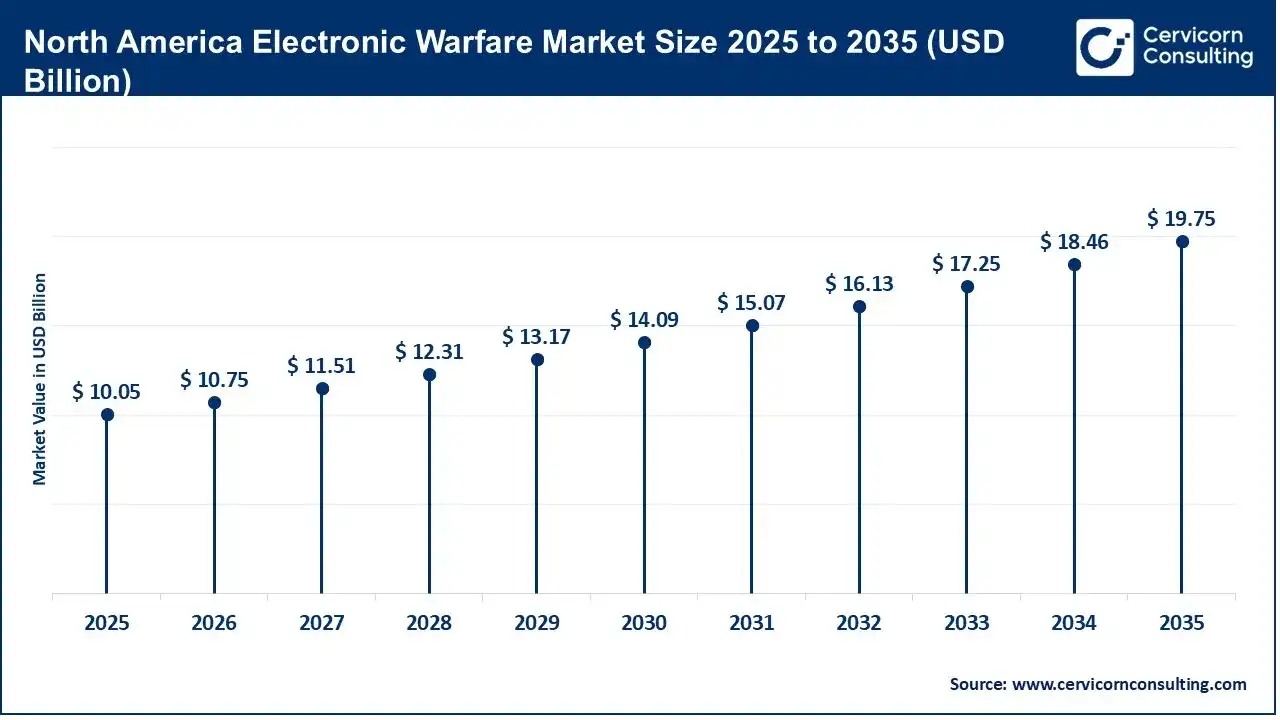
The North America electronic warfare market size was valued at USD 10.05 billion in 2025 and is projected to hit USD 19.75 billion by 2035. North America is expected to continue its dominance in the market because of the presence of significant providers of electronic warfare technology, high defense spending, and sophisticated military capabilities. The U.S. is making significant investments in intelligence, electronic attack, electromagnetic spectrum operations, and next-generation EW systems. Regional demand is being further strengthened by ongoing military modernization initiatives. The development of cutting-edge EW technologies is being aided by strong research and development capabilities. Regional market leadership is also a result of close cooperation between defense organizations and technology firms.
The Asia-Pacific electronic warfare market size was estimated at USD 7.67 billion in 2025 and is expected to surpass USD 15.07 billion by 2035. Asia Pacific is expected to be the fastest-growing region, fueled by rising geopolitical tensions, military modernization, and defense spending. The region's nations are making investments in cutting-edge radar, electronic attack, surveillance, and counter-UAS capabilities. Regional market expansion is also being aided by the increasing emphasis on domestic defense technologies and electromagnetic spectrum superiority. The need for integrated EW systems is growing due to the increased acquisition of cutting-edge military platforms. Regional growth is also anticipated to be accelerated by the growth of domestic defense manufacturing and technological advancement.
Segmental Analysis
Capability Analysis
Electronic support dominated the electronic warfare market because of its vital function in the identification, detection, and analysis of electromagnetic signals. The deployment of sophisticated electronic support systems is being prompted by the growing demand for situational awareness and real-time threat detection. Military platforms can better comprehend the electromagnetic environment and react to possible threats with the aid of these capabilities.
The segment is being further supported by the increasing use of sophisticated sensors and signal-monitoring technologies. Its top spot is also a result of growing demand for battlefield intelligence and early threat detection.
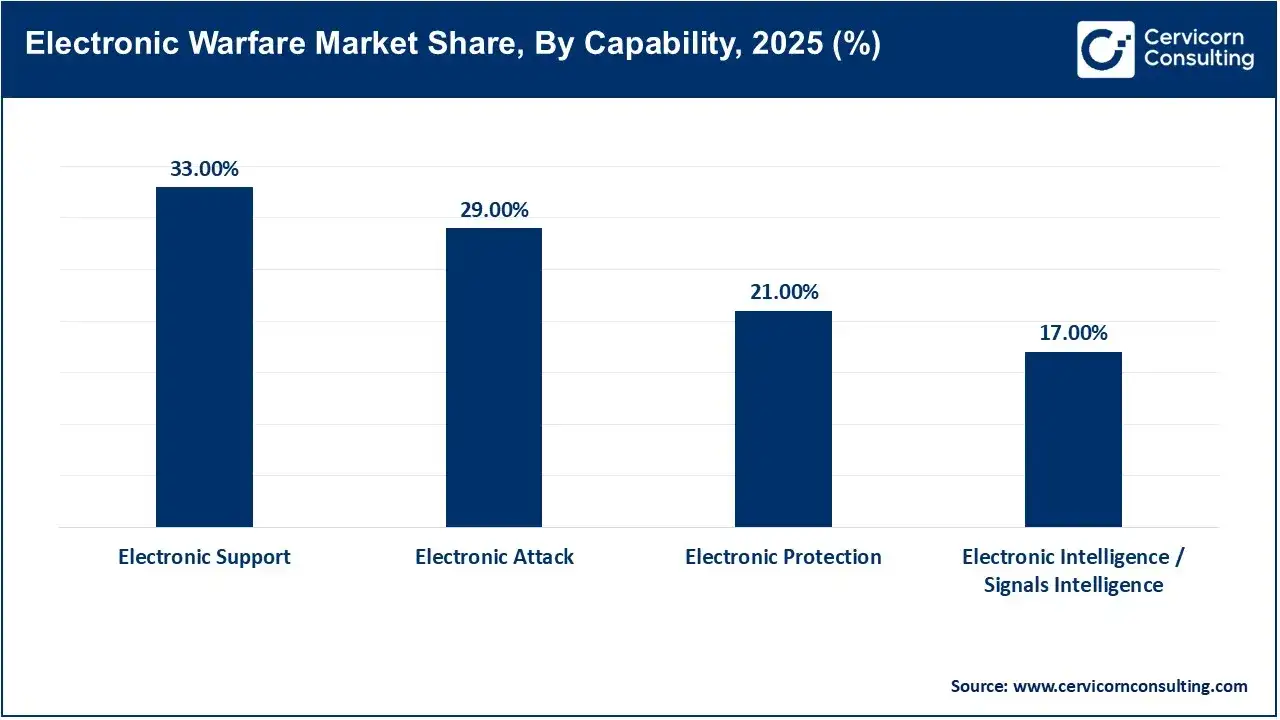
Electronic attack is expected to be the fastest-growing segment, driven by the growing need for sophisticated electronic attack, deception, and jamming technologies to combat changing electromagnetic threats. Increased funding for offensive EW capabilities is promoting the creation of systems that can interfere with enemy radar, navigation, and communications.
The growing complexity of contemporary battlefields is contributing to the segment's expansion. Advanced electronic attack solutions are becoming more and more in demand as the need to counter sophisticated electronic threats grows. Its applications are also being expanded by integration with land-based, naval, and arial platforms.
Product Analysis
EW equipment is expected to dominate the market due to the extensive use of specialized hardware for protection, jamming, interception, and electronic detection. Demand is being supported by growing military modernization initiatives and rising acquisition of cutting-edge EW systems. Additionally, defense organizations are adding advanced electronic warfare equipment to existing platforms. Older EW hardware is being replaced by more capable systems due to ongoing technological advancements. The market is becoming stronger due to the increasing need for integrated electronic protection across military platforms.
Electronic Warfare Market Share, By Product, 2025 (%)
| Product |
Revenue Share, 2025 (%) |
| EW Equipment |
72% |
| EW Operational Support |
28% |
EW operational support is expected to be the fastest-growing segment, driven by the growing demand for specialized services in the areas of operational management, simulation, maintenance, training, and EW planning. The need for ongoing technical and operational support is rising due to the increasing complexity of electronic warfare systems.
Opportunities in this market are being further created by the adoption of networked and software-driven EW systems. In order to manage and optimize advanced EW systems, defense organizations increasingly need specialized expertise. Segment expansion is also being aided by rising training and simulation expenditures.
Equipment Type Analysis
Jammers are expected to dominate the equipment type segment because they are frequently used to interfere with hostile radar, communication, and navigation signals. Defense forces are being urged to improve their jamming capabilities due to growing concerns about electronic threats. Demand is being further supported by their deployment on land-based, naval, and aerial platforms.
A greater range of frequencies and changing threats can now be addressed by jammers thanks to technological advancements. Their continued use is also being aided by the growing demand for electronic attack and battlefield defense.
Electronic Warfare Market Share, By Equipment Type, 2025 (%)
| Equipment Type |
Revenue Share, 2025 (%) |
| Jammers |
24% |
| Countermeasure Systems |
16% |
| Decoys |
10% |
| Directed Energy Weapons |
7% |
| Receivers |
13% |
| Radar Warning Receivers |
11% |
| Electronic Support Measures |
12% |
| Others |
7% |
Directed energy weapons are expected to be the fastest-growing segment, encouraged by rising expenditures on cutting-edge military technology. These systems offer sophisticated capabilities for quickly and precisely responding to both physical and electronic threats. New growth opportunities are being created by their increasing potential in counter-UAS and other contemporary battlefield applications. In order to engage threats quickly and affordably, defense organizations are increasingly investigating directed-energy technologies. It is anticipated that further study and development will increase their application on various military platforms.
Platform Analysis
Airborne platforms dominated the market because sophisticated EW systems are necessary for threat detection, radar defense, electronic attack, and situational awareness in aircraft. Demand is being supported by an increase in the use of fighter aircraft, helicopters, and specialized EW aircraft. Advanced EW capabilities are being incorporated into both new and existing airborne platforms as a result of military modernization initiatives. Demand is rising due to the increasing requirement for aircraft survivability in contested environments. The segment is also being strengthened by the integration of EW with cutting-edge avionics and sensors.
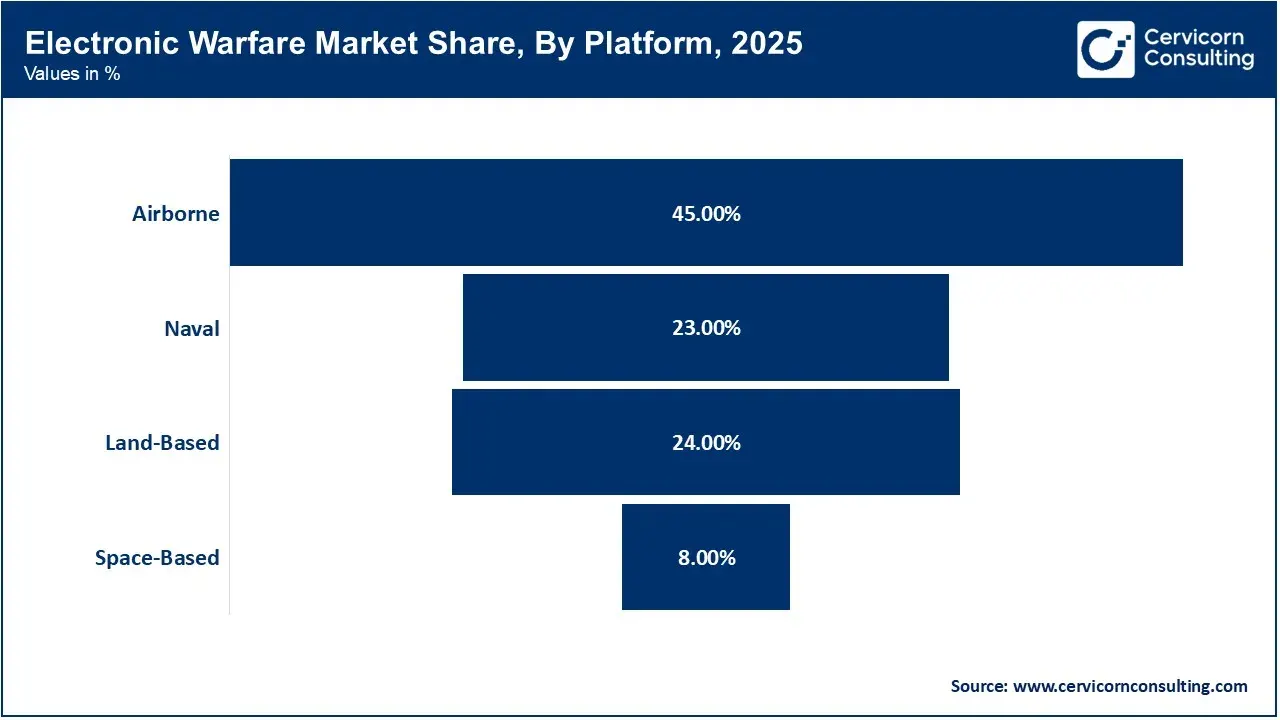
Space-based platforms are expected to be the fastest-growing segment as space-based intelligence, surveillance, communications, and electromagnetic operations become more and more important to military forces. Opportunities for sophisticated space-based EW capabilities are being created by the increasing use of satellites for monitoring and signal detection.
Investment in the space sector is being further stimulated by growing competition. Space-enabled EW technologies are becoming more and more in demand as satellite-based situational awareness gains importance. It is anticipated that developments in onboard processing and satellite systems will bolster segment expansion.
Technology Analysis
Receivers and signal processing technologies dominated the market since they serve as the cornerstone for efficient signal identification, detection, interception, and analysis. To handle complicated and quickly changing electromagnetic signals, modern EW systems need sophisticated processing capabilities. Adoption is also being aided by the growing need for real-time threat identification. Threats can now be identified more quickly and precisely thanks to advancements in digital signal processing. The demand for sophisticated receiver technologies is rising along with the volume and complexity of electromagnetic signals.
AI and machine learning-enabled/cognitive EW technologies are expected to be the fastest-growing segment, motivated by the growing demand for signal analysis, adaptive responses, and automated threat detection. With the help of these technologies, EW systems can process massive amounts of signals and react to evolving threats more effectively. Adoption is being accelerated by growing investments in software-defined and autonomous defense systems. AI-based systems can speed up response times and enhance decision-making in challenging electromagnetic environments. More opportunities are anticipated as interest in adaptive and self-learning EW solutions grows.
Application Analysis
Electronic intelligence and surveillance dominated the application segment because of the increasing need for ongoing electromagnetic activity detection and monitoring. These features enhance battlefield awareness and offer useful information about possible threats. The market is getting stronger due to the growing demand for military operations that are intelligence-driven. Defense forces are able to collect and analyze signals from ever-more complex environments thanks to advanced surveillance systems. Widespread adoption is also being supported by the necessity of early threat identification.
Electronic Warfare Market Share, By Application, 2025 (%)
| Application |
Revenue Share, 2025 (%) |
| Electronic Intelligence & Surveillance |
16% |
| Communication Intelligence |
10% |
| Radar & Signal Detection |
13% |
| Threat Warning & Identification |
12% |
| Jamming & Deception |
17% |
| Countermeasure Operations |
11% |
| Electromagnetic Spectrum Management |
8% |
| Cyber-Electromagnetic Operations |
6% |
| Counter-UAS Operations |
7% |
Counter-UAS operations are expected to be the fastest-growing segment because drones are being used in military and security operations at an increasing rate. Unauthorized or hostile unmanned aerial systems can be identified, interfered with, and neutralized using electronic warfare technologies. Defense forces are investing in cutting-edge counter-UAS solutions as concerns about drone-based surveillance and attacks grow.
The need for efficient countermeasures is growing as autonomous and inexpensive drones are used more frequently. Counter-UAS capabilities are being further expanded by integrating EW with radar, sensors, and other detection technologies.
End User Analysis
The air force dominated the end-user segment because radar protection, threat detection, electronic attack, and mission survivability all heavily depend on EW capabilities for airborne platforms. Demand is rising due to the modernization of fighter aircraft and specialized electronic warfare platforms. The market is being further supported by rising investments in cutting-edge airborne defense systems. EW technologies are becoming more and more in demand as aircraft employ more advanced radar and communication systems. Additionally, air forces are concentrating on increasing their operational efficacy in electromagnetic environments that are hotly contested.
Electronic Warfare Market Share, By End User, 2025 (%)
| End User |
Revenue Share, 2025 (%) |
| Army / Land Forces |
30% |
| Air Force |
26% |
| Navy |
21% |
| Space Forces |
7% |
| Intelligence & Homeland Security Agencies |
8% |
| Defense Ministries & Procurement Agencies |
6% |
| Others |
2% |
The navy is expected to be the fastest-growing segment as maritime forces concentrate more on defending ships and naval operations against advanced electromagnetic threats. Demand is being supported by the increasing use of EW systems on warships, submarines, and naval aircraft. More opportunities are anticipated due to the growing significance of electromagnetic dominance in contested maritime environments. Improved capabilities for identifying and thwarting radar and communication threats are necessary for modern naval operations. EW system adoption is being further aided by rising investments in cutting-edge naval platforms.
Government Initiatives
- In 2025, the U.S. Department of Defense: Through investments in spectrum management, electromagnetic battle management, data analytics, and cutting-edge digital capabilities, the Department of Defense has continued to bolster electromagnetic spectrum operations. These programs aid in the advancement of technologies for electronic warfare and spectrum dominance, as well as military preparedness.
- In 2025, the Ministry of Defence: With a focus on creating cutting-edge electronic warfare, electronic surveillance, communication, and countermeasure technologies, India continued to encourage domestic defense production through the Ministry of Defense and DRDO. By supporting domestic defense manufacturing, these programs lessen reliance on imported EW systems.
- In 2026, the U.S. Department of Defense: Electromagnetic spectrum superiority, including enhanced spectrum awareness, battle management, AI-enabled analysis, and sophisticated electronic warfare capabilities, was still emphasized in defense planning. The demand for next-generation EW technologies is anticipated to be supported by this kind of government investment.
Recent Developments
- In September 2026, Bharat Electronics Limited (BEL) received a boost from India’s latest defence procurement approvals, which include ground-based multi-purpose jammers and other electronic warfare-related systems. The development strengthens the demand for indigenous EW solutions and supports India’s focus on defence self-reliance. It also creates opportunities for domestic defence-electronics companies to expand their EW capabilities.
- In May 2026, Tonbo Imaging secured an Indian Navy contract under the ADITI 3.0 innovation framework for the integration and commissioning of a high-power microwave system for naval platforms. The technology can support counter-drone and electromagnetic warfare operations in complex defence environments. The development reflects India's increasing focus on indigenous advanced electronic and directed-energy defence technologies.
- In September 2025, BAE Systems and Lockheed Martin announced a strategic collaboration between their advanced research divisions to explore autonomous uncrewed systems and technologies for contested environments. The collaboration focuses on developing new capabilities that can operate effectively where electronic warfare and other battlefield threats are present. It also highlights the growing connection between autonomous systems and next-generation electronic warfare capabilities.
Top Companies
Segments Covered
By Capability
- Electronic Support
- Electronic Attack
- Electronic Protection
- Electronic Intelligence / Signals Intelligence
By Product
- EW Equipment
- EW Operational Support
By Equipment Type
- Jammers
- Countermeasure Systems
- Decoys
- Directed Energy Weapons
- Receivers
- Radar Warning Receivers
- Electronic Support Measures
- Others
By Platform
- Airborne
- Naval
- Land-Based
- Space-Based
By Technology
- Antennas
- Receivers & Signal Processing
- Anti-Jam Systems
- Radar Warning Systems
- Electronic Countermeasure Systems
- Directed Energy
- Infrared Missile Warning
- AI & Machine Learning-Enabled EW
- Cognitive / Software-Defined EW
- Others
By Application
- Electronic Intelligence & Surveillance
- Communication Intelligence
- Radar & Signal Detection
- Threat Warning & Identification
- Jamming & Deception
- Countermeasure Operations
- Electromagnetic Spectrum Management
- Cyber-Electromagnetic Operations
- Counter-UAS Operations
By End User
- Army / Land Forces
- Air Force
- Navy
- Space Forces
- Intelligence & Homeland Security Agencies
- Defense Ministries & Procurement Agencies
- Other Government Agencies
By Region
- North America
- Europe
- Asia Pacific
- Middle East & Africa
- Latin America