Digital Twin in Semiconductor Market Size and Growth Outlook 2026 to 2035
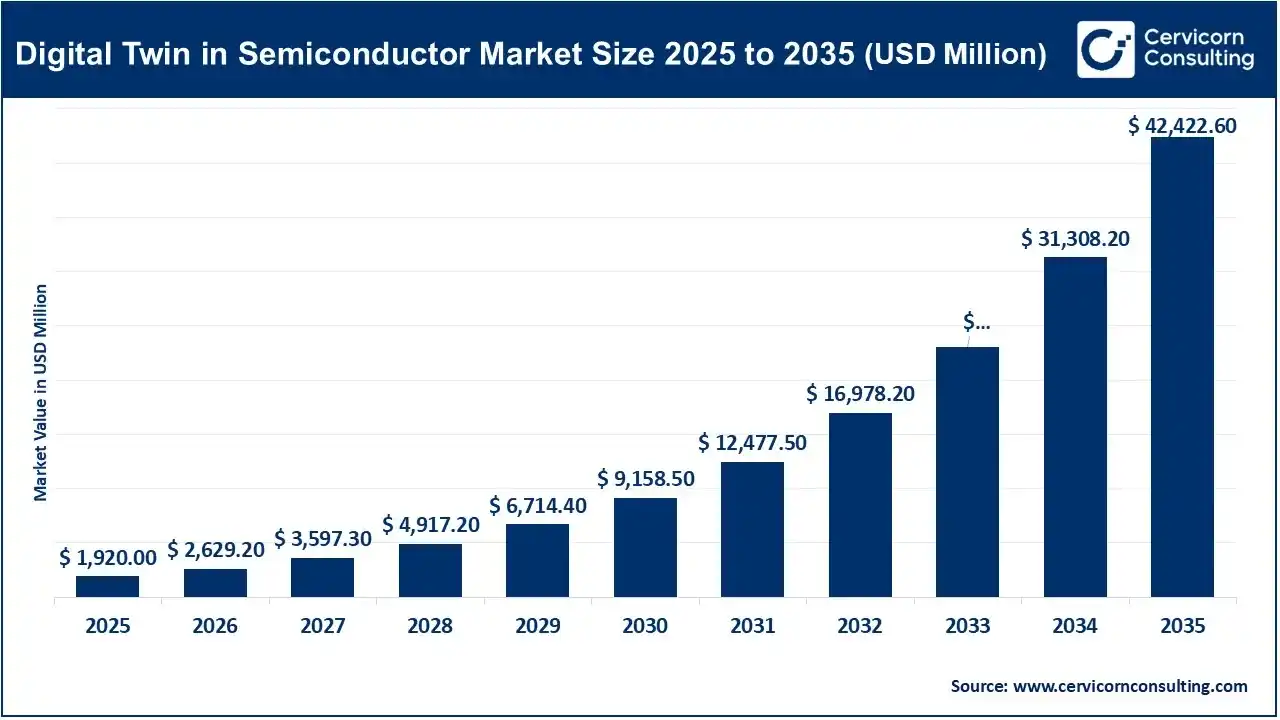
The digital twin in semiconductor market size was valued at USD 1,920 million in 2025 and is projected to grow from USD 2,629.2 million in 2026 to nearly USD 42,422.6 million by 2035, registering a CAGR of 36.2% over the forecast period 2026 to 2035. The market is growing due to the increasing adoption of virtual simulation, real-time monitoring, and AI-driven optimization in semiconductor manufacturing.
Report Highlights
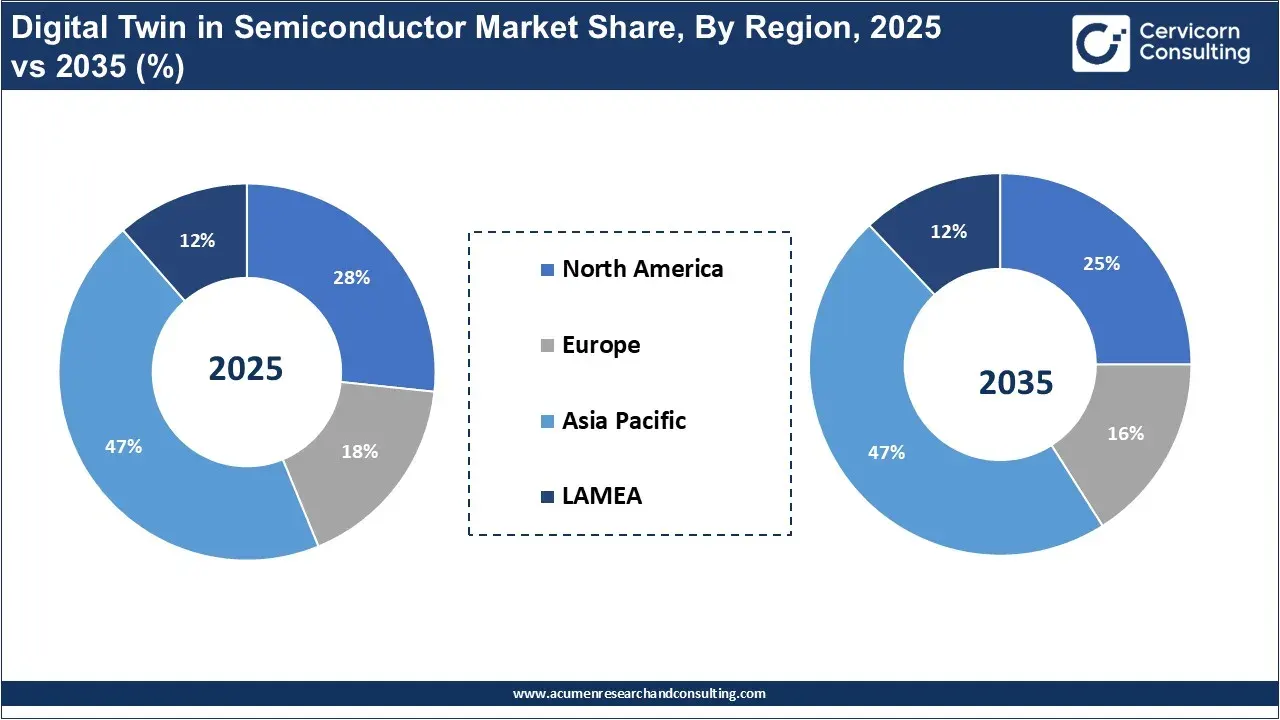
- By region, Asia-Pacific dominated the digital twin in semiconductor market with a 42% share in 2025, backed by its strong semiconductor manufacturing base, advanced fabrication facilities, and expanding adoption of smart manufacturing technologies.
- By region, Latin America and Middle East & Africa are the fastest-growing regions with a 36.2% CAGR each during the forecast period, supported by increasing investments in digital transformation, modern manufacturing, and localized semiconductor infrastructure.
- By component, software dominated the digital twin in semiconductor market with a 72% share in 2025, driven by increasing adoption of real-time monitoring, analytics, modeling, and simulation platforms.
- By component, services is the fastest-growing segment with a 38.2% CAGR, supported by rising demand for implementation, integration, consulting, maintenance, and technical support.
- By digital twin type, process dominated the digital twin in semiconductor market with a 48% share in 2025, owing to its growing use for process optimization, yield improvement, real-time monitoring, and operational efficiency.
- By digital twin type, product is the fastest-growing segment with a 38.6% CAGR, driven by increasing semiconductor complexity and the need for faster product design, testing, validation, and performance optimization.
- By deployment mode, on-premises dominated the digital twin in semiconductor market with a 42% share in 2025, supported by manufacturers' need for greater data security, infrastructure control, and integration with existing production systems.
- By deployment mode, cloud held the second-largest share at 34% in 2025, driven by demand for flexible deployment, remote access, collaborative simulation, and scalable computing capabilities.
- By fab type, front-end dominated the digital twin in semiconductor market with a 72% share in 2025, fueled by the complexity of wafer manufacturing and the need for continuous equipment monitoring, process optimization, predictive maintenance, and yield enhancement.
- By fab type, back-end held the second-largest share at 23% in 2025, supported by increasing digitalization of semiconductor testing, packaging, assembly, quality control, and production scheduling
- By end user, foundries dominated the digital twin in semiconductor market with a 28% share in 2025, driven by the need to manage high-volume production, improve yields, reduce downtime, and optimize complex fabrication processes.
- By end user, idms held the second-largest share at 25% in 2025, supported by growing use of digital twins across semiconductor design, engineering, process development, and manufacturing workflows.
What Is Driving the Growth of the Digital Twin in Semiconductor Market?
The digital twin in semiconductor market is growing due to the growing use of AI-driven optimization, real-time monitoring, and virtual simulation in semiconductor design and manufacture. To increase operational efficiency, anticipate equipment problems, optimize processes, and minimize downtime, semiconductor businesses can use digital twin technology to build virtual replicas of machinery, manufacturing processes, and facilities. The market is expanding due to the increasing complexity of semiconductor manufacturing, the need for sophisticated chips, and the growth of smart manufacturing.
- In July 2026, Silvaco announced a collaboration with NVIDIA to advance physics-based digital twins for semiconductor design and manufacturing, combining semiconductor simulation with AI and accelerated computing to improve prediction, optimization, and validation.
Recent Trends
- AI integration: Digital twins are increasingly combined with AI to improve process optimization and decision-making.
- Predictive maintenance: Manufacturers use digital twins to detect equipment issues early and reduce downtime.
- Yield optimization: Digital twins help identify production issues and improve wafer yield.
- Real-time monitoring: Connected equipment and sensors enable real-time monitoring of semiconductor processes.
- Virtual simulation: Companies use digital twins to test processes and equipment virtually before implementation.
- Smart manufacturing: Digital twins are supporting the development of automated and connected semiconductor fabs.
- Energy optimization: Digital twins help monitor energy use and improve efficiency across semiconductor facilities.
Government Initiatives
- In January 2025, the U.S. Department of Commerce awarded $285 million to establish and operate the SMART USA institute focused on digital twins for semiconductor design, manufacturing, advanced packaging, assembly, and testing. The initiative aims to accelerate semiconductor development, improve production efficiency, and support workforce training in digital-twin technologies.
- In January 2025, the U.S. Department of Commerce finalized a long-term partnership with Natcast to operate the National Semiconductor Technology Center under the CHIPS for America program. The initiative supports semiconductor research and development, reduces prototyping time and costs, and strengthens the domestic semiconductor technology ecosystem.
- In October 2025, the UK government published an official definition for digital twins to establish a common understanding of the technology and encourage wider adoption. The initiative supports the development of digital twins that can securely exchange information with real-world systems and improve data-driven decision-making.
- In June 2026, the European Commission proposed the Chips Act 2.0 as part of a broader package to strengthen Europe's semiconductor ecosystem and reduce strategic dependencies. The initiative supports advanced chip production, semiconductor supply-chain resilience, and greater technological capability across Europe.
Market Dynamics
Driver: Why Is the Growing Complexity of Semiconductor Manufacturing Driving the Digital Twin Market?
The need for digital twin technology is being driven by the growing complexity of semiconductor manufacturing. Manufacturers can electronically replicate machinery, procedures, and production settings with the use of digital twins, which enhance process optimization, lower mistake rates, and facilitate quicker decision-making. Adoption is being aided by the increasing need to increase production precision, efficiency, and yield.
- In August 2026, Silvaco announced a partnership with Dassault Systèmes to develop connected digital twin workflows for semiconductor manufacturing, helping manufacturers improve process development, accelerate yield ramps, and make better manufacturing decisions before committing costly fab resources.
Restraint: Why Does the High Cost and Complexity of Digital Twin Implementation Restrain Market Growth?
Market expansion may be hampered by the high expense and difficulty of deploying digital twin systems. It takes sophisticated software, sensors, computing infrastructure, and integration with current production techniques to create accurate virtual models. Implementation difficulties may also increase due to the requirement for qualified experts and trustworthy real-time data, especially for smaller semiconductor makers.
- In January 2026, Siemens introduced Digital Twin Composer to connect digital twin data with real-time physical information, addressing the challenge of bringing different engineering and operational data sources together in a unified environment.
Opportunity: How Can AI Integration Create Opportunities for the Digital Twin in Semiconductor Market?
The semiconductor industry is seeing new potential as a result of the integration of AI with digital twins. AI can evaluate data from both virtual and real-world settings to enhance simulations, forecast process results, spot possible problems, and streamline industrial processes. Digital twin applications are anticipated to rise due to the increasing use of AI-driven semiconductor design and smart-factory technologies.
Regional Analysis
- The North America digital twin in semiconductor market size was valued at USD 537.60 million in 2025 and is projected to reach USD 10.605.70 million by 2035, registering a CAGR of 34.5% from 2026 to 2035.
- The Europe digital twin in semiconductor market size was estimated at USD 345.60 million in 2025 and is expected to hit USD 6,787.60 million by 2035, with a CAGR of 34.4% from 2026 to 2035.
- The Asia-Pacific digital twin in semiconductor market size was accounted for USD 806.40 million in 2025 and is forecasted to surge USD 19,938.60 million by 2035, reflecting a CAGR of 37.9%.
- The LAMEA digital twin in semiconductor market was valued at USD 230.40 million in 2025 and is anticipated to surpass USD 5,090.70 million by 2035, accelerating a CAGR of 36.2% from 2026 to 2035.
Asia-Pacific Leads Digital Twin Adoption in Semiconductor Manufacturing
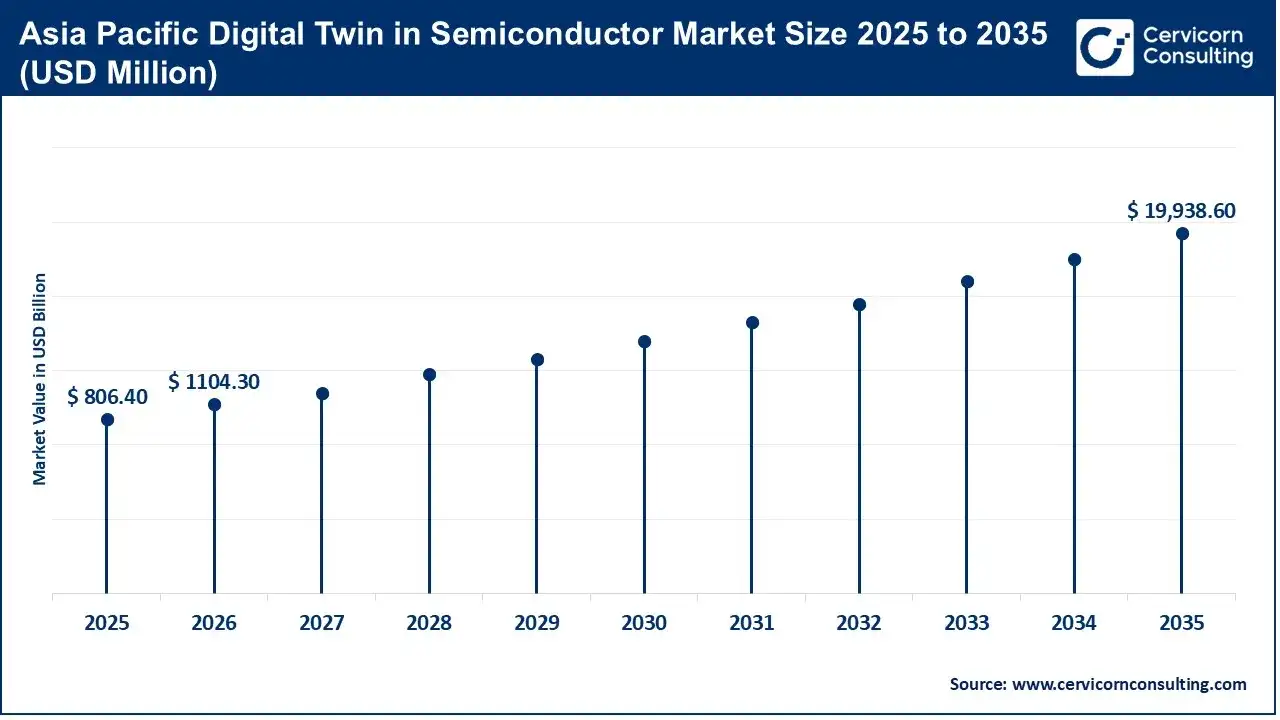
Asia-Pacific dominated the digital twin in semiconductor market with a 42% share in 2025, supported by its sophisticated fabrication facilities, strong semiconductor manufacturing base, and growing adoption of smart manufacturing technologies. Regional demand is further strengthened by major semiconductor manufacturers and increasing investments in advanced chip fabrication. The expansion of semiconductor fabs, combined with greater use of automation, artificial intelligence, and data-driven manufacturing, is creating additional opportunities for digital twin technologies across the region.
At the country level, China, Taiwan, South Korea, and Japan represent major markets within Asia-Pacific. Taiwan benefits from its concentration of advanced semiconductor foundries and increasing investments in next-generation fabrication, creating demand for digital twins to optimize production processes, equipment performance, and yield.
South Korea's large-scale semiconductor manufacturing ecosystem and investments in advanced memory and logic technologies are supporting adoption, while Japan's established semiconductor equipment and materials industries are encouraging the integration of digital twins into increasingly automated manufacturing environments. China is also expanding its domestic semiconductor manufacturing capabilities, creating opportunities for digital twin solutions across new and upgraded fabrication facilities.
Latin America and Middle East & Africa Emerging as High-Growth Digital Twin Markets
Latin America and Middle East & Africa are the fastest-growing regions in the digital twin in semiconductor market, with both regions recording a 36.2% CAGR during the forecast period. Increasing investments in digital technologies, modern manufacturing infrastructure, and semiconductor capabilities are supporting regional expansion. Efforts to improve production efficiency, modernize industrial facilities, and develop localized semiconductor capabilities are expected to encourage greater adoption of digital twin technologies.
At the country level, Brazil, Mexico, Saudi Arabia, the United Arab Emirates, and Israel are key markets shaping regional opportunities. In Latin America, Mexico's expanding electronics and advanced manufacturing ecosystem provides opportunities for digital twins in semiconductor-related production, while Brazil's investments in technology and domestic industrial capabilities support longer-term adoption.
In the Middle East & Africa, Saudi Arabia and the UAE are investing in advanced digital infrastructure and industrial transformation, creating a foundation for smart manufacturing technologies. Israel's established semiconductor design, technology, and innovation ecosystem further supports demand for digital twin applications focused on simulation, process optimization, and advanced manufacturing.
Segmental Analysis
Component Analysis
Software dominated the digital twin in semiconductor market with a 72% share in 2025, fueled by the expanding use of real-time monitoring platforms, analytics, modeling, and simulation. Before making modifications to physical systems, manufacturers can use software to optimize semiconductor processes and generate virtual duplicates. The capabilities of digital twin software are being further enhanced by the increasing integration of AI, machine learning, and sophisticated analytics.
Digital Twin in Semiconductor Market Share, By Component, 2025 & 2035 (%)
| Component |
Revenue Share, 2025 (%) |
Revenue Share, 2035 (%) |
| Software |
72% |
68% |
| Services |
28% |
32% |
Services is the fastest-growing segment, with a 38.2% CAGR. As semiconductor businesses embrace increasingly sophisticated digital twin solutions, there is a growing need for implementation, integration, consultancy, maintenance, and technical support. The need for specialized services is rising due to the requirement for tailored implementation and integration with current manufacturing infrastructure.
Digital Twin Type Analysis
Process dominated the digital twin in semiconductor market with a 48% share in 2025. Process-level digital twins are being used by manufacturers more and more to model production activities, optimize manufacturing parameters, increase yield, and minimize operational problems. Manufacturers can also test production modifications online and find inefficiencies with the use of process digital twins. Adoption in semiconductor factories is being accelerated by their capacity to facilitate real-time monitoring and process improvement.
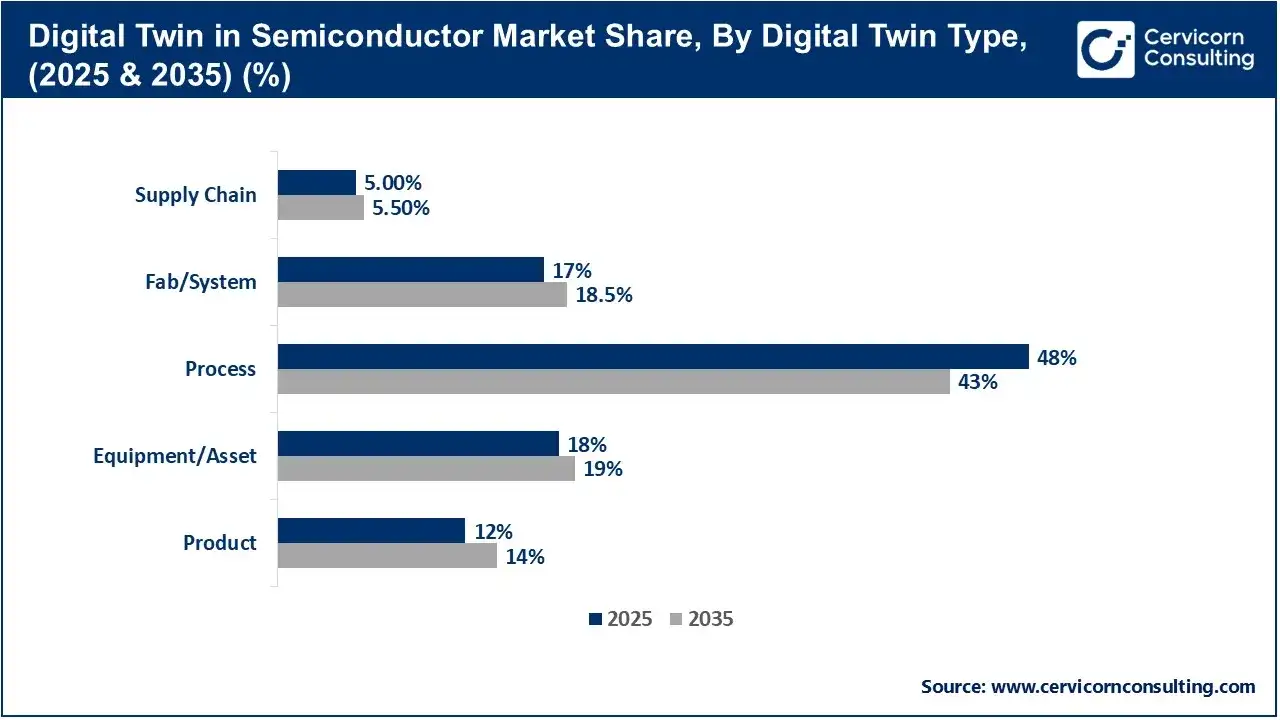
Product is the fastest-growing segment, with a 38.6% CAGR. As chip complexity rises, the usage of digital twins for semiconductor product design, testing, validation, and performance improvement is growing. The use of product digital twins is growing due to increased demand for quicker product development and early detection of design flaws.
Deployment Mode Analysis
On-Premises dominated the digital twin in semiconductor market with a 42% share in 2025, backed by the requirement for increased security, integration with current production systems, and management over critical manufacturing data. In order to handle vital manufacturing and operational data, semiconductor manufacturers frequently need specialized infrastructure. On-premises implementation is still supported by the requirement for data protection and control over production settings.
Digital Twin in Semiconductor Market Share, By Deployment Mode, 2025 (%)
| Deployment Mode |
Revenue Share, 2025 (%) |
| On-Premises |
42% |
| Cloud |
34% |
| Hybrid |
24% |
Cloud held the second-largest share at 34% in 2025, encouraged by the growing need for flexible digital twin deployment, remote access, collaborative simulation, and scaled computing. Large amounts of operational and simulation data can be processed by manufacturers using cloud platforms without the need for substantial on-site hardware. This market is anticipated to be further supported by the increasing use of cloud computing and linked manufacturing.
Fab Type Analysis
Front-End dominated the digital twin in semiconductor market with a 72% share in 2025, due to the intricacy of wafer manufacturing and the increasing demand for equipment monitoring, process optimization, predictive maintenance, and yield enhancement. Front-end manufacturing entails extremely intricate procedures that call for constant observation and exact control. Manufacturers can use digital twins to model production circumstances and spot any problems before they have an impact on actual operations.
Digital Twin in Semiconductor Market Share, By Fab Type, 2025 (%)
| Fab Type |
Revenue Share, 2025 (%) |
| Front-End |
72% |
| Back-End |
23% |
| Others |
5% |
Back-End held the second-largest share at 23% in 2025, encouraged by the growing use of digital technologies in testing, packaging, and semiconductor assembly processes. Virtual modeling and process optimization are becoming more and more necessary as modern packaging becomes more complex. Additionally, digital twins can enhance back-end operations' quality control, production scheduling, and equipment usage.
End User Analysis
Foundries dominated the digital twin in semiconductor market with a 28% share in 2025, motivated by the need to effectively manage high-volume production, increase yield, decrease downtime, and optimize complicated manufacturing processes. Foundries run complex manufacturing settings where process optimization and real-time monitoring are essential. The employment of digital twins in fabrication activities is being further encouraged by the growing demand for sophisticated semiconductor nodes.
Digital Twin in Semiconductor Market Share, By End User, 2025 (%)
| End User |
Revenue Share, 2025 (%) |
| Foundries |
28% |
| IDMs |
25% |
| Fabless |
12% |
| OSAT |
8% |
| Equipment OEMs |
15% |
| EDA/Software |
6% |
| Research Institutes |
4% |
| Others |
2% |
IDMs held the second-largest share at 25% in 2025, backed by their increased use of digital twin technologies in production and process development, as well as their integrated semiconductor design and manufacturing processes. To increase operational efficiency, digital twins can link the design, engineering, and production workflows. Additionally, their utilization facilitates process simulation, predictive maintenance, and the quicker creation of new semiconductor devices.
Recent Developments
- In August 2025, Tokyo Electron announced advancements in digital twin technology for semiconductor production equipment. The technology uses virtual replicas to forecast equipment behavior, test process conditions, and optimize semiconductor manufacturing before physical implementation. It also supports virtual experiments and process optimization, helping manufacturers improve production efficiency.
- In August 2026, Silvaco announced a partnership with Dassault Systèmes to develop connected digital twin workflows for semiconductor manufacturing. The collaboration aims to improve process development, accelerate yield ramps, and support better manufacturing decisions before costly fab resources are committed.
Top Companies
Segments Covered
By Component
By Digital Twin Type
- Product
- Equipment/Asset
- Process
- Fab/System
- Supply Chain
By Deployment Mode
By Fab Type
By End User
- Foundries
- IDMs
- Fabless
- OSAT
- Equipment OEMs
- EDA/Software
- Research Institutes
- Other
By Region
- North America
- Europe
- Asia-Pacific
- Latin America
- Middle East & Africa