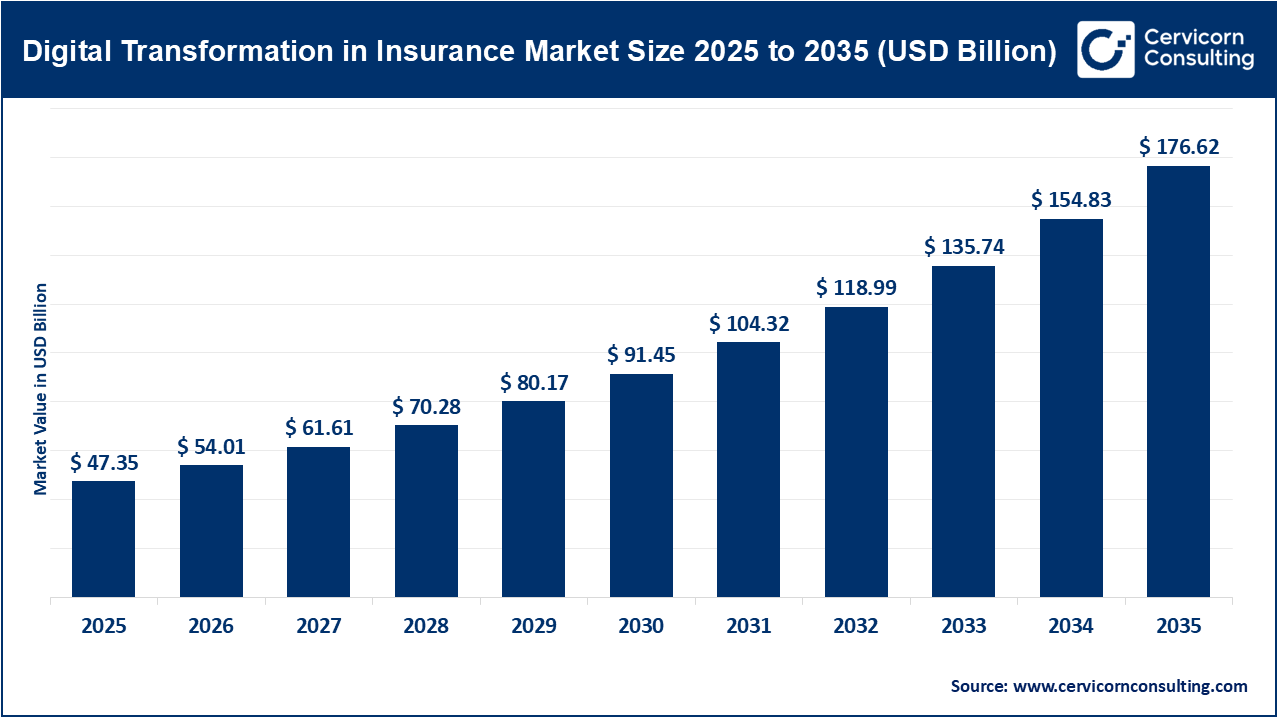
The global digital transformation in insurance market size was valued at USD 47.35 billion in 2025 and is expected to surpass around USD 176.62 billion by 2035, exhibiting at a compound annual growth rate (CAGR) of 14.1% over the forecast period from 2026 to 2035. The digital transformation in insurance market is primarily driven by the need to improve customer experience, operational efficiency, and speed to market in an increasingly competitive environment. Customers now expect seamless, omnichannel, and personalized insurance journeys similar to those offered by digital-native companies, pushing insurers to adopt AI, cloud computing, big data analytics, and mobile platforms. Rising volumes of structured and unstructured data from sources such as IoT devices, telematics, and wearables are enabling more accurate risk assessment, dynamic pricing, and real-time underwriting. At the same time, insurers face growing pressure to reduce operational costs and error rates, which is accelerating the adoption of automation, robotic process automation (RPA), and straight-through processing across underwriting, policy administration, and claims management.
Growth in this market is further supported by regulatory modernization, ecosystem partnerships, and the expansion of InsurTech collaboration models. Regulators in many regions are encouraging digital reporting, e-KYC, and data transparency, making digital infrastructure a necessity rather than an option. Cloud-based core system modernization allows insurers to replace legacy systems with scalable, flexible platforms that support faster product launches and integration with third-party ecosystems. Additionally, increasing investment in InsurTech startups and strategic partnerships between traditional insurers and technology providers are accelerating innovation across health, life, and property & casualty insurance lines. Together, these factors are driving sustained long-term growth in digital transformation spending across the global insurance industry.
Report Highlights
- By Region, North America leads the market with a 39.2% share, driven by early adoption of AI and cloud technologies, strong InsurTech presence, and high digital investment by insurers.
- By Technology, cloud computing dominates with a 28% share, supported by large-scale legacy system migration and growing use of SaaS-based insurance platforms.
- By Solution Type, policy administration systems hold the largest share at 22%, due to strong demand for core system modernization and automated policy management.
- By Deployment Mode, cloud-based deployment accounts for 72% of the market, driven by scalability, lower costs, and faster implementation.
- By End User, insurance companies lead with a 65% share, as they remain the primary adopters of digital transformation technologies.
Rapid Adoption of AI-Driven Automation Across Insurance Operations
The rapid adoption of AI-driven automation is a major trend accelerating growth in the digital transformation in insurance market. Insurers are increasingly implementing artificial intelligence and machine learning solutions to automate underwriting, claims processing, fraud detection, and customer service operations. These technologies significantly reduce manual effort, shorten turnaround times, and improve accuracy in decision-making. As customer expectations for faster and more transparent services continue to rise, AI-enabled automation is becoming a critical component of insurers’ digital strategies.
In addition to operational efficiency, AI-driven automation enables insurers to leverage large volumes of data for predictive analytics and personalized offerings. Real-time risk assessment, dynamic pricing models, and automated claims settlement enhance customer experience while improving profitability. The scalability of AI solutions, combined with cloud deployment, allows insurers of all sizes to adopt advanced capabilities with lower upfront investment. This trend is driving sustained technology spending and strengthening long-term market growth.
Recent Investments Activity in the Digital Transformation in Insurance Market
| Company |
Investment |
Description |
| FurtherAI |
USD 25 Mn Series A |
Raised funding led by Andreessen Horowitz to scale AI-powered automation in commercial insurance workflows, accelerating document processing, intake, and claims automation. |
| InsuranceDekho |
USD 70 Mn funding round |
Indian insurtech raised USD 70 million backed by Beams Fintech Fund, MUFG, and BNP Paribas Cardif to enhance digital insurance offerings and platform expansion. |
| Norm AI |
USD 48 Mn funding |
Secured capital for AI-driven compliance and regulatory automation tools, strengthening insurer digital operations and governance solutions. |
| Nirvana Insurance |
USD 80 Mn Series C |
California-based startup raised USD 80 million, boosting its trucking and specialty insurance platform capabilities with tech enhancements. |
| Peak3 |
USD 35 Mn Series A |
Funding to accelerate SaaS insurance tech expansion in UK/EU markets, strengthening digital insurance delivery and operations. |
| Azos |
USD 30.5 Mn Series B |
Brazilian insurtech raised Series B to expand life insurance tech and market reach in Latin America. |
| Korint Insurtech |
EUR 5 Mn funding |
European insurtech secured EUR 5 million to advance digital insurance transformation capabilities and platform growth. |
| Outmarket AI |
USD 4.7 Mn seed funding |
Seed round to develop AI-intelligent commercial insurance insights and workflow solutions. |
| Euroins Bulgaria (Eurohold) |
EUR 58.8 Mn capital increase |
Large insurer raised funds to support digital transformation initiatives and regional expansion. |
Recent Major Milestones
1. Launch of India’s Bima Sugam Digital Insurance Platform
India launched Bima Sugam, a unified digital insurance marketplace under the Insurance Regulatory and Development Authority of India (IRDAI), designed to digitize policy issuance, servicing, and claims across insurers on one platform. This initiative streamlines customer access to insurance products, reduces paperwork, and enhances transparency across the value chain—catalyzing wider adoption of digital channels and increasing overall insurance penetration in a large emerging market.
2. ZestyAI’s ZORRO Discover AI for Regulatory Insight
InsurTech ZestyAI introduced ZORRO Discover, an AI agent tailored to analyze complex regulatory documents using advanced language models, helping insurers navigate compliance and competitive landscapes more efficiently. By reducing manual effort and accelerating insights from regulatory data, this development helps insurers modernize compliance operations, lowers operational risk, and supports faster strategic responses—boosting confidence in digital capabilities.
3. SoundHound AI & Apivia Courtage Partnership for AI-Driven Contact Centers
SoundHound AI expanded its partnership with French insurer Apivia Courtage, deploying advanced conversational AI (Amelia 7) across contact centers to enhance customer engagement and automate service inquiries. This collaboration demonstrates how generative and conversational AI can elevate customer experience, reduce service costs, and improve operational responsiveness, encouraging broader investment in AI infrastructure across insurers.
4. India’s Insurance Policy Reforms Enabling Digital Growth (2025)
Recent policy reforms in India, including the Amendment of Insurance Laws allowing 100 % foreign direct investment and digital product initiatives like national claims exchanges, significantly boosted digital policy issuance, AI/ML underwriting, and customer engagement platforms. These reforms attract capital, foster competition, and drive digital innovation adoption—accelerating tech-led growth in one of the world’s fastest-growing insurance markets.
Market Dynamics
Market Drivers
- Rising Demand for Digital Customer Experience: Customers increasingly expect fast, seamless, and personalized insurance services across digital channels, similar to experiences offered by e-commerce and fintech platforms. This demand is pushing insurers to invest in mobile apps, AI-driven chatbots, digital onboarding, and omnichannel engagement tools. As customer satisfaction and retention become critical competitive differentiators, insurers are accelerating digital transformation initiatives to modernize customer journeys.
- Operational Efficiency and Cost Reduction Pressure: Insurers face ongoing pressure to reduce administrative costs, processing time, and human error while managing growing policy and claims volumes. Digital technologies such as AI, robotic process automation (RPA), and cloud-based core systems enable straight-through processing, faster claims settlement, and automated underwriting. These efficiencies directly improve profitability, making digital transformation a strategic necessity rather than a discretionary investment.
Market Restraint
- Legacy Systems and Integration Complexity: Many insurers still operate on legacy IT systems that are fragmented, inflexible, and costly to maintain. Integrating modern digital solutions with these systems is complex, time-consuming, and expensive, often requiring phased migration strategies. This slows down transformation timelines and discourages smaller or risk-averse insurers from fully embracing digital change.
- Data Privacy and Cybersecurity Concerns: Digital transformation increases insurers’ exposure to cyber threats, data breaches, and regulatory penalties related to data protection. The handling of sensitive personal, financial, and health data makes insurers prime targets for cyberattacks. Concerns over compliance with data privacy regulations and the cost of securing digital infrastructure can restrain adoption, particularly in highly regulated markets.
Market Opportunities
- AI-Driven Underwriting and Claims Automation: Advances in artificial intelligence and advanced analytics create strong opportunities to transform underwriting and claims processes. AI enables real-time risk assessment, personalized pricing, fraud detection, and automated claims settlement. These capabilities not only reduce costs but also improve accuracy and customer satisfaction, driving higher adoption of digital insurance platforms.
- Expansion in Emerging Markets through Digital Channels: Emerging economies present significant growth opportunities as digital platforms enable insurers to reach underserved populations at lower distribution costs. Mobile-based insurance, digital payments, and government-backed digital initiatives are accelerating insurance penetration in these regions. Digital transformation allows insurers to scale quickly without heavy physical infrastructure investment.
Market Challenges
- Skills Gap and Talent Shortage: Successful digital transformation requires expertise in data science, AI, cybersecurity, cloud architecture, and digital product design. Many insurers struggle to attract and retain this talent, especially when competing with technology firms and startups. This skills gap can delay implementation, increase reliance on external vendors, and reduce the effectiveness of digital initiatives.
- Change Management and Cultural Resistance Digital transformation often requires fundamental changes in organizational culture, workflows, and decision-making processes. Resistance from employees accustomed to traditional processes can slow adoption and reduce return on investment. Managing change across large, complex insurance organizations remains a key challenge, requiring strong leadership and long-term commitment.
Regional Analysis
The digital transformation in insurance market is segmented into various regions, including North America, Europe, Asia-Pacific, and LAMEA. Here is a brief overview of each region:
North America Digital Transformation in Insurance Market: Driven by InsurTech Innovation and Digital Investment
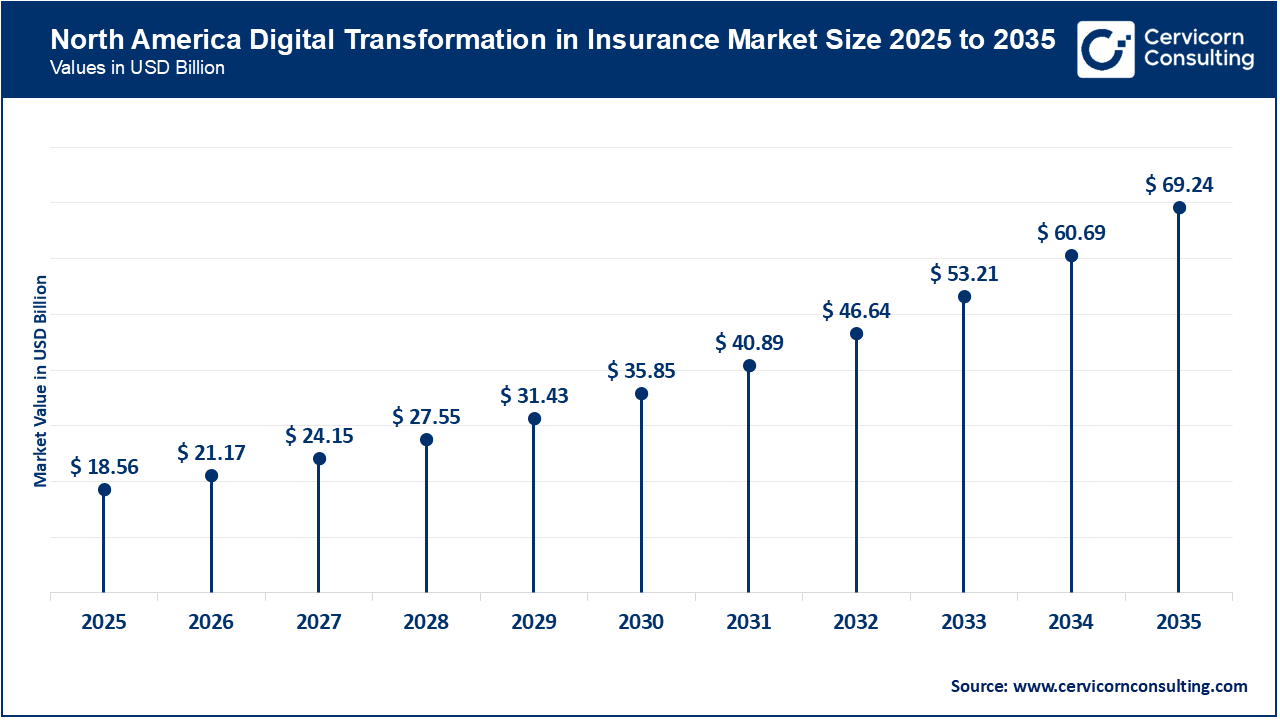
The North America digital transformation in insurance market size was valued at USD 18.56 billion in 2025 and is predicted to surpass around USD 69.24 billion by 2035. North America remains a dominant force in the digital transformation of insurance largely due to its strong technological infrastructure, extensive InsurTech ecosystem, and high levels of digital investment from both incumbents and startups. Insurers in the region lead in adopting advanced analytics, AI-driven underwriting, cloud migration, and automated claims — supported by favorable regulatory environments and significant venture capital inflows. The region’s mature digital payment and mobile penetration further enhance customer expectations, accelerating digital adoption across life, health, and property & casualty insurers. North America’s ecosystem fosters rapid scaling of digital platforms, making it a global hub for innovation and strategic partnerships in insurance technology.
Recent Developments:
- A major insurer launches an AI-powered claims automation platform to reduce settlement time.
- U.S. regulatory sandbox initiatives expand to include digital insurance product testing.
Asia-Pacific (APAC) Digital Transformation in Insurance Market: Driven by Rapid Digital Adoption and Government Support
The Asia-Pacific digital transformation in insurance market size was estimated at USD 9.42 billion in 2025 and is forecasted to grow around USD 35.15 billion by 2035. Asia-Pacific is growing at the fastest pace in the market, propelled by the rapid adoption of mobile, cloud, and data analytics technologies alongside strong government support for fintech and digital inclusion. Countries such as China, India, and Japan are witnessing rising demand for AI-powered claims processing, digital policy platforms, and embedded insurance within large-scale digital ecosystems. Government initiatives, digital identity programs, and regulatory sandboxes help reduce barriers to innovation, while demographic shifts and expanding middle classes increase insurance penetration through digital channels. The region’s combination of entrepreneurial InsurTech activity and supportive policy frameworks is accelerating digital transformation more dramatically than in other regions.
Recent Developments:
- Aon India announces strategic digital transformation plans with expanded digital risk platforms.
- Major Japanese insurer opens a global tech capability center in India focused on AI.
Europe Digital Transformation in Insurance Market: Driven by Regulatory Support for Digital and Customer-Centric Models
The Europe digital transformation in insurance market size was reached at USD 14.25 billion in 2025 and is projected to hit around USD 53.16 billion by 2035. Europe is driven by regulatory frameworks such as GDPR and Solvency II that promote digital customer experiences, data protection, and operational transparency. European insurers are increasingly investing in omnichannel platforms, advanced analytics, and InsurTech partnerships to meet evolving consumer demands for personalized, secure, and efficient services. The push toward sustainability reporting and digital compliance tools also adds momentum to transformation programs, while federated data initiatives enable better risk modeling and fraud detection. Europe’s strong emphasis on digital trust and customer rights creates a fertile environment for digital solutions that enhance both compliance and experience.
Recent Developments:
- EU regulatory updates push digital KYC and e-signature standards across insurance products.
- InsurTech incubators launch in key cities (London, Berlin) focusing on embedded insurance.
Digital Transformation in Insurance Market Share, By Region, 2025 (%)
| Region |
Revenue Share, 2025 (%) |
| North America |
39.2% |
| Europe |
30.1% |
| Asia-Pacific |
19.9% |
| LAMEA (Latin America, Middle East & Africa) |
10.8% |
LAMEA (Latin America, Middle East & Africa) Digital Transformation in Insurance Market: Driven by Innovation Hubs and Emerging Market Digitization
The LAMEA digital transformation in insurance market was valued at USD 5.11 billion in 2025 and is anticipated to reach around USD 9.07 billion by 2035. The LAMEA is driven by innovation hubs, rising InsurTech ecosystems, and the need to expand insurance access to underserved populations. In Latin America, insurers are partnering with banks and startups to introduce microinsurance and AI-based claims platforms, leveraging mobile penetration and digital wallets for broader reach. Middle Eastern financial centers like Dubai’s DIFC are fostering regulatory sandboxes that allow startups to test digital models, while African markets are exploring mobile-first insurance solutions adapted to local needs. Growth in LAMEA is supported both by demand for inclusive insurance and accelerating digital infrastructure.
Recent Developments:
- Mapfre designates Brazil as a global innovation hub for insurance tech
- Dubai’s DIFC regulatory sandbox expands support for cross-border InsurTech pilots.
Segmental Analysis
The digital transformation in insurance market is segmented into technology, solution type, deployment mode, end user, and region.
Technology Analysis
Cloud computing dominates the market as it forms the foundation for modernizing legacy systems and enabling enterprise-wide digital operations. Insurers increasingly rely on cloud platforms to achieve scalability, cost efficiency, faster deployment, and seamless integration with advanced technologies such as AI and analytics. Cloud adoption supports core functions including policy administration, claims processing, and customer engagement while ensuring regulatory compliance and business continuity. Hybrid and public cloud models are especially preferred by large insurers seeking flexibility, resilience, and innovation at scale.
Digital Transformation in Insurance Market Share, By Technology, 2025 (%)
| Technology |
Revenue Share, 2025 (%) |
| Artificial Intelligence (AI) & Machine Learning |
24% |
| Big Data & Advanced Analytics |
18% |
| Cloud Computing |
28% |
| Internet of Things (IoT) |
12% |
| Blockchain |
8% |
| Robotic Process Automation (RPA) |
10% |
Artificial intelligence and machine learning represent the fastest-growing technology segment due to their transformative impact on underwriting, claims automation, fraud detection, and personalized pricing. Insurers are rapidly adopting predictive analytics, computer vision, and generative AI to reduce processing time, improve decision accuracy, and enhance customer experience. Increasing data availability from digital channels, IoT devices, and customer interactions further accelerates AI adoption. As insurers pursue data-driven operations and automation, AI continues to attract significant investment and drives long-term market growth.
Solution Type Analysis
Policy administration systems dominate the solution segment as they serve as the operational backbone of insurance companies. Digital transformation initiatives typically prioritize upgrading these systems to manage policy issuance, renewals, endorsements, and cancellations more efficiently. Modern policy administration platforms enable automation, regulatory compliance, and real-time data access across multiple distribution channels. By improving operational efficiency and supporting new digital products, these systems play a critical role in enabling insurers to scale operations and deliver consistent customer experiences across life, health, and P&C insurance lines.
Digital Transformation in Insurance Market Share, By Solution Type, 2025 (%)
| Solution Type |
Revenue Share, 2025 (%) |
| Policy Administration Systems |
22% |
| Claims Management |
20% |
| Customer Relationship Management (CRM) |
14% |
| Risk & Compliance Management |
11% |
| Billing & Payment Solutions |
9% |
| Underwriting & Pricing Engines |
14% |
| Digital Distribution Platforms |
10% |
Digital distribution platforms are the fastest-growing solution segment as insurers increasingly shift toward direct-to-consumer models and online marketplaces. These platforms enable faster customer acquisition, lower distribution costs, and improved transparency across product offerings. Growth is driven by rising consumer preference for online purchasing, mobile-first engagement, and embedded insurance models. Insurers and InsurTechs are investing heavily in digital channels to expand reach, especially in emerging markets, making digital distribution a major growth driver within the overall digital transformation ecosystem.
Deployment Mode Analysis
Cloud-based deployment dominates the market as insurers increasingly replace traditional on-premises systems with scalable and flexible cloud solutions. Cloud deployment enables faster implementation, lower capital expenditure, and continuous system updates, which are critical for supporting digital transformation initiatives. Regulatory acceptance of cloud infrastructure and improvements in data security have further strengthened adoption. Insurers leverage cloud-based platforms to integrate AI, analytics, and automation tools efficiently, making cloud deployment the preferred model for both large enterprises and mid-sized insurance providers globally.
Digital Transformation in Insurance Market Share, By Deployment Mode, 2025 (%)
| Deployment Mode |
Revenue Share, 2025 (%) |
| On-Premises |
28% |
| Cloud-Based |
72% |
Cloud-based deployment is also the fastest-growing segment as smaller insurers and intermediaries accelerate migration from legacy systems. SaaS-based insurance solutions reduce upfront investment and simplify access to advanced digital capabilities such as AI-driven underwriting and automated claims. The need for remote operations, real-time data access, and faster innovation cycles further supports rapid cloud adoption. As digital ecosystems expand, cloud-based deployment continues to grow at a faster pace than traditional on-premises infrastructure across all insurance segments.
End User Analysis
Insurance companies represent the dominant end-user segment, accounting for the largest share of digital transformation spending. Life, health, and property & casualty insurers are investing heavily in modern core systems, AI-powered analytics, digital claims management, and customer engagement platforms. Competitive pressure, regulatory requirements, and the need to improve operational efficiency drive large-scale digital initiatives among insurers. Their financial capacity and strategic focus on long-term transformation position insurance companies as the primary drivers of market demand.
Digital Transformation in Insurance Market Share, By End User, 2025 (%)
| End User |
Revenue Share, 2025 (%) |
| Insurance Companies |
65% |
| Reinsurance Companies |
7% |
| Insurance Brokers & Agents |
18% |
| Third-Party Administrators (TPAs) |
10% |
Insurance brokers and agents are the fastest-growing end-user segment as they rapidly adopt digital tools to remain competitive in an increasingly digital insurance ecosystem. CRM platforms, digital sales tools, analytics, and automated policy management solutions help intermediaries enhance customer engagement and operational efficiency. As insurers digitize distribution channels, brokers and agents must integrate with insurer platforms and marketplaces. This necessity is driving accelerated technology adoption among intermediaries, contributing to strong growth in this segment.
Recent Developments by Major Companies
- In June 2025, Shift Technology was named among the Top 25 InsurTech Companies of 2025 by The Financial Technology Report for its advanced AI platform that automates underwriting, claims processing, and fraud detection, helping insurers improve accuracy and operational efficiency. This recognition highlights growing adoption of AI-based decisioning tools in the industry and reinforces Shift’s leadership in driving AI-powered digital transformation across global insurance operations.
- In May 2025, Bestow closed a USD 120 million oversubscribed Series D funding round, co-led by Growth Equity at Goldman Sachs Alternatives and Smith Point Capital, and secured a USD 50 million credit facility to accelerate the expansion of its digital insurance platform for life and annuity carriers. The capital infusion is being used to develop new products and services, scale technology capabilities, and grow enterprise demand, reinforcing Bestow’s role in modernizing life insurance technology stacks.
Market Segmentation
By Technology
- Artificial Intelligence (AI) & Machine Learning
- Fraud detection
- Predictive underwriting
- Claims automation
- Big Data & Advanced Analytics
- Risk modeling
- Customer behavior insights
- Cloud Computing
- Core insurance systems modernization
- Scalability & cost optimization
- Internet of Things (IoT)
- Telematics (auto insurance)
- Wearables (health & life insurance)
- Blockchain
- Smart contracts
- Secure claims processing
- Robotic Process Automation (RPA)
- Policy administration
- Back-office automation
By Solution Type
- Policy Administration Systems
- Claims Management
- Customer Relationship Management (CRM)
- Risk & Compliance Management
- Billing & Payment Solutions
- Underwriting & Pricing Engines
- Digital Distribution Platforms
By Deployment Mode
By End User
- Insurance Companies
- Reinsurance Companies
- Insurance Brokers & Agents
- Third-Party Administrators (TPAs)
By Region
- North America
- APAC
- Europe
- LAMEA