Data Center IT Market Overview and Insight
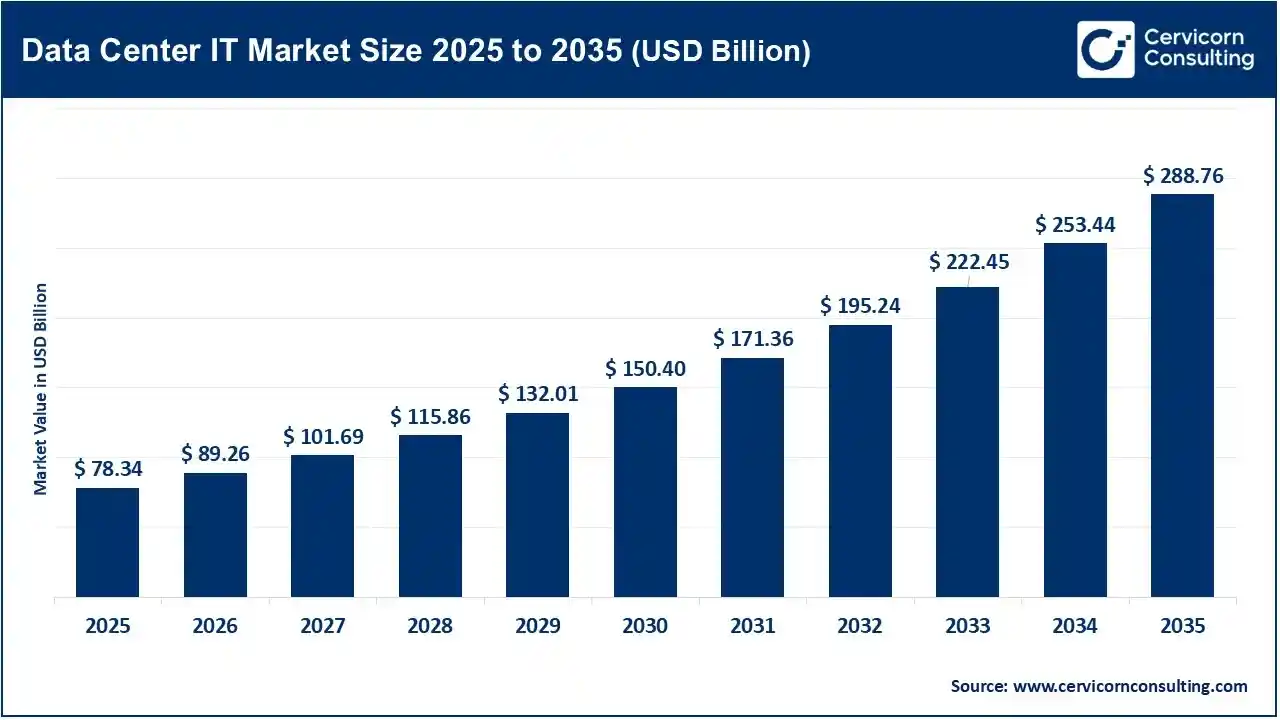
The global data center IT market size was valued at USD 78.34 billion in 2025 and is expected to be worth around USD 288.76 billion by 2035, exhibiting a compound annual growth rate (CAGR) of 13.9% over the forecast period 2026 to 2035. The rapid adoption of artificial intelligence (AI), machine learning (ML), generative AI, and high-performance computing (HPC) is a major driver of demand for advanced data center IT infrastructure, particularly high-performance servers, GPUs, storage, and high-speed networking equipment.
The IEA reports that electricity consumption by AI-focused data centers increased by 50% in 2025, while overall data center electricity demand increased by 17%. AI-focused data centers are also expected to triple their electricity consumption between 2025 and 2030, supporting continued investments in accelerated computing, high-density servers, and specialized IT infrastructure.
The expansion of cloud computing, digital services, enterprise workloads, online platforms, and data-intensive applications is further accelerating data center IT investments. Global data center electricity consumption reached approximately 415 TWh in 2024, representing about 1.5% of worldwide electricity consumption, and has grown at roughly 12% annually since 2017. Meanwhile, accelerated-server capacity grew four times faster than total server capacity between 2015 and 2024, reflecting increasing demand for AI and compute-intensive workloads. Growing virtualization, edge computing, cybersecurity requirements, real-time analytics, and digital transformation initiatives are therefore driving enterprises and cloud providers to upgrade servers, storage, networking, and data center management technologies.
Market Size & Forecast
- Valuation: USD 78.24 billion in 2025
- Growth Rate: 13.9% CAGR
- Future Scope: Exceeding USD 288.76 billion by 2035
- Dominant Region: North America expected to hit 39.80% revenue share
- Fastest Growing Region: Asia-Pacific
Report Highlights
- North America has dominated the market in 2025, supported by hyperscale operators, mature cloud ecosystems, AI infrastructure investment, and extensive enterprise digitalization.
- Servers dominated the component segment with a 38.7% market share, supported by rising demand for high-performance computing, AI workloads, cloud applications, and enterprise virtualization.
- Storage Systems accounted for 19.4%, driven by expanding data volumes, cloud storage requirements, analytics workloads, and increasing adoption of high-performance storage architectures.
- Hyperscale Data Centers led the data-center-type segment with a 36.8% market share, reflecting continued expansion by hyperscale cloud providers and AI infrastructure operators.
- Colocation Data Centers held 22.7%, supported by enterprises seeking scalable infrastructure, connectivity, reduced capital requirements, and access to established data-center ecosystems.
- IT & Telecommunications dominated the end-user segment with a 29.6% market share, supported by cloud platforms, telecom networks, digital services, hosting, and expanding data-processing requirements.
- BFSI represented 16.8%, driven by digital banking, real-time payments, fraud detection, financial analytics, cybersecurity, and increasing adoption of cloud-based financial applications.
What is Data Center IT?
Data Center IT refers to the information technology infrastructure deployed within data centers to compute, store, process, transmit, and manage digital workloads and data. It primarily includes servers, storage systems, networking equipment, virtualization and data-center management software, and security technologies that support enterprise applications, cloud services, AI workloads, databases, analytics, and digital services. Modern data center IT is increasingly shifting toward accelerated computing, software-defined infrastructure, hybrid cloud, and high-speed networking to handle AI and other data-intensive workloads.
Growth Factors
- AI Workload Expansion: AI model training, inference, and generative AI applications are increasing demand for high-performance servers, accelerators, storage, and networking equipment. As enterprises and cloud providers deploy more compute-intensive workloads, data centers are upgrading IT infrastructure to support greater processing capacity, faster data movement, and increasingly demanding computational requirements.
- Cloud Infrastructure Growth: Continued adoption of cloud computing, SaaS platforms, digital services, and enterprise applications is increasing demand for data center IT infrastructure. Hyperscale and cloud service providers are expanding server, storage, and networking capacity to accommodate growing workloads, while enterprises are modernizing infrastructure to support hybrid and multi-cloud environments.
- Digital Data Growth: The rapid creation and processing of data from connected devices, applications, video platforms, industrial systems, and enterprise software is increasing requirements for computing and storage infrastructure. As organizations generate larger datasets, data centers require additional servers, storage systems, networking equipment, and data-management infrastructure to process and retain information efficiently.
Data Center IT Market Dynamics
Key Drivers
- AI Infrastructure Demand: Rapid adoption of generative AI, machine learning, and inference workloads is increasing demand for high-performance servers, GPUs, AI accelerators, memory, and high-speed networking equipment. Organizations are upgrading data center IT infrastructure to handle computationally intensive workloads, creating sustained demand for advanced computing and processing systems.
- Cloud Service Expansion: Growing adoption of cloud computing, SaaS, digital platforms, and enterprise applications is encouraging hyperscale and cloud providers to continuously expand computing capacity. Increasing cloud workloads require additional servers, storage, networking equipment, and associated IT infrastructure, supporting ongoing data center equipment deployments and modernization projects.
- Enterprise IT Modernization: Enterprises across financial services, healthcare, manufacturing, retail, telecommunications, and government are replacing legacy IT infrastructure with scalable and higher-performance systems. Modernization programs focused on digital transformation, cybersecurity, virtualization, hybrid cloud, and data analytics are increasing demand for updated servers, storage systems, and networking equipment.
Key Restraints
- High Equipment Costs: Advanced servers, GPUs, AI accelerators, storage systems, and networking equipment require significant capital expenditure. The cost of high-performance computing infrastructure can make upgrades difficult for organizations with constrained technology budgets, particularly when multiple equipment categories must be replaced simultaneously to support new workloads.
- Hardware Supply Constraints: Data center IT infrastructure depends on processors, memory, storage components, accelerators, networking equipment, and other specialized hardware. Surging AI infrastructure demand can place pressure on component supply chains, potentially increasing procurement lead times, equipment prices, and project delays for data center operators and enterprise customers.
- Rapid Obsolescence: Fast technological advances in processors, accelerators, storage architectures, and networking technologies can shorten equipment refresh cycles. Organizations must continually evaluate infrastructure performance and compatibility, creating challenges around technology planning, depreciation, replacement timing, and the risk of investing heavily in equipment that becomes outdated relatively quickly.
Key Opportunities
- AI-Optimized Servers: Growing deployment of generative AI and machine learning is creating opportunities for servers incorporating GPUs, specialized accelerators, high-bandwidth memory, and advanced interconnects. Demand for AI training and inference infrastructure is encouraging data center operators and enterprises to invest in computing platforms specifically designed for increasingly complex and resource-intensive workloads.
- Edge Computing: Expansion of connected devices, industrial automation, autonomous systems, telecommunications, and real-time applications is creating demand for computing closer to data sources. Edge data centers require compact servers, storage, networking, and management systems capable of processing information locally while maintaining connectivity with centralized cloud and hyperscale environments.
- High-Speed Networking: Increasing AI cluster sizes and data-intensive workloads are creating opportunities for high-bandwidth switches, optical transceivers, network adapters, and interconnect technologies. Faster networking enables efficient movement of large datasets between processors and storage systems, making advanced connectivity an increasingly important component of modern data center IT infrastructure.
Key Challenges
- Rising Power Density: AI servers and accelerated computing systems can require substantially more power per rack than conventional IT equipment. Increasing rack densities create challenges for data center operators because IT upgrades may require corresponding improvements in power delivery and cooling infrastructure, potentially increasing deployment complexity and limiting existing facility capacity.
- Technology Integration: Modern data centers combine CPUs, GPUs, AI accelerators, storage platforms, networking equipment, virtualization technologies, and cloud-management systems. Integrating these technologies while maintaining interoperability, performance, cybersecurity, and operational visibility can be challenging, particularly when operators manage infrastructure spanning multiple hardware generations and technology architectures.
- Supply Chain Dependence: Data center IT deployments rely on global supply chains for semiconductors, processors, memory, storage, networking equipment, and specialized components. Geopolitical restrictions, manufacturing concentration, logistics disruptions, and component shortages can affect procurement schedules and costs, creating uncertainty for operators planning large-scale infrastructure expansions or technology refreshes.
Data Center IT Market Segmental Analysis
The data center IT market is segmented into component, data center type, end user, and geography.
Component Analysis
Servers dominate the Data Center IT market because they provide the core computing capacity required for cloud applications, enterprise workloads, databases, virtualization, analytics, and artificial intelligence. Demand is shifting toward high-performance and accelerated servers as organizations deploy GPU-based computing and high-density infrastructure. Server modernization is also being supported by increasing requirements for faster processing, greater memory capacity, improved energy efficiency, and workload-specific architectures. Hyperscale operators and enterprises are increasingly replacing conventional systems with specialized platforms capable of supporting AI-intensive and data-heavy applications.
Data Center IT Market Share, By Component, 2025 (%)
| Component Segment |
Revenue Share, 2025 (%) |
| Servers |
38.7% |
| Storage Systems |
19.4% |
| Networking Equipment |
18.6% |
| Data Center Management Software |
8.9% |
| Security Solutions |
6.1% |
| IT Infrastructure Management Solutions |
5.2% |
| Others |
3.1% |
Data center management software is the fastest-growing component as operators increasingly adopt automation, AI-based monitoring, predictive maintenance, workload orchestration, and centralized infrastructure management. The growing complexity of hybrid, hyperscale, and distributed data-center environments is increasing the need for software capable of improving resource utilization and operational visibility. Integration with digital twins, automated provisioning, predictive analytics, and energy-management platforms is further expanding adoption. Organizations are also using intelligent management tools to simplify increasingly complex IT environments while reducing manual intervention and improving infrastructure reliability.
Data Center Type Analysis
Hyperscale data centers dominate due to their extensive deployment by major cloud providers, internet companies, and technology firms supporting cloud computing, AI, streaming, search, and digital services. These facilities benefit from highly standardized architectures, massive computing capacity, centralized management, and economies of scale. Increasing AI workloads are further accelerating hyperscale expansion because large-scale AI training and inference require substantial computing, storage, and networking resources. Operators are consequently investing in advanced servers, accelerators, high-speed interconnects, and sophisticated infrastructure management technologies.
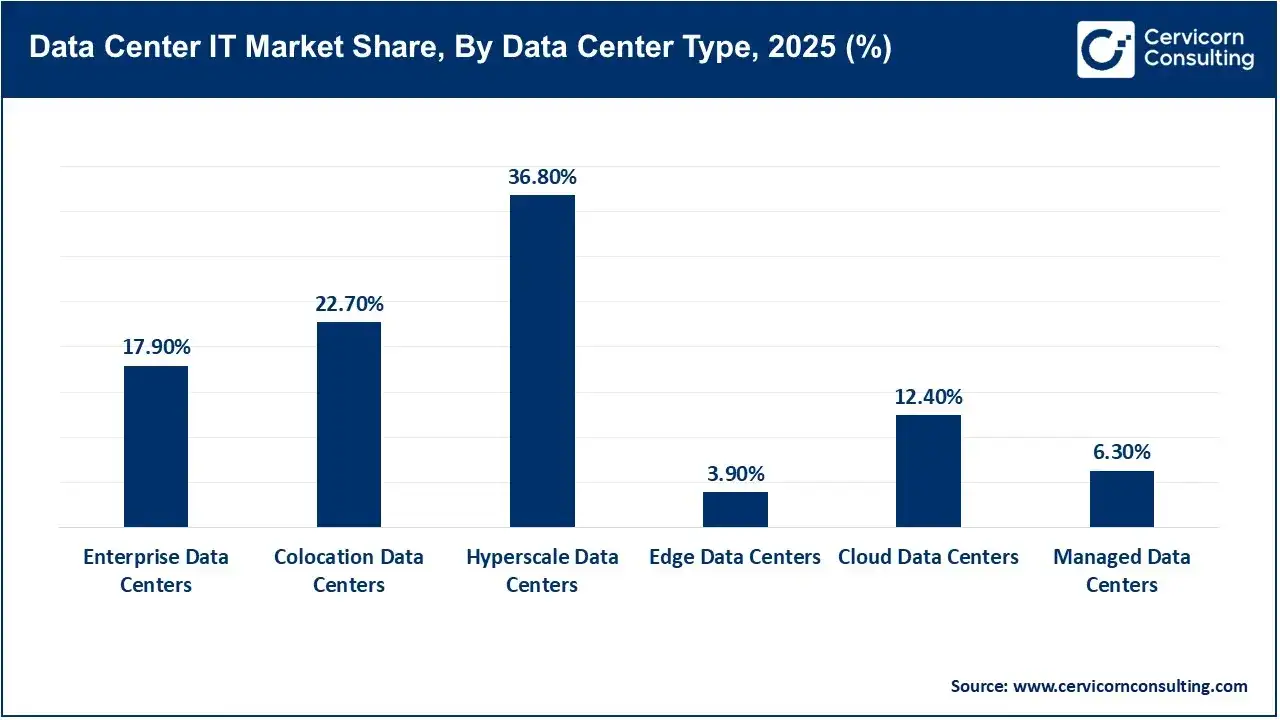
Edge data centers are experiencing the fastest growth as organizations move computing resources closer to end users, connected devices, and data-generation points. Demand is increasing from AI inference, Internet of Things applications, autonomous systems, 5G services, real-time analytics, and content delivery, where low latency is critical. Edge deployments enable localized processing and reduce dependence on centralized facilities for latency-sensitive workloads. The expansion of distributed computing architectures is also encouraging investments in compact servers, storage, networking equipment, remote management platforms, and highly automated infrastructure suitable for smaller and geographically dispersed facilities.
End User Analysis
IT and telecommunications dominate the Data Center IT market because cloud providers, telecom operators, internet companies, hosting providers, and technology enterprises operate extensive computing and networking infrastructure. These organizations require continuous investments in servers, storage, networking, cybersecurity, and infrastructure management to support growing digital services and network workloads. Cloud adoption, increasing data traffic, AI deployment, and expansion of digital connectivity are strengthening infrastructure requirements. Telecom operators are additionally deploying distributed computing environments to support 5G, edge applications, low-latency services, and increasingly data-intensive network operations.
Data Center IT Market, By End User, 2025 (%)
| End User Segment |
Revenue Share, 2025 (%) |
| IT & Telecommunications |
29.6% |
| BFSI |
16.8% |
| Healthcare |
9.2% |
| Government & Defense |
9.7% |
| Retail & E-commerce |
7.8% |
| Manufacturing |
7.1% |
| Media & Entertainment |
5.4% |
| Energy & Utilities |
4.8% |
| Education |
3.1% |
| Transportation & Logistics |
3.7% |
| Others |
2.8% |
Banking, Financial Services, and Insurance is among the fastest-growing end-user segments as financial institutions accelerate digital banking, mobile payments, cloud adoption, fraud detection, cybersecurity, and artificial intelligence initiatives. Financial organizations require highly available and secure IT infrastructure to process large volumes of transactions and customer data in real time. Increasing use of AI for risk analysis, personalized financial services, algorithmic applications, and fraud prevention is generating additional demand for advanced computing and storage. Regulatory requirements for data protection and operational resilience are also encouraging infrastructure modernization across financial institutions.
Data Center IT Market Regional Analysis
The data center IT market is segmented by region into North America, Europe, Asia-Pacific, Latin America, and LAMEA. Here is a brief overview of each region:
North America Data Center IT Market: Driven by AI Infrastructure Expansion, Hyperscale Cloud Deployment, Enterprise Digitization, and Increasing Demand for High-Density Computing
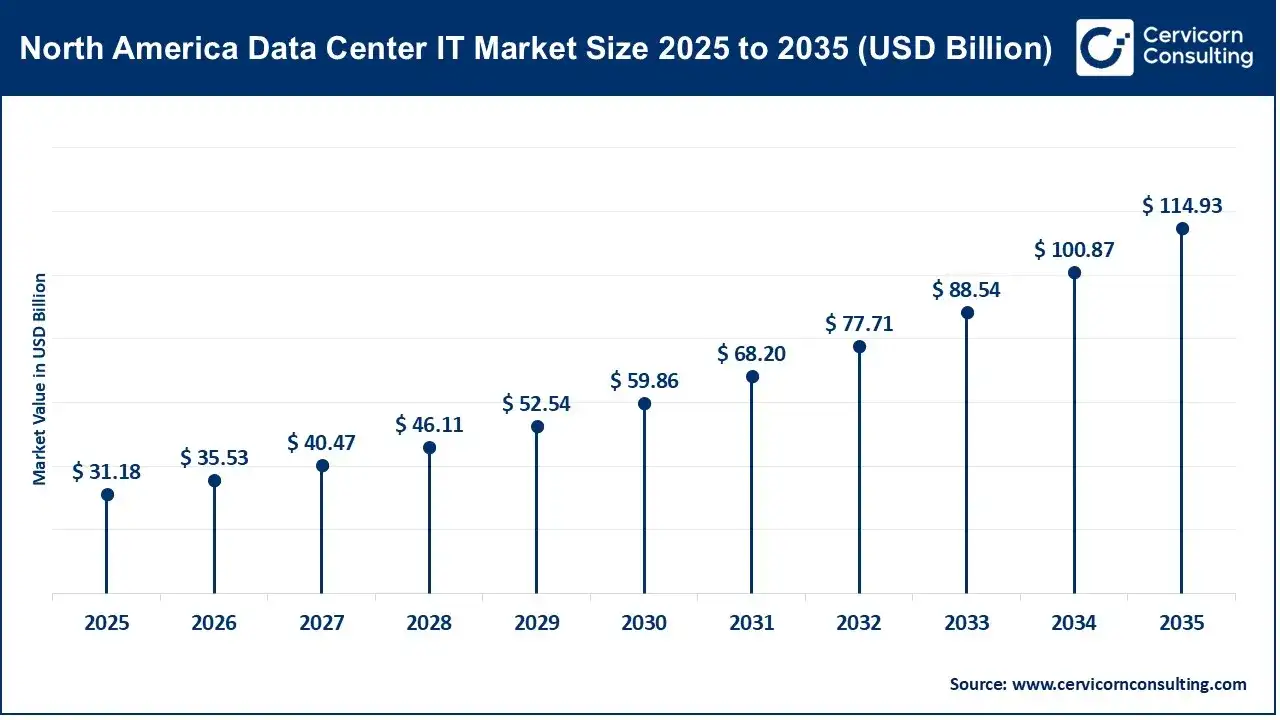
The North America data center IT market size was valued at USD 31.18 billion in 2025 and is forecasted to grow USD 114.93 billion by 2035. North America is the leading and most mature region, supported by extensive cloud adoption, hyperscale infrastructure, AI computing, enterprise digitalization, and strong investment from technology companies. The United States accounts for the overwhelming majority of regional capacity, while Canada and Mexico are developing as complementary markets. In 2025, supply across CBRE's eight primary North American data-center markets increased 36% year over year to 9,432 MW, while net absorption reached 2,497.6 MW, up 38%. Vacancy simultaneously declined to a record-low 1.4%, demonstrating exceptionally strong demand for data-center capacity.
United States: AI Expansion, Hyperscale Cloud Investment, Enterprise Digitalization, and Power-Ready Infrastructure Drive Market Demand
- The United States had 5,427 data centers in 2025, substantially more than any other country, providing a broad installed base for servers, storage, networking, and data-center management technologies.
- Northern Virginia reached 4,039.6 MW of total data-center inventory in 2025, with more than 1 GW of new capacity delivered during the year, reflecting sustained hyperscale and AI demand.
- The eight primary U.S. markets recorded 2,497.6 MW of net absorption in 2025, with Northern Virginia alone accounting for 1,102 MW, highlighting strong requirements from hyperscale, cloud, and AI operators.
Canada: Cloud Expansion, AI Infrastructure, Data Sovereignty, and Access to Power Support Market Development
- Canada had 337 data centers in 2025, making it one of the largest data-center markets outside the United States and supporting demand for enterprise servers, storage, networking, and cloud infrastructure.
- Canadian data-center development is benefiting from growing demand for cloud computing, AI workloads, digital services, and localized data processing, while access to comparatively attractive power resources supports selected development locations.
Asia-Pacific (APAC) Data Center IT Market: Driven by AI and Cloud Expansion, Hyperscale Deployment, Digitalization, and Rapid Development in Power-Advantaged Markets
The Asia-Pacific data center IT market size was estimated at USD 22.48 billion in 2025 and is forecasted to hit around USD 82.87 billion by 2035. Asia-Pacific is one of the most dynamic regions, supported by accelerating AI adoption, cloud services, digital transformation, expanding internet usage, and hyperscale investments. China, Japan, India, Australia, Singapore, South Korea, and Southeast Asia represent major demand centers, while Malaysia, Indonesia, and Thailand are emerging as important deployment locations. APAC's operational data-center capacity reached 13.8 GW in 2025, while the regional development pipeline reached a record 19.4 GW, comprising 3.7 GW under construction and 15.7 GW planned. AI and cloud workloads are increasingly directing new capacity toward power-secure locations.
China: Large Digital Economy, AI Investment, Hyperscale Expansion, and Domestic Cloud Infrastructure Drive Market Demand
- Chinese Mainland represented 37% of APAC's operational data-center capacity, equivalent to approximately 4.5 GW, making it the region's largest market.
- Goldman Sachs expects Chinese data-center demand to grow at a 20% CAGR between 2025 and 2028, driven by AI investment, hyperscalers, and large language model companies.
India: Rapid Digitalization, AI Adoption, Cloud Expansion, and Hyperscale Investments Support Market Growth
- India was one of APAC's largest data-center markets, with 1.3 GW of operational capacity in H1 2025, placing it among the region's five largest markets.
- Mumbai's operational IT load increased 42% during 2025, from 542 MW to 768 MW, demonstrating strong expansion in one of India's principal data-center hubs.
- Mumbai had 323 MW under construction and 998 MW planned at the end of 2025, reflecting substantial future requirements for servers, storage, networking, and accelerated computing infrastructure.
Europe Data Center IT Market: Driven by AI Adoption, Cloud Expansion, Hyperscale Deployment, Enterprise Digitalization, and Increasing Demand for Power-Ready Locations
The Europe data center IT market size was accounted for USD 17.55 billion in 2025 and is projected to surpass around USD 64.68 billion by 2035. Europe is a mature and rapidly evolving market, supported by expanding cloud services, AI workloads, enterprise digitalization, data-sovereignty requirements, and increasing demand for high-performance computing. The established FLAPD markets (Frankfurt, London, Amsterdam, Paris, and Dublin) remain important hubs, while Milan, Madrid, Helsinki, Oslo, Warsaw, and other secondary markets are gaining momentum as power and land constraints encourage geographic diversification. European data-center inventory across London, Frankfurt, Paris, and Amsterdam increased 18.9% year over year in Q1 2026, while European colocation signings intended for AI more than quadrupled during the first half of 2026.
United Kingdom: AI and Cloud Expansion, Hyperscale Demand, and Critical Digital Infrastructure Support Market Development
- London remains Europe's largest data-center market, with inventory exceeding 1 GW, supported by major cloud providers, colocation operators, enterprises, and connectivity infrastructure.
- London recorded 208 MW of net absorption in Q1 2026, demonstrating strong demand from hyperscalers and emerging neocloud providers.
Germany: Frankfurt Hyperscale Growth, AI Infrastructure, Enterprise Demand, and Strong Connectivity Drive Market Demand
- Frankfurt recorded 23% year-over-year supply growth in Q1 2026, the strongest increase among Europe's major markets tracked by CBRE.
- The market recorded 218 MW of net absorption in Q1 2026, driven primarily by hyperscalers and neocloud providers.
- Frankfurt's strategic connectivity, established cloud ecosystem, and position as a major European internet exchange location continue to support demand for servers, networking, storage, and colocation infrastructure.
Data Center IT Market Share, By Region, 2025 (%)
| Region |
Revenue Share, 2025 (%) |
| North America |
39.8% |
| Asia-Pacific |
28.7% |
| Europe |
22.4% |
| LAMEA |
9.1% |
LAMEA Data Center IT Market: Driven by Cloud Adoption, AI Infrastructure, Digital Transformation, Data Localization, and Expanding Connectivity
The LAMEA data center IT market was valued at USD 7.13 billion in 2025 and is anticipated to reach around USD 26.28 billion by 2035. LAMEA is an increasingly important market, supported by accelerating cloud adoption, artificial intelligence, digital transformation programs, rising internet usage, and investments in local digital infrastructure. The region encompasses highly developed Middle Eastern hubs alongside rapidly expanding Latin American and African markets, creating diverse opportunities for servers, storage, networking, security, and infrastructure-management technologies. In Latin America, colocation inventory increased 20% during 2025, while the development pipeline was 42% precommitted, demonstrating strong demand from hyperscalers, cloud providers, enterprises, and digital-service companies.
Middle East: AI Investment, Cloud Expansion, Digital Sovereignty, and Government Transformation Drive Market Demand
- Middle Eastern data-center capacity is projected to increase from approximately 1 GW in 2025 to 3.3 GW over the following five years, driven by AI, cloud computing, regulatory initiatives, and investments from hyperscalers and regional technology companies.
- The GCC had approximately 1 GW of installed data-center capacity in 2025, with Saudi Arabia and the UAE representing the region's principal markets.
- Saudi Arabia had 274 MW of data-center capacity in 2024, with another 127 MW under construction, supported by Vision 2030, cloud adoption, AI investments, and digital-economy initiatives.
Latin America: Cloud Adoption, Hyperscale Deployment, Renewable Energy, and Digitalization Strengthen Market Expansion
- Latin America's data-center demand is concentrated in Brazil, Mexico, Chile, and Colombia, which are attracting substantial hyperscale and colocation investments.
- Brazil had 706 MW of data-center capacity by August 2026, representing approximately half of Latin America's total capacity, with renewable-energy availability supporting new development.
- São Paulo remained the region's largest data-center market, with 493 MW of inventory in Q1 2025, while occupied capacity reached 446 MW, reflecting strong cloud and enterprise demand.
Data Center IT Market Key Companies
Segments Covered
By Component
- Servers
- Storage Systems
- Networking Equipment
- Data Center Management Software
- Security Solutions
- IT Infrastructure Management Solutions
- Others
By Data Center Type
- Enterprise Data Centers
- Colocation Data Centers
- Hyperscale Data Centers
- Edge Data Centers
- Cloud Data Centers
- Managed Data Centers
By End User
- IT & Telecommunications
- Banking, Financial Services & Insurance (BFSI)
- Healthcare
- Government & Defense
- Retail & E-commerce
- Manufacturing
- Media & Entertainment
- Energy & Utilities
- Education
- Transportation & Logistics
- Others
By Geography
- North America
- Europe
- Asia-Pacific
- LAMEA