
Content
The Oil Storm: How the 2026 Iran-US/Israel War is Reshaping Global Energy


A Conflict That Disrupted the World's Energy Supply
When the United States and Israel initiated coordinated military operations against Iran on February 28, 2026, under the designation Operation Epic Fury, few anticipated the swift manner in which these events would influence global energy markets. Within forty-eight hours, Iran retaliated with missile and drone strikes across nine Gulf nations and took the significant step of closing the Strait of Hormuz, the world's most critical maritime oil chokepoint.
The International Energy Agency (IEA) characterised this development as the "greatest global energy security challenge in history." What initially appeared to be a regional military conflict rapidly transformed into the most substantial supply disruption in the history of the global oil market, exceeding the impacts of the 1973 Arab oil embargo and the disruptions induced by Russia's invasion of Ukraine in 2022.
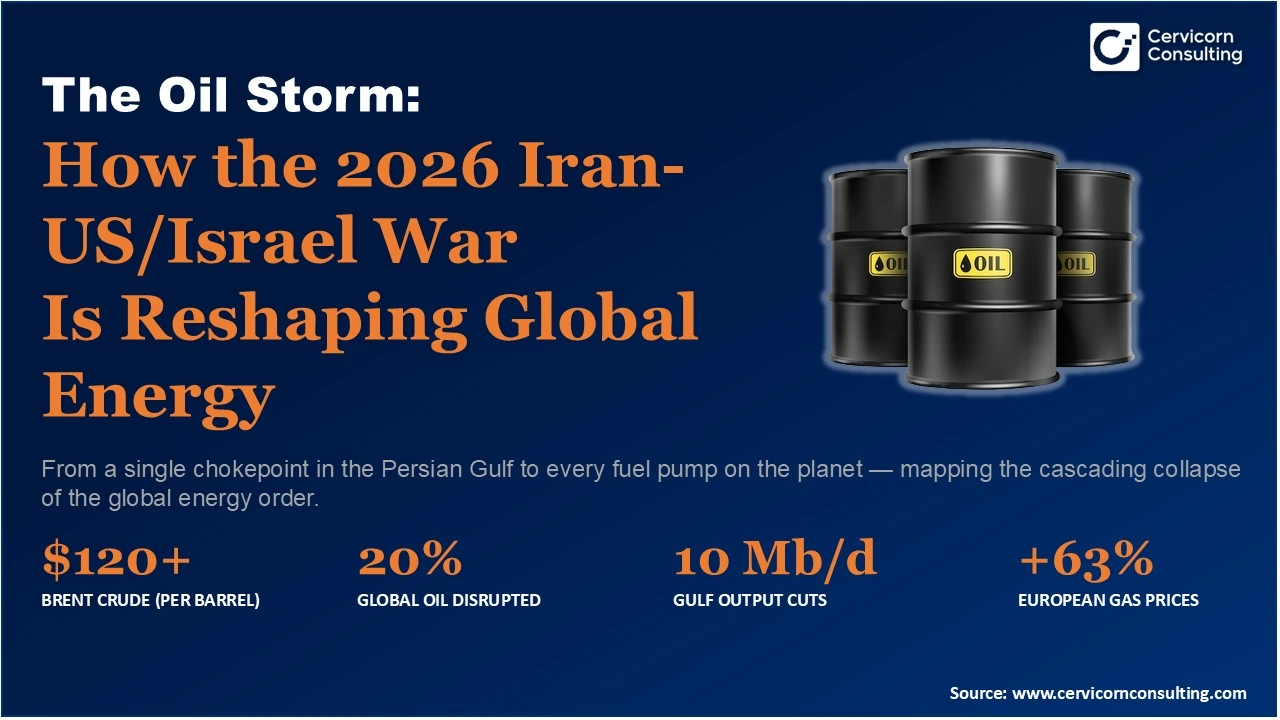
This analysis examines the multifaceted effects of the conflict on the oil and gas sector, including surging crude oil prices, a strained liquefied natural gas (LNG) market, India's economic vulnerabilities, global inflationary pressures, and the long-term implications for the energy transition.
Feb 28, 2026: US and Israel launch strikes on Iran. Brent crude immediately jumps 8%, from USD 71.32 to 77.24 per barrel, within two trading days.
Mar 1–2, 2026: Iran activates closure of the Strait of Hormuz. QatarEnergy declares force majeure on LNG exports. Commercial tanker traffic collapses to a trickle.
Mar 6, 2026: US Treasury issues India a 30-day emergency waiver to purchase stranded Russian oil cargoes at sea to prevent a domestic fuel collapse.
Mar 18, 2026: Israel targets Iran's South Pars gasfield — the world's largest. Brent rises 5% to USD 108.66 per barrel. Oil later exceeded USD 120 per barrel.
Mar 27–30, 2026: India reduces central excise duties on petrol and diesel by INR 10 per litre each. The rupee reaches a record low of 94.79 against the US dollar.
To understand how these trends will specifically impact your market share, reach out to our analysts here: +91 8983225533 | sales@cervicornconsulting.com
The Strait of Hormuz: The World's Most Dangerous 33 km
To comprehend the imminent energy crisis of 2026, it is imperative to understand the significance of the Strait of Hormuz — a crucial and irreplaceable narrow waterway located between Iran and Oman. Historically, market stability was predicated on the assumption of a "safe Gulf": irrespective of political tensions, oil supplies were expected to flow uninterruptedly due to the reliance of all stakeholders on the associated revenue. The conflicts anticipated in 2026 have fundamentally overturned this longstanding assumption.
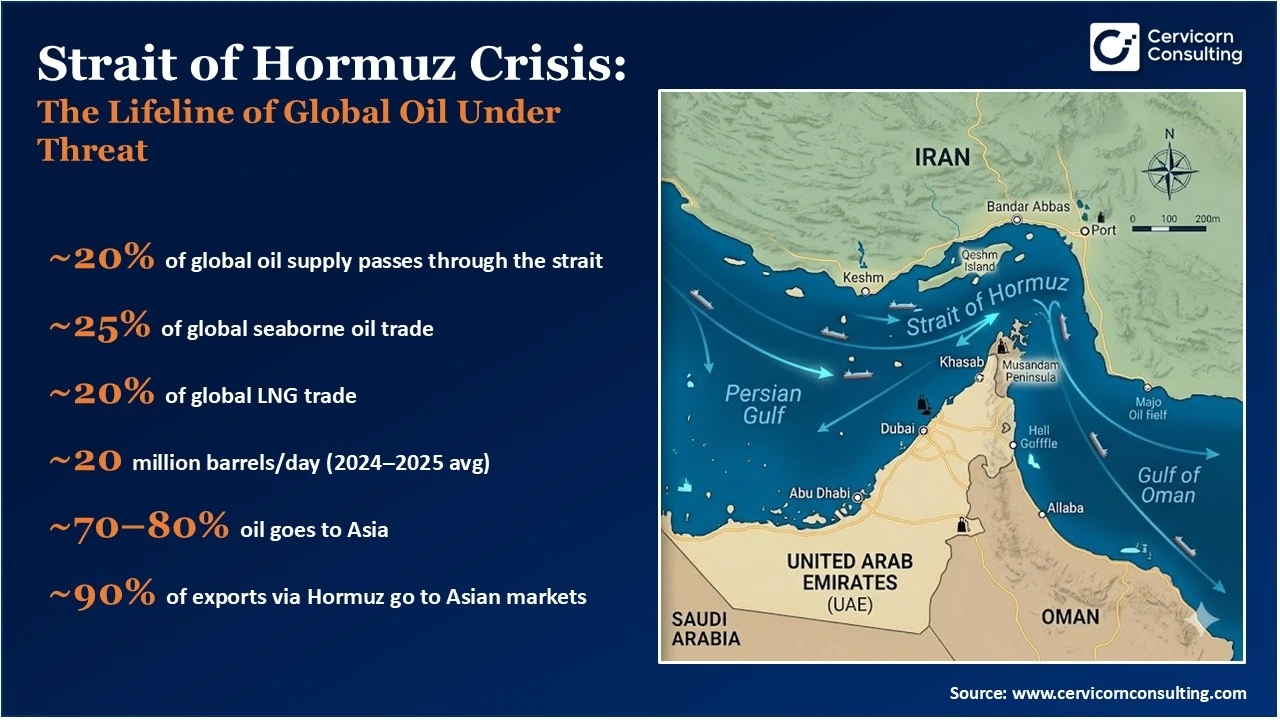
"Before the war, roughly twenty million barrels of oil and petroleum products moved each day through the Strait of Hormuz, the world's most important maritime chokepoint."
— Council on Foreign Relations, March 2026
The figure of 20 million barrels per day represents approximately 20% of the world's petroleum passing through a single route. Additionally, approximately 110 billion cubic metres of liquefied natural gas (LNG) annually, accounting for 19% of global LNG trade, transit through the strait — primarily originating from Qatar's Ras Laffan complex, the world's largest LNG export hub.
Alternative routes are substantially limited. Saudi Arabia and the United Arab Emirates possess pipeline capacities totalling only around 2.6 million barrels per day, leaving approximately 18 million barrels per day without an alternative route should the strait be closed. Non-OPEC nations such as the United States lack sufficient spare capacity to bridge this gap. As an expert remarked, "We are witnessing a complete departure from the traditional principles of energy security."
In contrast to the 2022 Russia-Ukraine crisis, during which rerouting and diversification contributed to market stabilisation, a physical blockade of the Strait of Hormuz cannot be mitigated through such measures. The strategies that proved effective in 2022 are no longer applicable.
The Price Surge: From USD 71 to USD 120+ in Weeks
Since February 28, the trend of oil prices has been both volatile and unprecedented. Brent crude, the global benchmark, was valued at USD 71.32 per barrel prior to the strikes. Within two trading days, it experienced an 8% increase. As the conflict escalated and the closure of the Strait of Hormuz became a reality, prices surged beyond USD 100, reaching nearly USD 120 per barrel by mid-March — approaching the all-time high of USD 147 recorded in July 2008. Some analysts forecast a worst-case scenario of USD 150 or higher.
The International Energy Agency (IEA) characterised this as the most significant disruption to oil supply in modern history, with flows through the strait declining from 20 million barrels daily to a mere trickle. Gulf production cuts are estimated at 7 to 10 million barrels per day, representing 7–10% of global demand in a single instance.
Why This Is Different from 2022
In 2022, the Russia-Ukraine conflict precipitated disruptions driven by sanctions, which were nonetheless partially alleviated through rerouting, strategic reserve releases, and sourcing from alternative suppliers. The International Energy Agency coordinated the release of 180 million barrels to stabilize the markets.
In 2026, the closure of the Strait of Hormuz constitutes a physical blockade, preventing producers from exporting regardless of their intent. Oilfields in Iraq, Kuwait, and the United Arab Emirates are ceasing operations due to full storage capacities and halted tanker traffic. Restarting these fields after an extended shutdown could take days, weeks, or even months. This scenario represents more than a mere price spike; it signifies a fundamental failure in the supply infrastructure.
Iranian forces have also targeted regional energy infrastructure, including the Bahrain Petroleum Company's (BAPCO) refinery, leading several Gulf states to declare force majeure and shut down facilities as a precaution. On March 18, Israel's strike on Iran's South Pars gas field— the largest in the world— caused a 5% surge in Brent crude prices to USD 108.66 per barrel.
Every USD 10 increase in oil prices is estimated to reduce US GDP growth by about 0.1 percentage points. With prices roughly USD 50 per barrel above pre-conflict levels, economists at the Council on Foreign Relations estimate this may slow growth by up to 0.5 percentage points if the trend continues— an effect most pronounced in energy-importing emerging economies.
Supply Chain Disruption: Beyond Oil and Gas
The Strait of Hormuz is not exclusively a conduit for energy. According to the World Bank, more than 80% of global trade transpires via maritime routes. The effective closure of these routes has resulted in significant repercussions extending beyond crude oil and liquefied natural gas (LNG), culminating in an extensive supply chain crisis.
The cost of war-risk insurance for tankers and commercial vessels has risen markedly since the onset of hostilities. Notably, on March 5, major insurers withdrew "war risk" coverage for the region. In the absence of insurance, a tanker valued at USD 200 million is rendered inoperable, irrespective of oil prices. Consequently, shipping lanes have become largely vacant, and global freight markets face mounting pressure.
The Hidden Commodity Crisis
Fertilizers: The Gulf region accounts for approximately 50% of the world's urea and sulfur exports, while also supplying 20% of the global LNG used as feedstock for nitrogen fertilizers. Morningstar predicts that nitrogen fertilizer prices could potentially double from the levels observed in 2024, with phosphate prices expected to increase by approximately 50%. The United Nations World Food Programme has issued a warning concerning a possible scenario similar to the food crisis of 2022.
Semiconductors: The ongoing crisis has restricted the supply of helium, a crucial resource for semiconductor manufacturing, owing to the Gulf's prominent role as a principal exporter of helium.
Aviation: The closure of airspace throughout the Middle East has led to stranded passengers and prolonged travel durations for long-haul flights, with airlines resorting to rerouting at significant additional fuel expenses.
Iraq, Kuwait, and the United Arab Emirates have been compelled to reduce oil production, not due to attacks on their oil fields, but because their storage capacities are exhausted—tankers are not transporting the oil away. Analysts from Rystad Energy have cautioned that reactivating these fields after extended shutdowns could itself require several weeks or even months, implying that even a ceasefire occurring tomorrow would not lead to an immediate restoration of supply.
The main message is clear: the global "just-in-time" energy delivery system—based on reliable Gulf flows—has worsened. The conflict has revealed what Al Jazeera analysts call a "fundamental vulnerability: the heavy concentration of hydrocarbon flows through critical chokepoints."
India: A War It Isn't Fighting, Costs It Cannot Avoid
For India — the world's third-largest oil importer and second-largest LPG consumer — the 2026 Iran war has emerged with severe implications. As an analyst remarked: "More than any other conflict, including its own with Pakistan, this war could exert the most significant influence on India's economy."
India's Energy Exposure at a Glance
India imports over 85% of its crude oil, with approximately half transiting the Strait of Hormuz. It sources approximately 80% of its natural gas and 91% of its LPG from the Gulf region. The rupee has depreciated to a record low of 94.79 per US dollar. India's crude oil basket has increased from below USD 80 to approximately USD 140 per barrel. The government has reduced central excise duties on petrol and diesel by INR 10 per litre each, incurring a significant reduction in tax revenues to protect consumers from price fluctuations.
The immediate and visible impacts have been severe. LPG (cooking gas) prices have increased by INR 60 per cylinder, with the government instructing refineries to redirect propane and butane from petrochemical production to domestic cooking gas. Fertilizer plants and power grids are now operating under "Tier 2" priority status, with supplies capped at 70% of their gas requirements. India's strategic crude oil reserves, totalling 25 days of supply, are already being depleted; additionally, the emergency waiver issued by the US Treasury, allowing purchases of stranded Russian oil cargoes at sea for 30 days, has provided a temporary relief.
"The conflict is simultaneously undercutting India's energy security, remittances, and geopolitical influence — making Delhi one of the biggest losers in a war it isn't even fighting."
— The Christian Science Monitor, March 28, 2026
The macroeconomic projections are indeed sobering. India's growth forecast of 7.0–7.4% for FY2027 now faces significant downside risk. Moody's analysis has identified India as the most vulnerable major economy, projecting that output could decline by nearly 4% from its baseline trajectory if the conflict persists. A sustained oil price of USD 100 per barrel could push India's retail inflation above 5%, with every 10% increase in crude oil prices potentially adding 40–60 basis points to the Consumer Price Index (CPI).
Furthermore, every USD 10 per barrel increase in oil prices could widen India's current account deficit by 0.4–0.5% of Gross Domestic Product (GDP). At an oil price of USD 140 per barrel, analysts estimate annual incremental outflows of USD 40–50 billion, which accounts for more than 1% of India's GDP. The sectors most affected domestically include aviation, paints and chemicals, oil marketing companies (such as BPCL, HPCL, IOC), as well as Fast-Moving Consumer Goods (FMCG) and logistics.
There is also a human dimension to consider, as approximately 10 million Indians reside in Gulf countries, sending back more than USD 40 billion annually—roughly one-third of India's total remittance inflows. Any economic slowdown in the Gulf region would directly impact household incomes across Indian states connected to the diaspora.
Future Outlook: The Scenarios Ahead
The ultimate trajectory of global energy markets depends significantly on a singular variable: the duration of the Hormuz closure and the ongoing conflict. Analysts have delineated three broad scenarios.
Scenario 1 — Quick Resolution (1–2 months): A diplomatic breakthrough or ceasefire is anticipated to open the strait by late April or May. Prices are projected to decline towards USD 85–95 per barrel. Inflation remains elevated but remains within manageable levels. Global economic growth is expected to slow by 0.3–0.5% in 2026, followed by a recovery. India's import expenditures are expected to increase by USD 40–50 billion. The observed damage is substantive but not structural.
Scenario 2 — Prolonged Conflict (3–6 months): Prices remain above USD 130 per barrel. The Eurozone enters a recession. India's GDP growth declines to between 6.0% and 6.5%. Global food prices increase sharply due to fertilizer shortages. Central banks encounter a challenging trade-off between inflation control and economic growth. Several producing nations in Africa and Southeast Asia are experiencing severe fuel crises. Delays in Qatar's LNG expansion exacerbate tight gas markets, extending shortages into 2027–2028.
Scenario 3 — Escalation and Fragmentation: The conflict widens, implicating NATO territory, with disruptions affecting shipping in the Red Sea and systematic targeting of energy infrastructure across the Gulf region. Oil prices escalate beyond USD 150 per barrel. Western economies experience an energy shock reminiscent of the 1970s. The global energy landscape undergoes a fundamental reorganisation. China advances its electrification initiatives, and Russia shifts its strategic focus. The international community becomes divided into Atlantic and Asian energy blocs.
"What begins as a battlefield shock hardens into a geoeconomic one. Historically, every major oil shock has generated a policy response proportional to the pain it inflicts."
— World Economic Forum, March 2026
Regardless of which scenario unfolds, certain structural shifts appear irreversible. The "safe Gulf" assumption has become obsolete. War-risk insurance markets have undergone re-pricing. Energy security is now conceptualised as a question of national sovereignty rather than solely the procurement of commodities. Governments previously indifferent to the energy transition are now recognising that domestic renewables, battery storage, and electrification serve not only as climate policies but also as insurance policies against geopolitical disruptions.
Chatham House observes that the diplomatic summit in April will be closely monitored as the first significant inflection point. Nonetheless, regardless of the outcome, the geopolitical infrastructure of the global energy system — the alliances, supply chains, and transit assumptions established over the past five decades — has been permanently altered.
Conclusion
The 2026 Iran-US/Israel conflict has achieved a level of disruption unprecedented in previous energy crises, affecting multiple sectors including oil, LNG, fertilizers, shipping, aviation, and food supply chains through a single strategic chokepoint. Unlike the Russia-Ukraine conflict, which could be mitigated through diversification and rerouting, a blockade of the Strait of Hormuz admits no such alternatives.
For the oil and gas industry, this signifies a clear and unequivocal message: the era of relying on consistent Gulf supply flows has ended. For policymakers, the conflict has condensed decades of discourse on energy transition into weeks characterised by existential urgency. For investors, the costs associated with fossil fuel dependence — as well as the importance of domestic clean energy — have become painfully evident.
Specifically concerning India, this represents a critical moment of structural vulnerability. With an 85% dependence on crude oil imports, a 91% reliance on the Gulf for LPG, and a sustained pressure on the rupee, the conflict has transformed energy self-sufficiency from a mere aspiration into an essential economic obligation.
The Strait of Hormuz has long been recognised as the world's most perilous 33-kilometre waterway. In 2026, the global community has finally come to understand the implications of living without it.
Cervicorn Consulting helps businesses understand the impact of geopolitical events like the Iran war by providing data-driven insights, risk assessments, and strategic advisory tailored to the oil and gas sector. They analyze supply chain disruptions, price volatility, regulatory shifts, and regional instability to help companies anticipate challenges and make informed decisions. By combining market intelligence with scenario planning, Cervicorn Consulting enables organizations to mitigate risks, optimize operations, and adapt their strategies in a rapidly changing energy landscape, ensuring resilience even during global crises.
To understand how these trends will specifically impact your market share, reach out to our analysts here: +91 8983225533 | sales@cervicornconsulting.com