
Content
China Dominates the Humanoid Robot Market: Can Tesla Catch Up?


China's humanoid robotics industry is accelerating through large-scale manufacturing, cost-efficient hardware, and a rapidly expanding domestic ecosystem. The next challenge is turning shipment growth into real-world productivity.
Key Takeaways
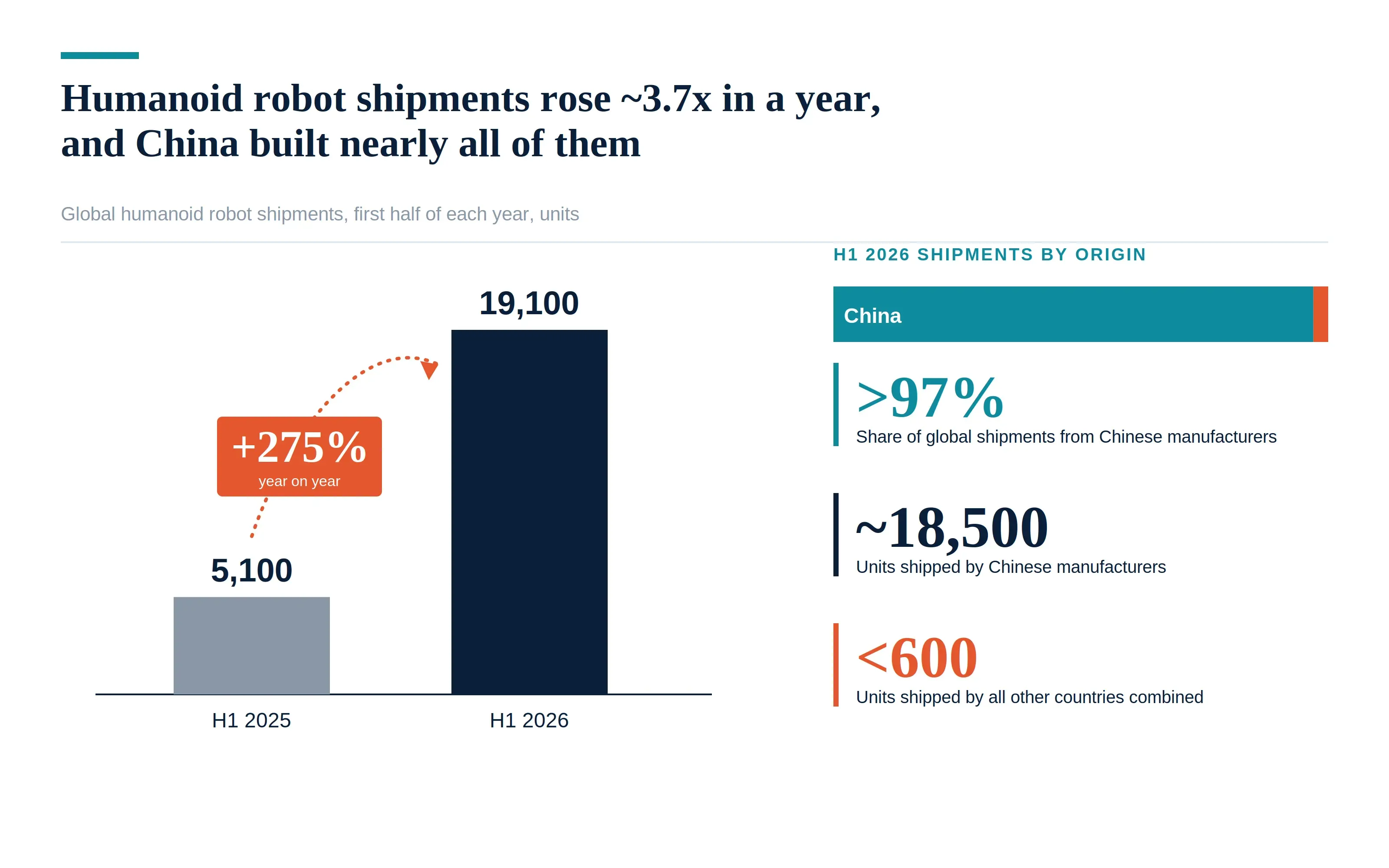
- Global humanoid robot shipments reached approximately 19,100 units in H1 2026, up from around 5,100 units in H1 2025 (Smart Analytics Global), an increase of roughly 275%.
- Chinese manufacturers accounted for more than 97% of worldwide shipments, equal to roughly 18,500 units, which leaves fewer than 600 units for all other countries combined.
- Shipment leadership is not the same as commercial success. Reliability, dexterity, and cost per completed task will decide the winners.
- Tesla and other international players can still compete through AI capability, software integration, and application-specific performance.
China Strengthens Its Position in the Global Humanoid Robot Industry
Humanoid robots are moving from research laboratories and demonstration stages toward commercial applications in manufacturing, logistics, and other industrial environments. In this emerging humanoid robots market, China has established a substantial lead in production scale.
According to industry estimates cited in recent reporting, global humanoid robot shipments reached approximately 19,100 units in the first half of 2026, compared with around 5,100 units during the same period in 2025. Chinese manufacturers accounted for more than 97% of worldwide shipments.
This growth highlights China's ability to combine robotics research with industrial manufacturing capacity. Companies such as AgiBot, Unitree Robotics, and UBTech are expanding their product portfolios, improving manufacturing processes, and exploring new commercial applications.
However, shipment figures tell only part of the story. The industry's long-term success will depend on whether these machines can perform useful tasks reliably, safely, and economically.
Need a market-entry view on humanoid robotics? Request a custom research briefing from Cervicorn Consulting.
Robotics Investment Gains Momentum in China
China's humanoid robotics industry is also attracting investment through public and private capital markets. Unitree Robotics' planned Shanghai STAR Market listing is one example of the growing interest in financing robotics companies with substantial manufacturing ambitions.
China's investment environment provides robotics companies with opportunities to fund research, expand production facilities, develop supply chains, and accelerate commercialization.
Compared with funding models that emphasize venture capital and future profitability, a manufacturing-oriented approach can place greater emphasis on production capacity, supplier development, and market penetration.
However, the long-term success of this model will depend on whether companies can translate investment and manufacturing growth into sustainable revenue and profitable operations.
Why Is China Building Humanoid Robots Faster Than Other Countries?
China's growing influence in humanoid robotics reflects four interconnected advantages.
1. An Established Manufacturing Ecosystem
China has extensive manufacturing capabilities across electric vehicles, industrial automation, batteries, sensors, motors, and precision mechanical components. Many of these technologies are directly relevant to humanoid robot development.
Access to established suppliers can reduce component costs, shorten production cycles, and allow manufacturers to refine robot designs more quickly. This gives Chinese companies an advantage when moving from prototypes to larger production volumes.
2. Competitive Hardware Costs
Humanoid robots require sophisticated components, including actuators, sensors, cameras, computing systems, and dexterous robotic hands. Producing these components at scale can help manufacturers lower overall system costs.
More affordable hardware could expand demand beyond research institutions to manufacturers, logistics operators, universities, and service businesses.
Nevertheless, purchase price alone does not determine commercial viability. Maintenance, software, energy consumption, safety requirements, and integration costs also influence the total cost of ownership.
3. A Growing Domestic Market
China's industrial base provides potential testing grounds for humanoid robots. Factories, warehouses, logistics facilities, and selected service environments can help developers evaluate robotic systems under real operating conditions.
Domestic customers can also provide valuable feedback that informs subsequent product generations. If manufacturers can demonstrate measurable productivity improvements, successful deployments could support wider adoption in international markets.
4. Investment and Competitive Pressure
A growing network of robotics startups, established technology companies, investors, and industrial partners is contributing to product development.
Competition among manufacturers can accelerate innovation in mobility, manipulation, perception, and robotic control. At the same time, strong investment activity creates pressure to demonstrate commercial demand and sustainable business models.
Evaluating suppliers or partners in China's robotics ecosystem? Talk to our analysts about supplier mapping and competitive benchmarking.
Can Tesla's Optimus Catch Up with Chinese Humanoid Robot Makers?
Tesla's Optimus program illustrates the difference between developing a sophisticated robot and manufacturing it at commercial scale.
The company has ambitious plans for humanoid robots in factory operations, where machines could eventually perform repetitive, physically demanding, or potentially hazardous tasks. Tesla also has experience in automotive manufacturing, automation, and artificial intelligence.
However, achieving reliable humanoid performance remains technically demanding. Robotic hands must manipulate objects of different sizes and textures, while arms and legs must coordinate movements in environments that change throughout the day.
Scaling production adds another layer of complexity. A commercially useful robot must be consistent, maintainable, safe around people, and capable of completing tasks without constant human intervention.
Chinese manufacturers currently have a substantial advantage in reported shipment volumes. Tesla and other international competitors must demonstrate that their technology can translate into dependable performance, efficient production, and attractive operating economics.
The competitive question is no longer simply who can demonstrate a humanoid robot. It is who can manufacture, deploy, and support one at scale.
From Factory Floors to Logistics and Service Applications
The potential market for humanoid robots extends across several industries, although adoption will vary according to task complexity, safety requirements, and economic feasibility.
- Manufacturing: Robots could support material handling, component delivery, machine tending, inspection, and repetitive assembly activities. Their value will depend on task reliability and integration with existing production systems.
- Warehousing and logistics: Humanoid platforms may eventually assist with moving containers, handling mixed objects, and working in facilities designed around human movement. Specialized wheeled robots and robotic arms will remain competitive alternatives for many tasks.
- Retail and customer-facing environments: Robots may support information services, demonstrations, and selected repetitive activities. Broader adoption will require dependable interaction, appropriate safety controls, and a clear business case.
- Healthcare and assisted living: Humanoid systems could eventually assist with selected logistical and support activities. Sensitive care tasks require particularly rigorous standards for safety, reliability, privacy, and human supervision.
- Research and education: Universities and laboratories can use humanoid platforms to develop robotics software, test AI models, and study human-like movement and manipulation.
These applications represent different stages of commercial readiness. A successful demonstration should not automatically be interpreted as evidence of widespread deployment or proven profitability.
The Remaining Barrier: Artificial Intelligence and Dexterity
Manufacturing scale is only one part of the humanoid robotics equation. Robots must also interpret their surroundings, understand instructions, plan movements, and respond to unexpected situations.
Performing a predefined action in a controlled setting is considerably easier than completing the same task in an unfamiliar environment. A robot working in a real factory may encounter misplaced objects, changing lighting, blocked pathways, or components presented in unexpected positions.
Advances in vision-language-action models, simulation, synthetic training data, reinforcement learning, and real-world robot learning could improve adaptability. Yet the effectiveness of these approaches must be validated through practical performance.
Dexterous manipulation is another major challenge. Human hands can adjust grip, coordinate multiple fingers, and respond to subtle changes in force. Replicating this flexibility at an affordable price remains difficult.
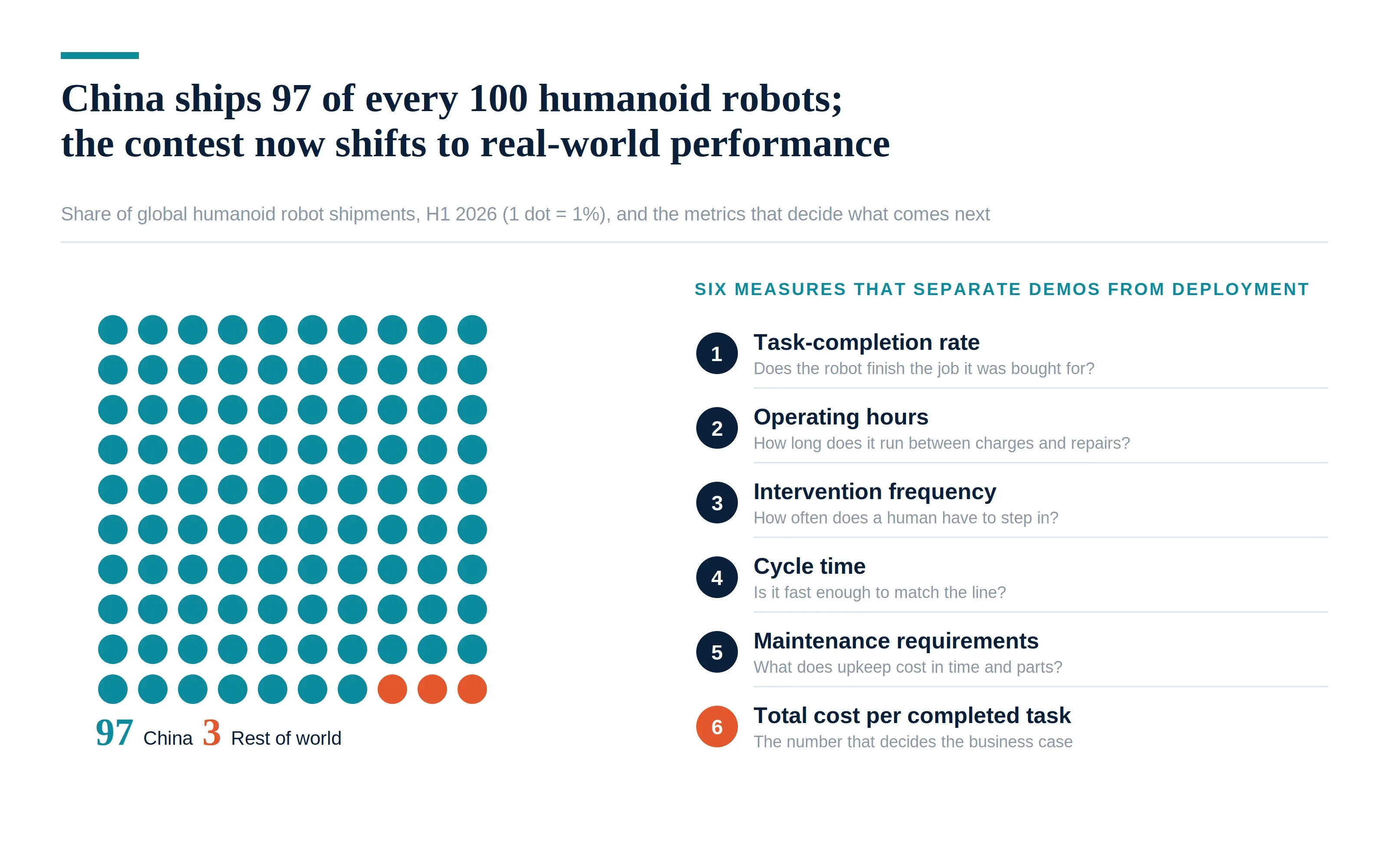
For businesses considering adoption, the relevant measures include task-completion rates, operating hours, intervention frequency, cycle times, maintenance requirements, and total cost per completed task.
Market Opportunities for Robotics Suppliers and Investors
The expansion of humanoid robotics creates opportunities beyond the companies assembling complete robots.
Component suppliers may benefit from demand for actuators, precision gears, sensors, cameras, batteries, power electronics, embedded computing, and advanced materials. Software developers can target robot perception, motion planning, simulation, fleet management, and AI training systems.
System integrators may also play an important role by connecting humanoid platforms with manufacturing execution systems, warehouse management software, and existing industrial equipment.
For investors and corporate strategy teams, several questions deserve attention:
- Which manufacturers are converting shipment growth into recurring commercial revenue?
- How quickly are hardware costs declining, and which components remain expensive?
- Which applications deliver measurable productivity improvements today?
- How do Chinese and international manufacturers compare in reliability, software capabilities, and service support?
- What barriers could limit adoption, including safety certification, labor regulations, export controls, and customer acceptance?
Answering these questions requires more than shipment data. Businesses need competitive intelligence, supplier analysis, application-level demand estimates, technology assessments, and country-specific market research.
Planning an investment or market-entry decision? Book a consultation with Cervicorn Consulting for application-level demand estimates and competitor benchmarking.
What the Next Phase of Humanoid Robotics Could Look Like
China's current shipment leadership gives its manufacturers an important starting advantage. Greater production volume can support supplier development, cost reduction, and faster product iteration.
However, the market remains at an early stage. Shipment growth does not necessarily indicate that robots are operating profitably or replacing substantial amounts of human labor. Commercial outcomes will depend on customer demand, system reliability, and the ability to deliver repeatable economic benefits.
Tesla and other international players still have opportunities to compete through AI capabilities, software integration, manufacturing expertise, and application-specific performance. The strongest companies will likely combine capable hardware with reliable autonomy and a clear return on investment.
For businesses across manufacturing, logistics, and technology, humanoid robotics is becoming a strategic area to monitor. The next phase of competition will be determined not just by how many robots companies build, but by how effectively those robots solve real operational problems.
Frequently Asked Questions
How many humanoid robots were shipped globally in the first half of 2026?
- Approximately 19,100 units. That compares with around 5,100 units in the first half of 2025, a rise of roughly 275%.
What share of humanoid robot shipments comes from China?
- Chinese manufacturers accounted for more than 97% of global humanoid robot shipments in the first half of 2026, which equals roughly 18,500 units.
Which companies lead China's humanoid robot industry?
- AgiBot, Unitree Robotics, and UBTech are among the Chinese manufacturers expanding their product portfolios and production capacity.
Why is China ahead in humanoid robot manufacturing?
- Four factors stand out: an established manufacturing ecosystem, competitive hardware costs, a large domestic market for real-world testing, and strong investment and competitive pressure.
Can Tesla's Optimus compete with Chinese humanoid robots?
- Tesla has strengths in automotive manufacturing, automation, and AI, but it must prove reliable performance, efficient production, and attractive operating economics at scale. Chinese makers currently lead in reported shipment volumes.
What are the biggest technical barriers for humanoid robots?
- AI-driven adaptability in unfamiliar environments and dexterous manipulation. Human-level hand flexibility at an affordable price remains difficult to replicate.
How should a business evaluate a humanoid robot investment?
- Look at task-completion rates, operating hours, intervention frequency, cycle times, maintenance requirements, and total cost per completed task, not just the purchase price.
Which industries are likely to adopt humanoid robots first?
- Manufacturing and logistics are the nearest-term candidates, followed by retail, research and education, and, with stricter safety standards, healthcare and assisted living.
Can Cervicorn Consulting provide custom research on humanoid robotics?
- Yes. We provide competitive intelligence, supplier analysis, application-level demand estimates, and market-entry strategy. Email sales@cervicornconsulting.com to discuss your requirements.
Research Methodology
This analysis combines secondary research with Cervicorn Consulting's own market analysis:
- Data sources: Shipment estimates are from Smart Analytics Global as cited in recent reporting. Company and listing information comes from public reporting and, where noted, requires verification against official exchange and regulatory disclosures.
- Qualitative assessment: Competitive, technology, and application readiness views reflect analyst judgment based on public company announcements, product disclosures, and industry developments.
- Validation: Figures are cross-checked against available public sources, and unverified items are flagged.
- Limitations: Shipment estimates differ between research firms depending on how a humanoid robot is defined and how shipments are counted. Shipments do not measure revenue, profitability, or deployment productivity.
Data as of October 2026. Estimates are subject to revision as new reports are published.
About Cervicorn Consulting
Cervicorn Consulting provides market intelligence and consulting services to help businesses evaluate emerging technologies, assess competitive landscapes, identify growth opportunities, and make informed strategic decisions.
For research inquiries covering the humanoid robot market, robotics technologies, competitive intelligence, market entry strategies, and industry opportunities, contact sales@cervicornconsulting.com.