Automotive Semiconductor Market Size, Growth, Forecast 2026 to 2035
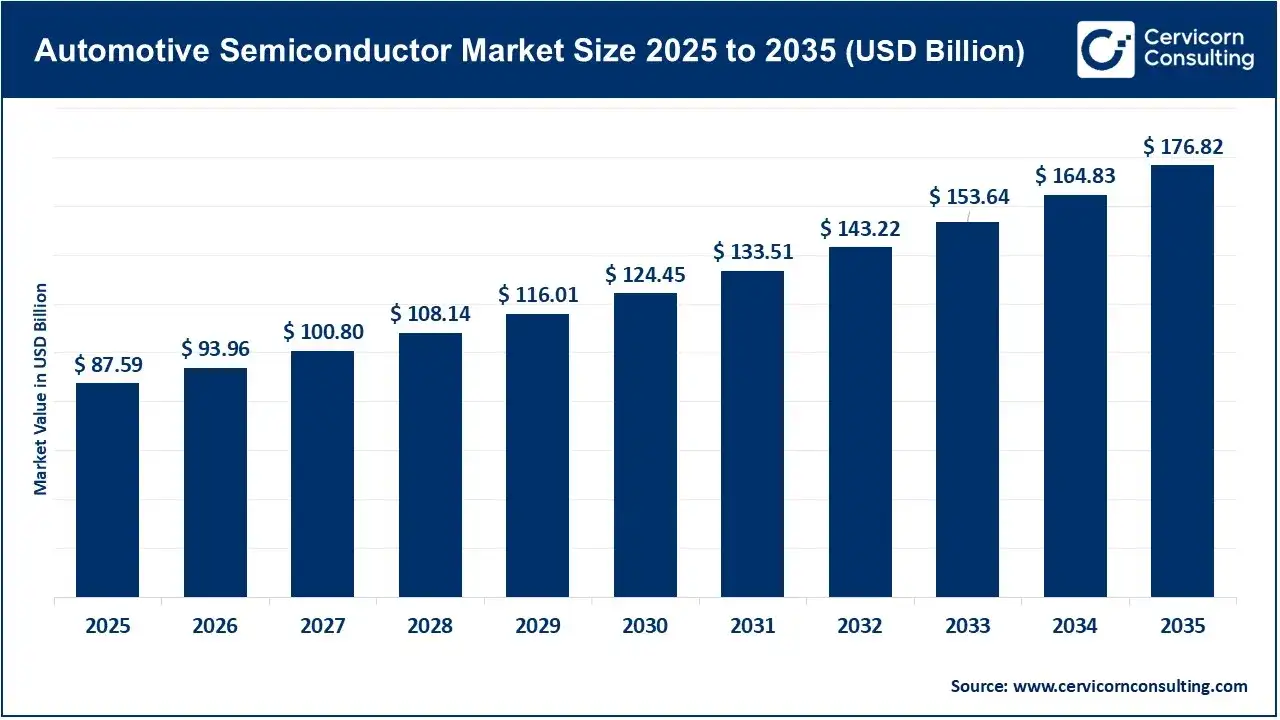
The global automotive semiconductor market size was valued at USD 87.59 billion in 2025 and is projected to grow from USD 93.96 billion in 2026 to nearly USD 176.82 billion by 2035, registering a CAGR of 7.3% over the forecast period 2026 to 2035. The market is driven by the increasing use of electronic systems in vehicles, rising electric vehicle adoption, growing demand for advanced safety features, and the shift toward connected and software defined vehicles. Pertrain systems, safety features, body electronics, infotainment, connectivity, and vehicle control are increasingly using semiconductors. Modern vehicles are becoming more dependent on semiconductor technologies due to the growing adoption of software-defined vehicles, electric vehicles, and advanced driver-assistance technologies.
In April 2026, Infineon Technologies announced that it remained the world's leading automotive semiconductor supplier for the sixth consecutive year, highlighting its strong position in automotive microcontrollers and other semiconductor technologies.
Report Highlights
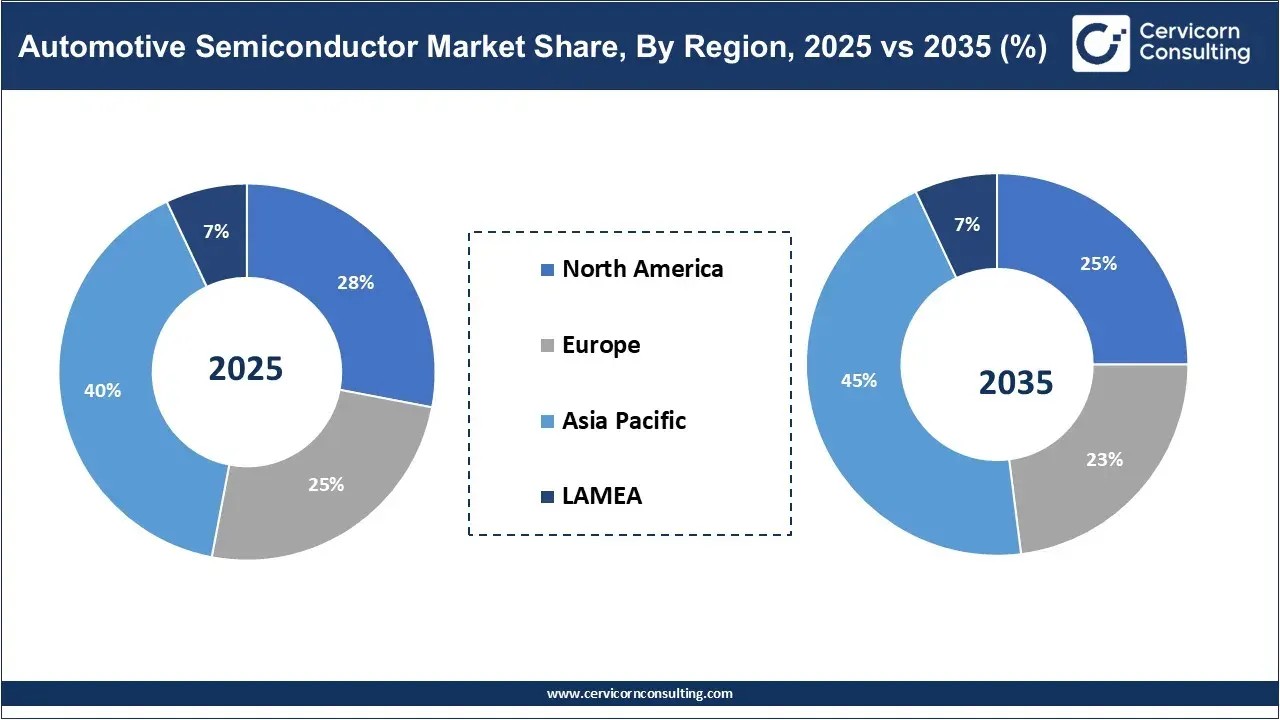
- By region, Asia Pacific generated highest revenue share of 40% in 2025, driven by strong automotive production and semiconductor demand.
- By region, Europe is expected to register strong growth, supported by EV adoption and advanced automotive technologies.
- By component, processor held the largest revenue share of 28% in 2025, driven by rising demand for advanced vehicle electronics.
- By component, memory device is expected to register strong growth as rising data volumes from ADAS, infotainment, connectivity, and autonomous driving increase demand for high-capacity memory solutions.
- By vehicle type, SUV held the largest revenue share of 42% in 2025, supported by strong demand for feature-rich vehicles and higher semiconductor content.
- By vehicle type, hatchback & sedan are expected to register strong growth with rising adoption of connected and automated systems.
- By propulsion type, ICE held the largest revenue share of 55% in 2025, supported by continued vehicle demand and the large installed base of conventional vehicles.
- By propulsion type, EV is expected to register strong growth with increasing electric vehicle adoption and higher semiconductor integration.
- By application, powertrain held the largest revenue share of 32% in 2025, driven by increasing electronic integration in propulsion, power management, engine control, and energy management systems.
- By application, safety & ADAS is expected to register strong growth as automakers increasingly adopt advanced safety and driver-assistance technologies.
Latest Trends
- Rising vehicle electrification: Growing EV adoption is increasing demand for power semiconductors, battery-management systems, and power-control technologies.
- Growth of ADAS: Increasing adoption of advanced safety features is creating demand for processors, sensors, radar, and other semiconductor technologies.
- Shift toward software-defined vehicles: Automakers are moving toward centralized computing and software-controlled vehicle functions.
- Increasing semiconductor content: Modern vehicles require more chips for safety, connectivity, infotainment, power management, and vehicle control.
- Growing use of advanced power semiconductors: Silicon carbide and other advanced materials are gaining importance in electric vehicle power systems.
- Rise of AI-enabled vehicles: AI is increasingly being used for advanced driving, vehicle perception, safety, and intelligent in-car functions.
Government Initiatives
| Country/Region |
Government Initiative / Policy |
Key Focus |
| United States |
Inflation Reduction Act (IRA) |
EVs, batteries, and clean-energy manufacturing |
| European Union |
European Chips Act |
Strengthening Europe's semiconductor ecosystem |
| China |
Made in China 2025 / semiconductor development programs |
Domestic semiconductor and advanced manufacturing capabilities |
| Japan |
Government semiconductor revitalization initiatives |
Domestic semiconductor manufacturing and technology development |
| South Korea |
K-Semiconductor Strategy |
Semiconductor manufacturing, infrastructure, and R&D |
| India |
India Semiconductor Mission (ISM) |
Semiconductor fabrication, packaging, and ecosystem development |
| Taiwan |
Semiconductor industry support policies |
Advanced chip manufacturing and R&D |
| Germany / EU |
IPCEI on Microelectronics and Communication Technologies |
Strategic semiconductor R&D and manufacturing |
Market Dynamics
Driver
The growing use of electronic systems, electric vehicles, connected technologies, and advanced safety features is driving demand for automotive semiconductors. Modern vehicles require chips for connectivity, entertainment, safety, and vehicle computing, while EVs require semiconductors for battery management, power conversion, charging, and motor control. Thus, market expansion is being supported by the increasing semiconductor content per vehicle.
- In January 2026, Texas Instruments introduced new automotive semiconductor technologies, including high-performance computing SoCs, 4D imaging radar, and automotive Ethernet solutions, supporting the growing demand for safer and more automated vehicles.
Restraint
The necessity for highly dependable automotive-grade components, complicated qualification requirements, supply-chain risks, and high production costs can limit market expansion. Automotive semiconductors can have lengthy research and production cycles and must adhere to stringent safety and quality standards. Manufacturers may face risks if they rely on concentrated global supply chains.
Opportunity
Semiconductor manufacturers are seeing new opportunities as a result of the rapid growth of software-defined vehicles, autonomous driving, connected cars, and electrified vehicles. As vehicles become more sophisticated and electronically integrated, there will likely be greater demand for high-performance computing systems, sensors, power devices, memory, and automotive networking technologies.
- On 24 June 2026, Infineon Technologies announced the production of its new 8Tx8Rx automotive imaging radar MMIC, supporting centralized radar architectures and the growing use of advanced sensing technologies in vehicles.
Key Technological Shifts
- From conventional to software-defined vehicles: Vehicle functions are increasingly controlled through software and centralized computing systems.
- From distributed to centralized architectures: Automakers are moving toward centralized and zonal architectures to manage growing electronic systems more efficiently.
- From traditional silicon to advanced power technologies: Silicon carbide and other advanced materials are gaining importance in high-efficiency EV power systems.
- Rise of AI-powered automotive computing: AI is increasingly being used for ADAS, autonomous driving, and intelligent vehicle functions.
- Growth of advanced sensing: Radar, cameras, LiDAR, and other sensors are becoming increasingly important for vehicle safety and automation.
Regulatory Framework for Automotive Semiconductor Industry
Automotive safety, cybersecurity, software updates, pollution, and electronic system dependability are the main concerns of the automotive semiconductor regulatory framework. Software update management is covered by UN R156, whereas vehicle cybersecurity is covered by UNECE standards such as UN R155. As vehicles become more software-driven and connected, these requirements are becoming increasingly important.
- In June 2026, UNECE adopted a global framework for automated driving systems, establishing requirements for safety management, testing, validation, and monitoring. Such developments are expected to increase demand for reliable and safety-focused semiconductor technologies.
Regional Analysis
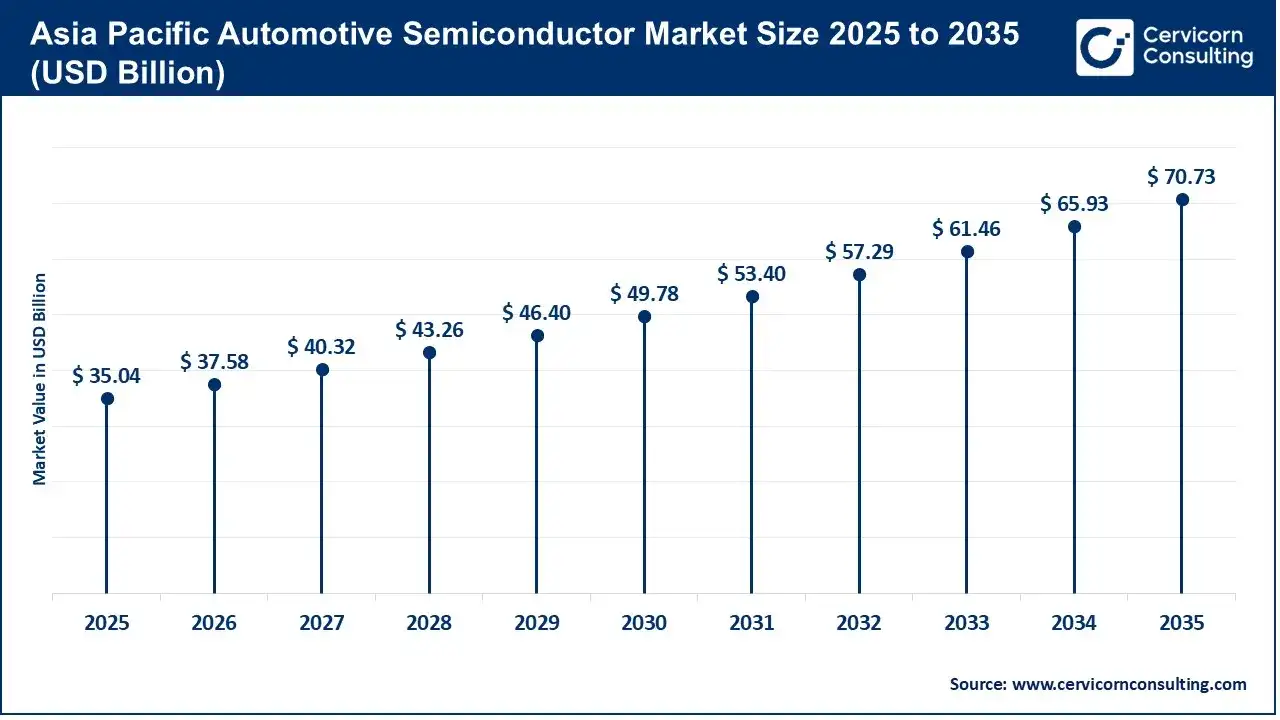
The Asia Pacific automotive semiconductor market size was valued at USD 35.04 billion in 2025 and is forecasted to reach USD 70.73 billion by 2035. The Asia Pacific region held the largest revenue share in the automotive semiconductor market in 2025, backed by a mature semiconductor ecosystem and a robust automobile manufacturing base. China, Japan, South Korea, India, and other countries have developed into significant hubs for the manufacture of automobiles and automotive electronics. The need for automotive semiconductors used in power management, battery systems, sensors, and advanced electronic controls is rising due to the rapid uptake of electric vehicles. The regional supply chain is also being strengthened by rising investments in automotive technology and semiconductor production.
The Europe automotive semiconductor market size was estimated at USD 21.90 billion in 2025 and is projected to hit USD 44.21 billion by 2035. Europe is expected to register strong growth during the forecast period as automakers invest more in software-defined, connected, autonomous, and electrified vehicles. The use of advanced automotive electronics is also being encouraged by strict vehicle safety and pollution standards. Further investments in semiconductor technologies and initiatives to strengthen the regional automotive supply chain are expected to generate additional opportunities.
Segmental Analysis
Component Analysis
The processor segment held the largest revenue share in the automotive semiconductor market in 2025, driven by the growing use of high-performance computing systems in modern vehicles. ADAS, autonomous driving, digital cockpits, infotainment, connectivity, and centralized vehicle computing all make extensive use of processors. The demand for automotive processors is rising due to the increased use of software-defined vehicles and sophisticated electronic architectures.
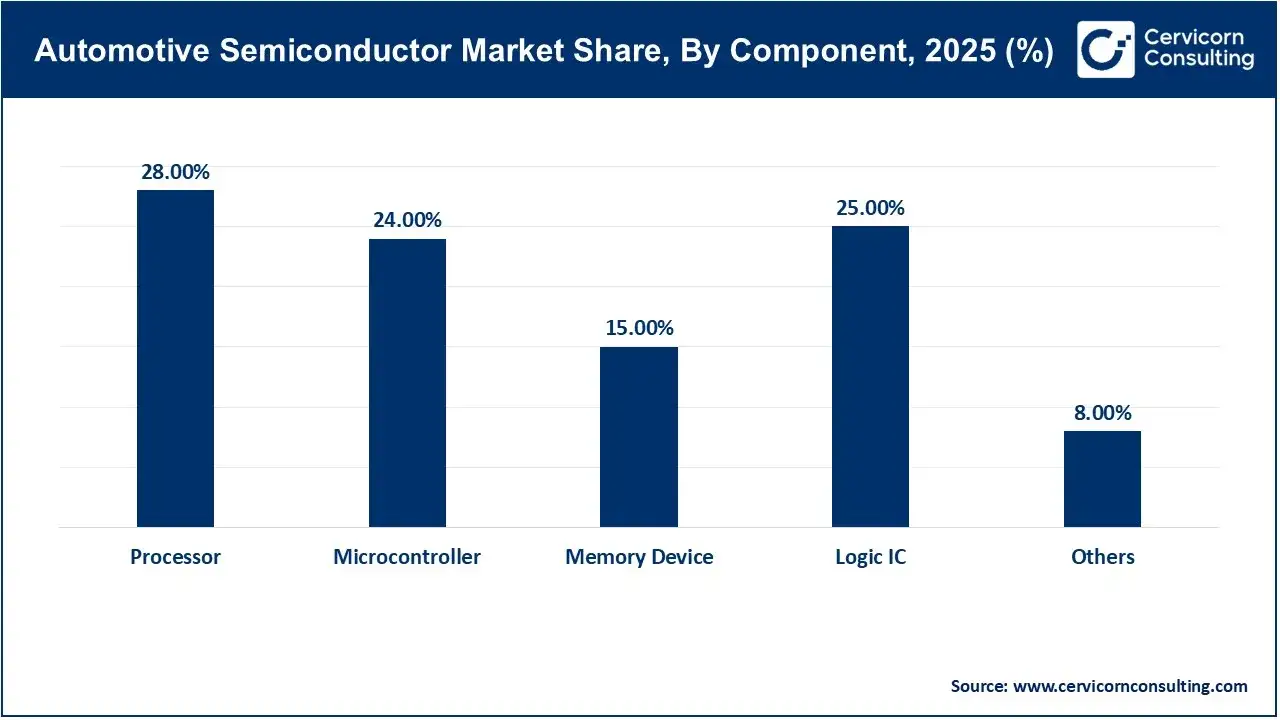
The memory device segment is expected to register strong growth during the forecast period. ADAS, infotainment, connectivity, and autonomous driving technologies are contributing to the growing volumes of data that vehicles produce and process. The demand for high-capacity and high-performance memory solutions is rising due to the expanding use of centralized computing and AI-enabled automotive applications.
Vehicle Type Analysis
The SUV segment held the largest revenue share in the automotive semiconductor market in 2025, driven by the growing incorporation of advanced electronic systems in SUVs and robust consumer demand for these vehicles. ADAS, infotainment, connectivity, digital displays, and electronic control systems are becoming increasingly common in modern SUVs. Semiconductor content per vehicle is rising due to the increasing use of high-end, technologically sophisticated SUVs.
Automotive Semiconductor Market Share, By Vehicle Type, 2025 (%)
| Vehicle Type |
Revenue Share, 2025 (%) |
| Hatchback & Sedan |
28% |
| SUV |
42% |
| LCV |
18% |
| HCV |
12% |
The hatchback & sedan segment is expected to register strong growth during the forecast period as automakers progressively incorporate digital technologies, electrification, enhanced safety systems, and connected features into these vehicle categories. Higher semiconductor integration is being encouraged by growing consumer demand for safer and more connected automobiles. Adoption of both sedans and hatchbacks is being supported by the growth of affordable automotive electronics.
Propulsion Type Analysis
The ICE segment held the largest revenue share in the automotive semiconductor market in 2025, fueled by the continued production of conventional automobiles and the substantial installed base of internal combustion engine vehicles worldwide. Semiconductors are needed for entertainment, connectivity, safety systems, engine management, emissions control, and electronic control functions in internal combustion engine vehicles. Demand for semiconductors is sustained by the growing electronic content of conventional vehicles.
Automotive Semiconductor Market Share, By Propulsion Type, 2025 (%)
| Propulsion Type |
Revenue Share, 2025 (%) |
| ICE |
55% |
| EV |
45% |
The EV segment is expected to register strong growth during the forecast period because battery management, power conversion, motor control, charging, and energy management in electric vehicles require a higher degree of semiconductor integration. Power semiconductors and other automotive chip technologies are in greater demand due to rising EV adoption and investments in vehicle electrification.
Application Analysis
The powertrain segment held the largest revenue share in the automotive semiconductor market in 2025, driven by the growing use of electronic systems for vehicle propulsion, energy efficiency, power management, and engine control. The need for semiconductors in powertrain systems, such as battery management, inverters, motor control, and power conversion, is growing as a result of the electrification trend. The market is expanding due to rising demand for technologically advanced and efficient vehicles.
Automotive Semiconductor Market Share, By Application, 2025 (%)
| Application |
Revenue Share, 2025 (%) |
| Powertrain |
32% |
| Safety & ADAS |
28% |
| Infotainment & Connectivity |
25% |
| Others |
15% |
The safety & ADAS segment is expected to register strong growth during the forecast period as automakers incorporate more sophisticated safety features such as lane assistance, adaptive cruise control, automated emergency braking, and collision avoidance. Processors, sensors, cameras, radar, and other semiconductor components are required for these systems. The development of autonomous driving technologies and stricter vehicle safety regulations are driving up demand.
Semiconductor Type Analysis
The silicon-based semiconductor segment held the largest revenue share in the automotive semiconductor market in 2025, driven by its extensive application in electrical components, power management, sensors, computing, and vehicle control systems. A well-established manufacturing ecosystem, wide availability, and demonstrated dependability in automotive applications are advantages of silicon-based semiconductor technology. Their widespread application in both conventional and electric vehicles keeps them at the top of the market.
Automotive Semiconductor Market Share, By Semiconductor Type, 2025 (%)
| Semiconductor Type |
Revenue Share, 2025 (%) |
| Silicon-Based Semiconductor |
85% |
| Gallium Nitride Semiconductor |
5% |
| Silicon Carbide Semiconductor |
10% |
The gallium nitride semiconductor segment is expected to register strong growth during the forecast period as automakers increasingly seek compact, high-efficiency power solutions for electric vehicles. GaN devices can support advanced power-management applications, fast charging, and efficient power conversion. GaN-based automotive semiconductors are anticipated to benefit from increased electrification and the need to improve energy efficiency.
Recent Developments
- In January 2026, Texas Instruments introduced new automotive semiconductors, including high-performance computing SoCs, an 8x8 4D imaging radar transceiver, and an automotive Ethernet PHY, supporting ADAS, software-defined vehicles, and autonomous driving applications.
- In April 2026, Infineon Technologies announced that it retained its position as the world's leading automotive semiconductor supplier for the sixth consecutive year, according to TechInsights' 2025 market analysis. The company also reported a 36% market share in automotive microcontrollers.
- In August 2026, Infineon Technologies and MediaTek announced collaboration on future automotive smart cockpit solutions, with MediaTek qualifying Infineon's automotive-grade NOR Flash for its Dimensity Auto Cockpit platform.
Top Companies
Segments Covered
By Component
- Processor
- Microcontroller
- Memory Device
- Logic IC
- Others
By Vehicle Type
- Hatchback & Sedan
- SUV
- LCV
- HCV
- By Propulsion Type
- ICE
- EV
By Application
- Powertrain
- Safety & ADAS
- Infotainment & Connectivity
- Others
By Semiconductor Type
- Silicon-Based Semiconductor
- Gallium Nitride Semiconductor
- Silicon Carbide Semiconductor
By Region
- North America
- Europe
- Asia Pacific
- Latin America
- Middle East & Africa
