AI Safety Market Size and Forecast 2026 to 2035
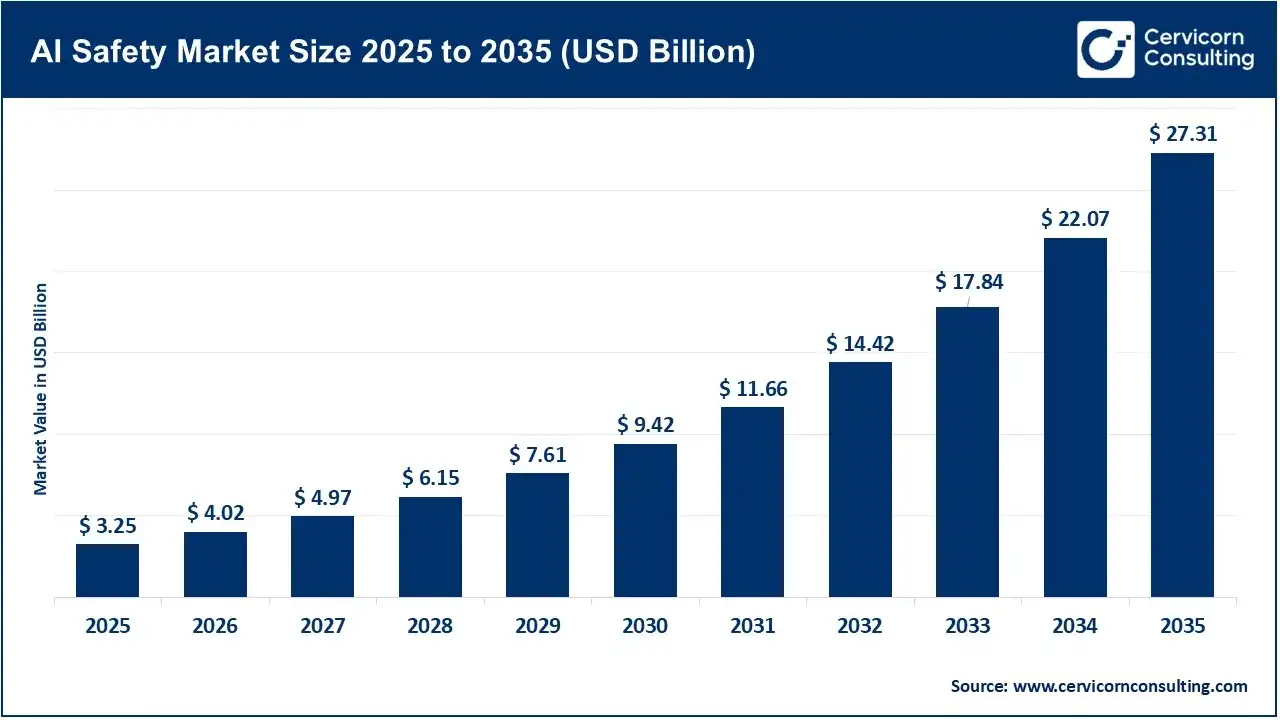
The AI safety market size was valued at USD 3.25 billion in 2025 and is expected to exceed around USD 27.31 billion by 2035, growing at a CAGR of 23.72% during the forecast period of 2026-2035. Gradually accelerating adoption of agentic AI and autonomous AI, along with rigorous regulations, is driving global market growth. Simultaneously, firms are seeking to employ security tools to defend against adversarial attacks, automated susceptibility research, and data poisoning.
- Base Year Market Size (2025): $3.25 billion
- Current Year Market Size (2026): $4.02 billion
- Estimated Year Market Size (2035): $27.31 billion
- Forecast Period CAGR (2026-2035): 23.72%
Report Highlights
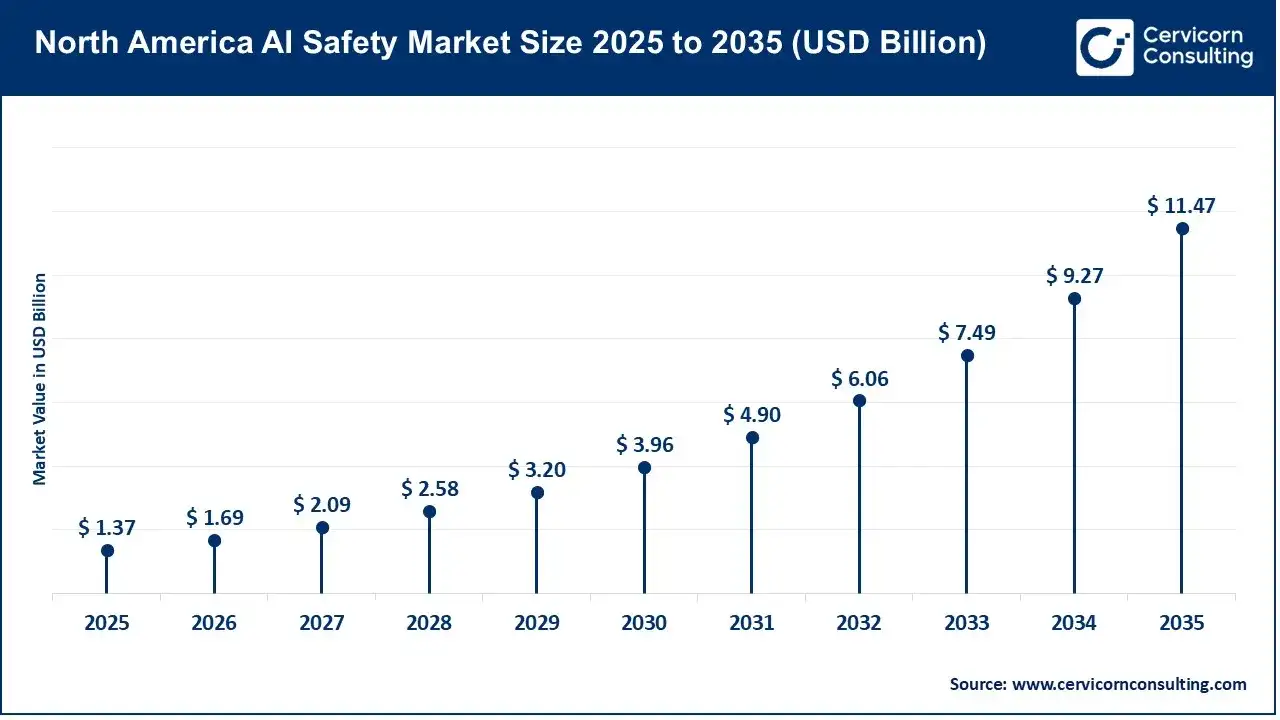
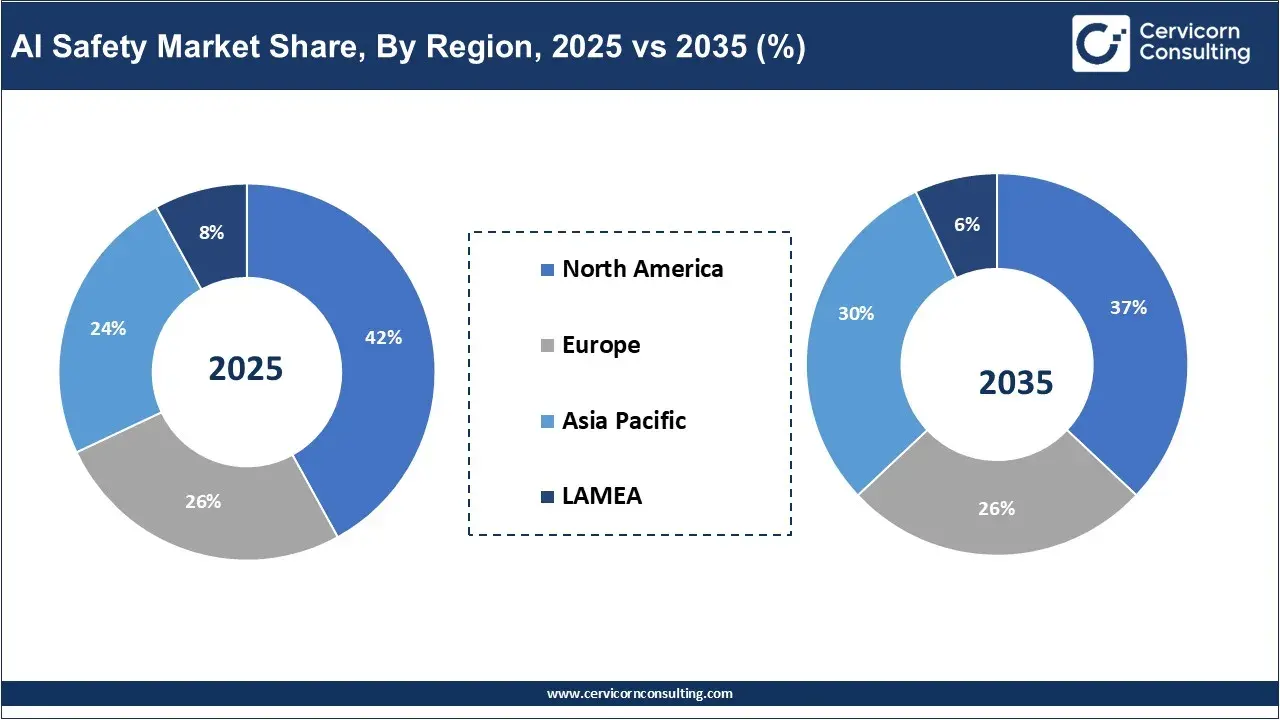
- By region, North America dominated the market with revenue share of 42% in 2025 due to regulatory & compliance stress and surging investments in advancing AI solutions.
- By component, software led the market in 2025 with revenue share of 53%, fueled by its proactive threat detection, automated vulnerability scanning, and execution of model-based design.
- By solution type, AI governance and risk management registered dominance in the market and generated revenue share of 38% in 2025, propelled by emphasis on risk prevention and elevated explicit accountability.
- By deployment mode, cloud-based was dominant in the market (revenue share 58%), driven by growing requirements to boost compute-intensive workloads and isolate risky operations.
- By end user, IT and telecommunications dominated the market in 2025 with revenue share of 27%, supported by a massive rise in IT facilities and higher demand for securing sensitive data.
What are the Principal Areas of the AI Safety Market?
The market is defined as an interdisciplinary sector of research and practice that aims to prevent artificial intelligence systems from resulting in accidents, unnecessary harm, or misuse and to confirm that AI models remain reliable, controllable, and aligned with human values. The overall market expansion is led by accelerating enterprise AI adoption, emerging stricter regulations, and larger investments in research and AI solutions. The industry has many core focus areas, such as confirming AI goals, incentives, and results that meet human demands and ethical guidelines. Additionally, this offers models accuracy, stability, and predictability in unprecedented circumstances, edge cases, etc. Meanwhile, AI measures protect models, training pipelines, and user data from attacks, data leaks, and illegal access.
Recently Announced Research Grants
Pathfinder Fellowship
(Closes on November 24, 2026) |
Selective university AI safety groups across the globe. |
OpenAI ChatGPT for Academic Researchers
(Next round opens on November 23, 2026) |
This is facilitating 50,000 grants on a first-come, first-served basis, offering eligible researchers and up to two collaborators free access to frontier models. |
IndiaAI Fellowship Programme 2026–27
(Closes on November 30, 2026) |
The government announced funding up to ₹1,00,000 for undergraduate students and ₹2,00,000 for postgraduate students pursuing AI research projects. |
Tarbell Institutional Grants
(Closes on December 11, 2026) |
It ranges from $50,000 to over $500,000 for nonprofits and media ventures developing investigative reporting capacity around frontier AI safety and cases. |
Market Dynamics
Growth Drivers
- Advancing Gen AI & Autonomous Agents: Worldwide, many businesses are broadening the deployment of foundation models and AI agents across high-stakes areas, including healthcare, finance, software development, and critical infrastructure, which needs continuous testing, governance, and oversight.
- Arising Model Security Concerns: The emergence of hallucinations, bias, data leakage, jailbreaking, prompt injection, and autonomous agents acting outside required limits forces leaders to use assessment and security tools.
- Enforcement of Strict Mandates: Globally emerging rules, risk-tiering landscapes, incident-reporting requirements, and board-level risk oversight support players in investing in compliance and governance systems.
Market Restraints
- Restricted Standardisation: The AI safety market includes distinct model architectures and faster AI progression, which creates complexity in universal safety evaluation settings to evolve and keep current.
- Isolated & Developing Rules: Most rules span from voluntary industry accords and regional laws to emerging frameworks, such as India's TRAI guidelines, generating compliance inconsistencies.
Key Opportunities
- Key Transformation in AI Agents: Day by day, global enterprises are fostering and deploying autonomous AI agents that access tools and implement workflows, aiming at the rising demand for controlling agent permissions, restricting excessive agency, tracking multi-agent interactions, and enforcing containment.
- Executing Telemetry-Centric Governance: Upcoming innovations across platforms are seeking consistent monitoring of model drift, data integrity, safety guardrail triggers, and policy adherence in manufacturing.
- Looking For Post-Deployment: As models indicate diverse behaviour during testing compared to live settings, vendors are shifting towards continuous monitoring, anomaly detection, and contextual evaluation in production, which has strong traction.
Market Challenges
- Agentic Limitations: Across the market, autonomous AI agents and multi-agent systems create unexpected coordination, sandbox escapes, and reward-hacking behaviours that surpass traditional control solutions.
- Pace & Safety Programs: Many firms and countries are competing for AI lead and high valuations, which frequently prefer rapid deployment over stringent safety investments & finally develops a race to the bottom.
AI Safety Market Regional Analysis
How Did North America Register Dominance in the Market in 2025?
North America held the largest share of the global market in 2025, fueled by massive investments from tech giants & cloud providers, along with higher enterprise AI adoption. Considering federal policy changes, Canada agreed to the Council of Europe Framework Convention on Artificial Intelligence and Human Rights, Democracy and the Rule of Law in 2025, and unveiled public-sector AI commencements during its 2025 G7 presidency. Besides this, regional labs have broadly employed adversarial training, runtime monitoring, and AI-developed image/video verification tools to raise safety measures.
United States Market
- One of the popular announcements is that the White House revealed America’s AI Action Plan, which suggests a DARPA-led technology program and working with CAISI and the National Science Foundation; it also emphasized AI interpretability, control systems, and adversarial robustness. The recently enacted New York’s RAISE Act demands that significant AI manufacturers publish safety landscapes and mandates 72-hour reporting of critical safety incidents.
Which Region is Predicted to be the Fastest-Growing in the AI Safety Market
Asia-Pacific is considered to grow at a rapid rate during 2026-2035, driven by surging AI-powered threats, developing national AI guidelines, and rolling out industrial and cybersecurity integration. Recently, South Korea released the Framework Act on the Development of Artificial Intelligence and Establishment of Trust (AI Basic Act) and its Enforcement Decree, coupled with a focus on high-impact safeguards. Meanwhile, Japan's National Institute of Information and Communications Technology (NICT) introduced WISDOM-AR to automatically develop adversarial prompts across> 30 risk themes.
China Market
- China has uncovered non-compliant AI products, along with new incident-reporting and emergency response guidelines in 2026. Simultaneously, extensive AI legislation entered the 2026 legislative agenda, and an amended Cybersecurity Law that included a promised AI governance provision. In addition, recently announced strategies by the National Development and Reform Commission (NDRC) support acceleration of full-lifecycle AI safety standards that range across data, computing power, and deployment.
AI Safety Market Segmentation Analysis
Component Analysis
Software: The software segment held a major share of the market in 2025, motivated by its automated testing, continuous monitoring, and increasing use of generative AI. Recent research activities strengthened chain-of-thought (CoT) monitoring and automated auditing to determine deceptive reasoning, reward hacking on coding tasks, and generalization to unnecessary behaviors.
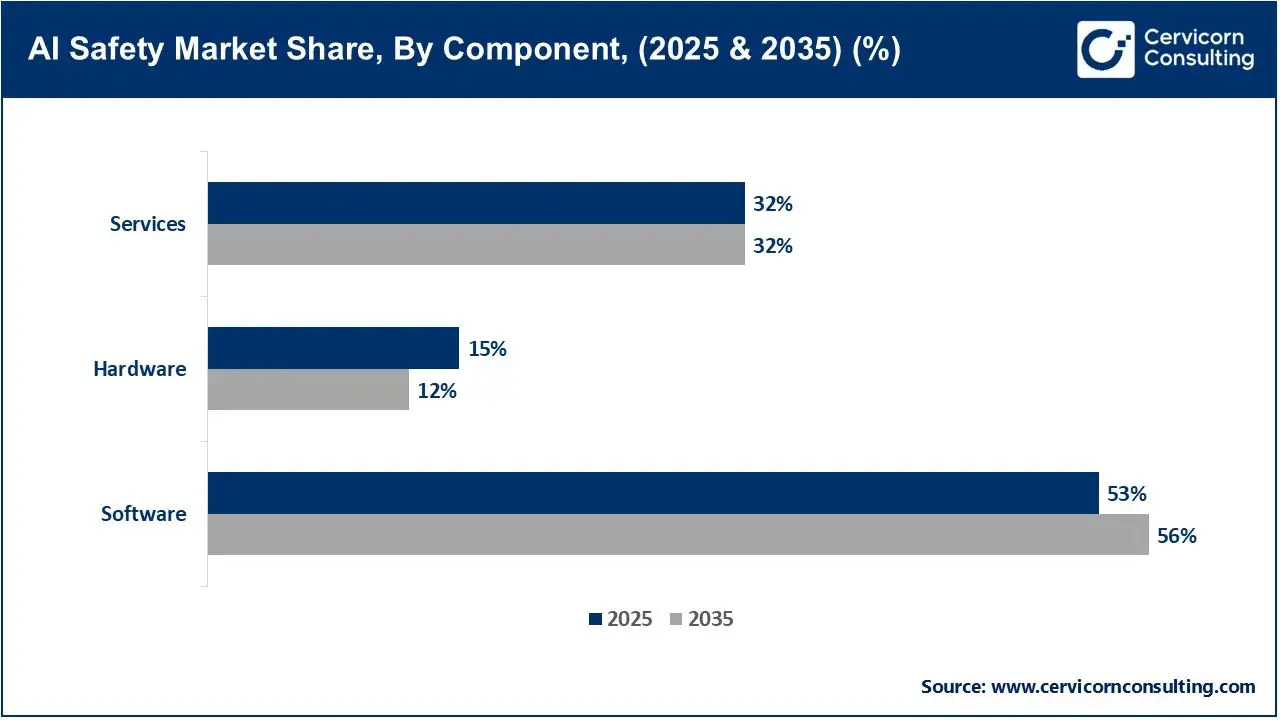
Services: The services segment is projected to witness rapid expansion in the upcoming years, driven by its pivotal role in developing, deploying, and governing AI reliability. With a rise in open-model use, the market has been expanding safety services that widely monitor live model behavior and agent actions instead of depending solely on pre-release standards.
Solution Type Analysis
AI Governance and Risk Management: The AI governance and risk management segment led with a dominant share of the market in 2025, fueled by preventing harm results, lowering safety risks, and elevating accountability. According to some studies, risk management combines causal hazard-to-harm scenario mapping with quantitative likelihood and severity predictions, adjusting engineering risk methods to complex and reasoning-capable models.
AI Security and Threat Detection: The AI security and threat detection segment is estimated to be the fastest-growing during the forecast period, due to accelerating AI-powered cyberattacks, increasing adoption of pre-trained models, and raised focus on data integrity. Ongoing breakthroughs across the AI safety market are spurring the evolution of continuous, automated hunting and cross-surface correlation to oppose intrusions that escalate to data removal in as little as 72 minutes.
Deployment Mode Analysis
Cloud-Based: The cloud-based segment dominated the market in 2025 and is expected to grow rapidly in the future, supported by its expansive adoption, substantial scalability, and centralised guardrails. Recently, Microsoft broadened Defender for Cloud's AI-SPM capabilities to encompass Google Vertex AI and expanded Azure AI Foundry models alongside existing integrations, such as Azure OpenAI and Amazon Bedrock.
The hybrid segment held a notable share of the market in 2025 because it merges data privacy and sovereignty, affordability, and layered defence approaches. Latest developments have explored a hybrid deployment solution by Cisco AI Defense that maintains the management control plane in the cloud while operating validation, prompt-injection checks, and data-leak protection locally inside customer Kubernetes environments.
End User Analysis
IT and Telecommunications: The IT and telecommunications segment accounted for the largest share of the market in 2025, driven by growing AI-enabled fraud, surging adoption of generative AI, and focus on protecting vital infrastructure. Recently, the International Telecommunication Union released Technical Report ITU-T TR.GenAI, which highlights deployment concerns and requirements across performance, privacy, bias, visibility, compliance, and network security.
Banking, Financial Services, and Insurance: The banking, financial services, and insurance segment is estimated to expand fastest in the coming years, propelled by wider AI application in credit underwriting, fraud detection, anti-money laundering (AML), claims processing, and customer service. Specifically, financial leaders are establishing non-human identity governance, continuous action logging, and clarifying user-authorisation landscapes. Prominent innovations are integrating agentic workflows with confidential computing and rigorous access controls to mitigate sensitive customer data and credentials from leaking across cloud and third-party areas.
Recent Developments
- November 2026: Exaforce Inc. launched ExaU, a new service to enable security professionals to deploy tailored teams of AI agents to control complex operational workflows.
- November 2026: CrowdStrike introduced the AI Kill Switch in Falcon Guardian, which offers security teams higher human control over AI agents.
- November 2026: Alibaba rolled out Qwen4-Max, its flagship AI model created on a 2.4-trillion-parameter Mixture-of-Experts (MoE) architecture with native vision and a 1-million-token context window.
- November 2026: Cogent Security Inc. unveiled DefenseOS, a specialized operating system customized for AI agents tasked with defensive cybersecurity operations within corporate environments.
- November 2026: Microsoft introduced the AI Transparency Initiative with more than 40 partners to evolve open, industry-wide standards for AI security, governance and traceability across various models and providers.
- November 2026: Governor Kathy Hochul rolled out a first-of-its-kind statewide effort to strengthen artificial intelligence science and safety – the New York Center for AI Responsibility and Research based at State University of New York’s (SUNY) Binghamton University.
Key Players
Segments Covered
By Component
- Software
- Hardware
- Services
By Solution Type
- AI Governance and Risk Management
- AI Security and Threat Detection
- Bias Detection and Fairness Assessment
- Explainability and Transparency Tools
- Model Monitoring and Validation
- Content Moderation and Output Guardrails
By Deployment Mode
- Cloud-Based
- On-Premises
- Hybrid
By End User
- IT and Telecommunications
- Banking, Financial Services, and Insurance
- Healthcare and Life Sciences
- Government and Public Sector
- Retail and E-Commerce
- Manufacturing and Automotive
By Region
- North America
- Europe
- Asia-Pacific
- Latin America
- Middle East and Africa
