AI-RAN Market Size and Growth 2026 to 2035
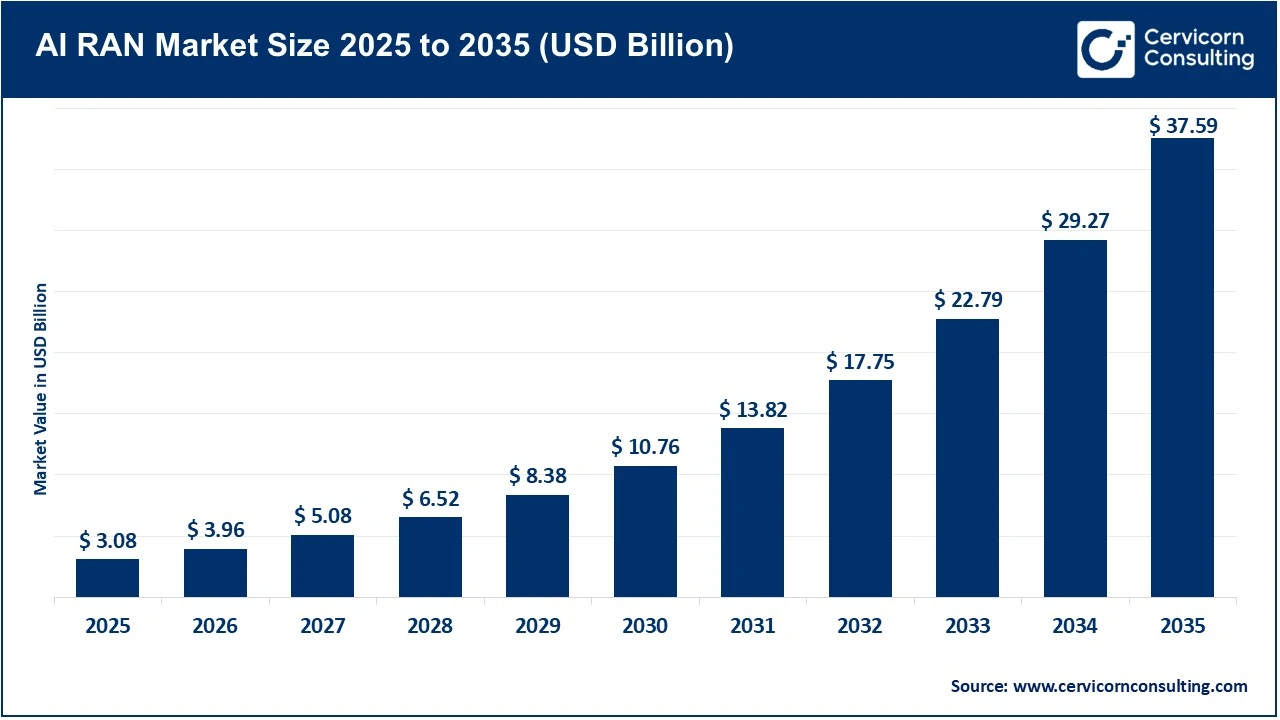
The global AI-RAN market size reached USD 3.08 billion in 2025 and is expected to be worth around USD 37.59 billion by 2035, exhibiting a compound annual growth rate (CAGR) of 28.5% over the forecast period from 2026 to 2035. The primary driver of the artificial intelligence radio access network (AI-RAN) market is the growing need for network automation and operational efficiency. As operators deploy advanced technologies such as MIMO and beamforming, the number of configuration parameters has increased dramatically, making manual optimisation of each parameter impractical. In 2025, AI-driven autonomous networks are expected to reduce operational expenditures (OpEx) by approximately 25% for Tier-1 operators by automating fault detection and self-healing capabilities. For example, by utilizing machine learning to analyze traffic patterns, the AI-RAN system can dynamically reallocate resources to areas of high load, enabling instantaneous resource allocation without human intervention.
The increasing need for spectrum optimization and capacity management in evolving 5G and upcoming 6G networks is another major growth driver of the market. AI-RAN architectures utilise advanced deep learning algorithms to optimise frequency usage, reduce interference, and enhance signal transmission paths. These capabilities are critical for managing rising network density and data traffic in urban environments. Furthermore, AI is playing an essential role in enabling the transition towards “AI-native” air interfaces, which are expected to be a foundational component of 6G networks. The introduction of AI-based spectrum management is yielding spectral efficiencies that exceed 35% gains over traditional 5G deployments in urban environments.
Report Highlights
- By Region, North America dominates the regional segment, capturing around 38%, mainly due to the strong presence of leading telecom and AI companies.
- By Component, the software segment capturing highest revenue share of 40%, primarily due to increasing adoption of AI-driven network automation, analytics, and intelligent traffic management solutions.
- By Component, the hardware is the fastest-growing segment with 35% share, mainly because of the increasing demand for GPUs, AI accelerators, and edge computing infrastructure.
- By deployment, the on-premises segment leading with 55% of the market share, primarily due to low latency requirements, enhanced data security, and better control over network operations.
- By deployment, the cloud deployment is the fastest-growing segment with around 45% share, supported by scalability, flexibility, and the ability to efficiently deploy AI models across distributed networks.
- By RAN technology, the open RAN (O-RAN) segment dominates the market, accounting for 45% of the market, due to its flexibility, interoperability, and strong industry support for multi-vendor ecosystems.
- By RAN technology, the hybrid RAN is the fastest-growing segment with 25% share, primarily driven by gradual transition strategies adopted by telecom operators from traditional to AI-enabled networks.
- By End-user, the telecom operators dominate the segment, capturing around 70% of the market, mainly due to their central role in deploying and managing RAN infrastructure.
- By End-user, the government is the fastest-growing segment with around 10% share, driven by increasing investments in smart cities, and national 5G initiatives.
Prioritization of Energy Sustainability and Green RAN Infrastructure
Energy sustainability and the adoption of green RAN infrastructure are emerging trends shaping the evolution of the AI-RAN market. The growing emphasis on "Green RAN" has become a strategic opportunity for telecom operators, as energy costs constitute a large share of the total network cost. The use of AI is critical to sustainability, enabling organizations to dynamically power down hardware components during periods of low traffic without negatively affecting the quality of service (QoS). This is particularly relevant, as the radio access network (RAN) is reported to account for approximately 80% of a mobile operator's total energy consumption. In early 2026, integrating AI across organizations generated a 15-20% reduction in electricity usage, an important metric for organisations to consider as they work to meet their Environmental, Social, and Governance (ESG) targets while managing the energy consumption of AI processing itself.
Top 5 Trends and Technologies
- AI-Driven Network Automation (SON Evolution): Enables up to 25% OpEx reduction for Tier-1 operators through automated fault detection, self-healing, and real-time optimisation.
- Massive MIMO with AI Optimisation: Improves network capacity and coverage by 30 to 40% by dynamically tuning beamforming and antenna parameters with AI algorithms.
- AI-Based Spectrum Management: Enhances spectral efficiency by over 35% in urban deployments through intelligent frequency allocation and interference mitigation.
- Edge AI Integration in RAN: Reduces latency by 40 to 60% by processing data closer to the user, enabling faster decision-making and real-time resource allocation.
- AI-Native 6G Air Interface Development: Expected to deliver 10x improvements in network efficiency by embedding AI directly into radio protocols and air interface design.
Industry Performance Metrics and Statistical News Highlights
The performance metrics for AI-RAN deployment indicate a clear advantage over legacy systems across multiple pillars. Some key statistics from industry highlights include:
- OpEx Reduction: AI-native automation reduces the cost of maintaining the network by 25%.
- Energy savings: AI-driven "micro-sleep" modes save 15 to 20% power across radio units.
- Latency Improvement: Predictive AI algorithms reduce handoff latency by 10ms in high-speed mobility environments.
- Spectral Efficiency: AI optimises beamforming, increasing data throughput by 22% in congested urban cells.
- Mean-Time-To-Repair (MTTR): Generative AI-based troubleshooting tools reduced MTTR by 40% in trials in early 2026.
What are the key hardware requirements and scalability challenges for deploying AI workloads at the RAN edge?
The implementation of AI-RAN systems requires a shift from conventional Application-Specific Integrated Circuits (ASICs) to more advanced computational platforms such as GPUs and NPUs. Scalability is achieved through the virtualization of the RAN (vRAN), enabling general-purpose servers to run AI workloads alongside traditional networking functions. Additionally, current developments focus on “AI-on-5G” platforms, where a single hardware unit can handle both 5G signal processing and edge AI inference, delivering up to 3x higher hardware utilisation compared to discrete systems.
Key Challenges
- Compute Overhead: Running AI and network workloads simultaneously increase computational demand, potentially leading to higher energy consumption than the savings achieved through AI optimization.
- Power Efficiency Constraints: Edge deployments require low-power hardware, making it challenging to balance performance with energy efficiency.
- Scalability Complexity: Virtualized RAN environments introduce orchestration and resource management challenges at scale.
- Hardware Cost & Upgrades: Transitioning from ASICs to GPUs/NPUs involves significant infrastructure investment and upgrade cycles.
Advancements in Infrastructure and Hardware
- NPU Integration: The emergence of Neural Processing Units designed for low-power AI inference at the base station.
- Converged Compute: Hardware platforms capable of running 5G L1/L2 processing and AI workloads on a single architecture.
- Edge Intelligence from Space: The extension of AI-RAN concepts to Non-Terrestrial Networks (NTN) to provide global, ubiquitous connectivity by LEO satellites.
Report Scope
| Area of Focus |
Details |
| Market Size in 2026 |
USD 3.96 Billion |
| Market Size in 2035 |
USD 37.59 Billion |
| CAGR 2026 to 2035 |
28.50% |
| Top-performing Region |
North America |
| Highest Growth Region |
Asia-Pacific |
| Key Segment |
Component, Deployment Mode, RAN Technology, End User, Region |
| Key Companies |
Nokia, Ericsson, Huawei, Samsung Electronics, Qualcomm, NVIDIA, Intel, Cisco Systems, NEC Corporation, ZTE Corporation, Mavenir, Rakuten Symphony, Fujitsu, Juniper Networks, VMware |
Recent Major Milestones
1. Corporate Innovation and New Product Launches
Corporate innovation and continuous product development remain major growth drivers in the AI-RAN market. In early 2024, the formation of an AI-RAN Alliance marked a turning point for the industry, with stakeholders including NVIDIA, Ericsson, Nokia, and SoftBank now working together on initiatives that integrate AI with cellular technologies to make networks more efficient and create new revenue streams by offering "AI-at-the-edge" services. In 2025, several vendors launched "AI-native" base stations with built-in hardware acceleration for deep learning.
2. Government Initiatives and National Telecommunications Strategies
Government initiatives and national telecommunications strategies are emerging as critical milestones shaping the AI-RAN market. AI-RAN is increasingly a priority for governments, driven by national security and technology sovereignty. In regions such as the United States and Europe, over USD 1.5 billion in federal grant funding was awarded to projects that integrate AI with Open RAN (O-RAN) to reduce reliance on legacy vendors and strengthen vulnerable supply chains. These investments are accelerating the deployment of secure, distributed AI communication systems capable of operating in contested or high-interference environments, especially in support of public safety and defence missions.
3. Partnerships and Collaborations across Industries
Strategic partnerships and cross-industry collaborations have become a defining feature of the AI-RAN ecosystem. The confluence of telecommunications and AI has spurred partnerships across industries, particularly among telecom equipment manufacturers and AI chip manufacturers. For instance, SoftBank is deploying an AI-powered mobile network in Japan in partnership with NVIDIA. SoftBank has demonstrated, using high-performance GPU platforms, the ability to run 5G RAN and AI workloads on the same infrastructure and has reported a substantial improvement in hardware efficiency. These partnerships are critical for developing the "distributed edge-based collaborative knowledge-sharing" (DECKS) architecture needed to accommodate future networks of autonomous vehicles and urban navigation.
4. Standardization Developments and Regulatory Implications
Advancements in regulatory frameworks and standardisation efforts are playing a crucial role in driving AI-RAN adoption. The integration of AI and machine learning frameworks into global standards has provided the necessary foundation for wider adoption. The 3rd Generation Partnership Project (3GPP) has incorporated AI specifications into Releases 18 and 19, focusing on using AI for air interface optimisation and network management. Moreover, standardisation has directly addressed interoperability among AI-RAN vendors, resulting in nearly a 30% increase in AI-RAN vendor interoperability.
AI-RAN Market Regional Analysis
The AI RAN market is segmented by region into North America, Europe, Asia-Pacific, and LAMEA. Here is a brief overview of each region:
Asia-Pacific AI-RAN Market: Driven by 5G Infrastructure Expansion and High Adoption Intelligence
The Asia-Pacific AI-RAN market size was valued at USD 0.92 billion in 2025 and is expected to hit around USD 11.28 billion by 2035. Asia Pacific is emerging as the fastest-growing region, driven by its extensive 5G infrastructure footprint and rapid adoption of network automation technologies. The region hosts a high density of network nodes in urban environments, where traditional network management approaches are increasingly inefficient. As a result, AI-RAN solutions are being implemented to optimise interference levels and improve handover protocols beyond conventional rule-based systems. In manufacturing hubs in countries such as South Korea and Japan, AI-RAN is helping power "lights-out" factories, where connectivity is low-latency and in sync with robotic precision.
China: Leadership Position in Large-Scale 5G Deployment and AI Patent Activity
China is maximizing its enormous infrastructure base, making it a spectacular global testing ground for AI-native network management.
- Infrastructure Scale: China has built and deployed over 3.5 million 5G base stations, providing the most comprehensive data environment for training RAN-specific AI models.
- Policy Support: The national "AI Plus" initiative identifies telecommunications as a key sector for productivity improvements through the adoption of intelligent automation.
- Economic Impact: AI-enabled optimisation has been credited with a 15% improvement in spectrum efficiency in high-traffic urban districts such as Shenzhen and Shanghai.
India: Accelerated Digital Adoption and National Network Modernization
Asia is the fastest-growing 5G market, and India is utilising AI capabilities to manage historical data and address rising mobile data consumption and network complexity.
- Data Consumption: With the highest smartphone data consumption in the world, India requires AI-driven congestion management to maintain quality of service.
- Spectrum Efficiency: High spectrum acquisition costs are prompting operators to adopt AI to maximise capacity in existing frequency bands.
- Deployment Velocity: Indian telcos are deploying AI-RAN features at a pace aligned with their historic 5G roll-out speeds to maintain network stability.
North America AI-RAN Market: Driven by Cloud-Native AI Integration and R&D Investment
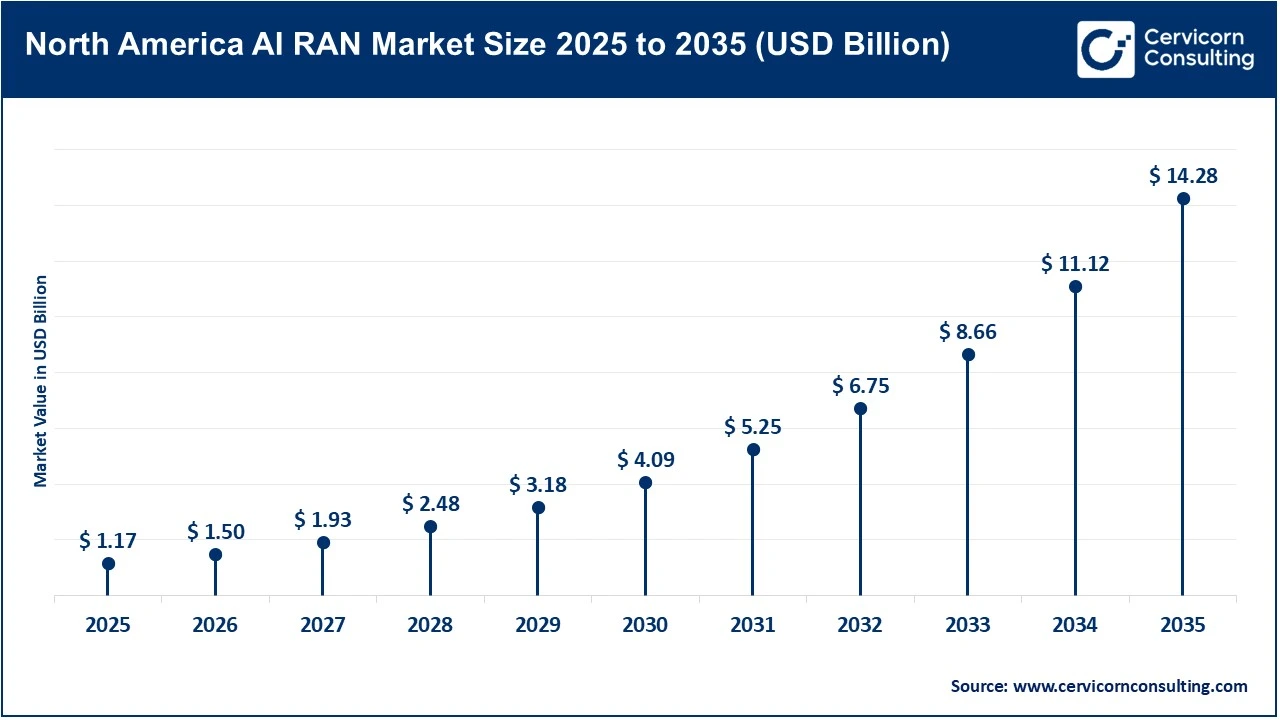
The North America AI-RAN market size was estimated at USD 1.17 billion in 2025 and is projected to reach around USD 14.28 billion by 2035.
North America represents a technologically advanced in the market, characterised by a strong shift towards virtualized RAN (vRAN) and deep integration with cloud ecosystems. The regional strategy focuses on the "brain" of the network through AI-driven capabilities and on partnerships between Tier-1 carriers and leading cloud providers such as AWS, Google Cloud, and Microsoft Azure, which host AI workloads at the network edge. North America has seen a year-over-year increase of approximately 25% in private 5G network investments for enterprise customers. The cloud-native model enables the rapid scaling of AI models while ensuring the infrastructure remains flexible enough to adopt generative AI applications for real-time network troubleshooting and customer experience management.
United States: AI-RAN Architecture and Next-Generation Standard Development
The US is focused on the software-defined architecture and security protocols that will shape the global AI-RAN standard.
- Security Leadership: US policy focuses on "Clean" networks, driving AI development to detect and mitigate cyber threats in real time at the radio interface
- Ecosystem Control: US-based chip manufacturers such as Nvidia and Intel provide the essential hardware-software stacks powering AI-RAN globally.
- Standard Development: The US is leading international coordination of interoperability requirements for AI models in the RAN Intelligent Controller (RIC).
Canada: Telecommunications Software Development and Network Virtualization
Canada's AI-RAN market draws on a strong academic history of AI research and a focus on intelligent resource orchestration.
- Academic Synergy: Canadian operators are collaborating with world-leading academic AI institutes, such as Mila, to develop next-generation optimisation algorithms.
- Sustainability Focus: Canadian telcos are pioneers in AI-driven thermal management of base stations in extreme weather.
- Rural Connectivity: AI is also being used to optimise long-range 5G signals, delivering high-speed broadband to remote and rural communities.
Europe AI-RAN Market: Driven by Regulatory Standardization and Green Energy Policies Affecting the Market
The Europe AI-RAN market size was reached at USD 0.68 billion in 2025 and is forecasted to surpass around USD 8.27 billion by 2035. In Europe, the adoption of AI-RAN is significantly influenced by strict regulatory frameworks and ambitious sustainability targets. A major growth driver in the region is the push towards “Green AI”, where operators will prioritise AI algorithms to significantly reduce the carbon footprint of telecommunications and optimise power consumption on the radio interface. European consortia of telecom operators have committed more than USD 1 billion to AI-enabled energy-efficiency initiatives, aiming for 20% total energy savings across continental networks by 2027.
United Kingdom: Strategic Commitment to Open RAN and Vendor Diversity
The UK has positioned itself as a global leader in Open RAN and is embracing AI to manage the complexity of multi-vendor network environments.
- Research Hubs: Government funding has enabled major AI-RAN testbeds in cities such as London and Bristol to assess real-world performance.
- Regulatory Frameworks: The UK is at the forefront of developing regulatory frameworks for safety and transparency that govern AI used in critical national infrastructure.
- Strategic Investment: Recent funding initiatives include a multi-million-pound investment to develop AI-driven RAN software that can operate across heterogeneous hardware.
Germany: Enabling Industry 4.0 with Private AI-Enhanced 5G Networks
The German market is characterised by an industrial base in which AI-RAN is used to manage complex private manufacturing networks.
- Private Spectrum: Germany has allocated specific frequency bands for industrial use, so AI-RAN is used to manage interference in complex factory settings.
- Data Sovereignty: AI models are often developed to run "on-premise" due to strict German and European data sovereignty laws.
- Automotive: Investment in C-V2X (Cellular Vehicle-to-Everything) is significant, and AI-RAN is used to manage mission-critical, low-latency links for connected vehicles.
AI RAN Market Share, By Region, 2025 (%)
| Region |
Revenue Share, 2025 (%) |
| North America |
38% |
| Asia Pacific |
30% |
| Europe |
22% |
| LAMEA |
10% |
LAMEA AI-RAN Market: Driven Digital Transformation and Urbanization Trends as Connectivity Accelerators
The LAMEA AI-RAN market was valued at USD 0.31 billion in 2025 and is anticipated to reach around USD 3.76 billion by 2035. The LAMEA region is witnessing growing adoption of AI-RAN as a transformative solution to bridge digital connectivity gaps in rapidly urbanising economies. In countries such as Brazil and South Africa, AI-RAN is enabling cost-effective expansion of high-quality network coverage, as opposed to traditional deployments, which struggle with the cost implications of manual management. In the Middle East, particularly in countries such as the UAE and Saudi Arabia, AI-powered 5G infrastructure is being deployed in accordance with their national "Vision" programmes. Increasing demand for reliable network connectivity in high-density, low ARPU (Average Revenue per User) environments has enhanced AI-optimised mobile connectivity to support the growth of digital banking and mobile commerce economies across the LAMEA region.
Brazil: Leveraging AI to Bridge the Digital Divide for Mobile Connectivity
In Brazil, AI-RAN is used to deliver cost-efficient connectivity across its vast agricultural regions and to enhance network coverage and efficiency in urban centres.
- Urban Interference: AI is crucial for managing extremely high levels of interference from signals and variable demand, particularly in mega-cities like São Paulo.
- Modernizing Economy: The deployment of AI-RAN is part of a broader national strategy to digitize the economy, reduce operational costs (OPEX), and ensure continuity of services across the nation.
- Affordability: Brazilian operators can offer more competitive prices to a broader segment of the population by reducing operational overhead through AI automation.
United Arab Emirates: Strategic Vision for AI-Powered Smart Cities Infrastructure
In the UAE, the implementation of AI-RAN is rapidly advancing as a foundational framework for its ambitious smart city initiatives and broader digital transformation agenda.
- Smart City Leadership: AI-RAN powers real-time traffic management and public safety systems in Dubai and Abu Dhabi.
- High-End Offerings: The network is designed for high-bandwidth use cases, including augmented reality and metaverse applications for tourism and retail.
- Vision 2031: AI-RAN is a key performance indicator in the national plan to become a global leader in all aspects of artificial intelligence applications.
AI-RAN Market Segmental Analysis
The AI-RAN market is segmented into component, deployment mode, RAN technology, end-user, and region.
Component Analysis
Software components are currently the dominant segment of the AI-RAN market, driven by the global industry shift towards virtualisation and Software-Defined Networking (SDN). This shift enables operators to deploy AI capabilities in the same way that upgradable software code is used to virtualise the RAN, rather than relying on fixed, dedicated circuitry. Meanwhile, operators can continuously upgrade service performance without the expensive "rip-and-replace" cycles involving hardware.
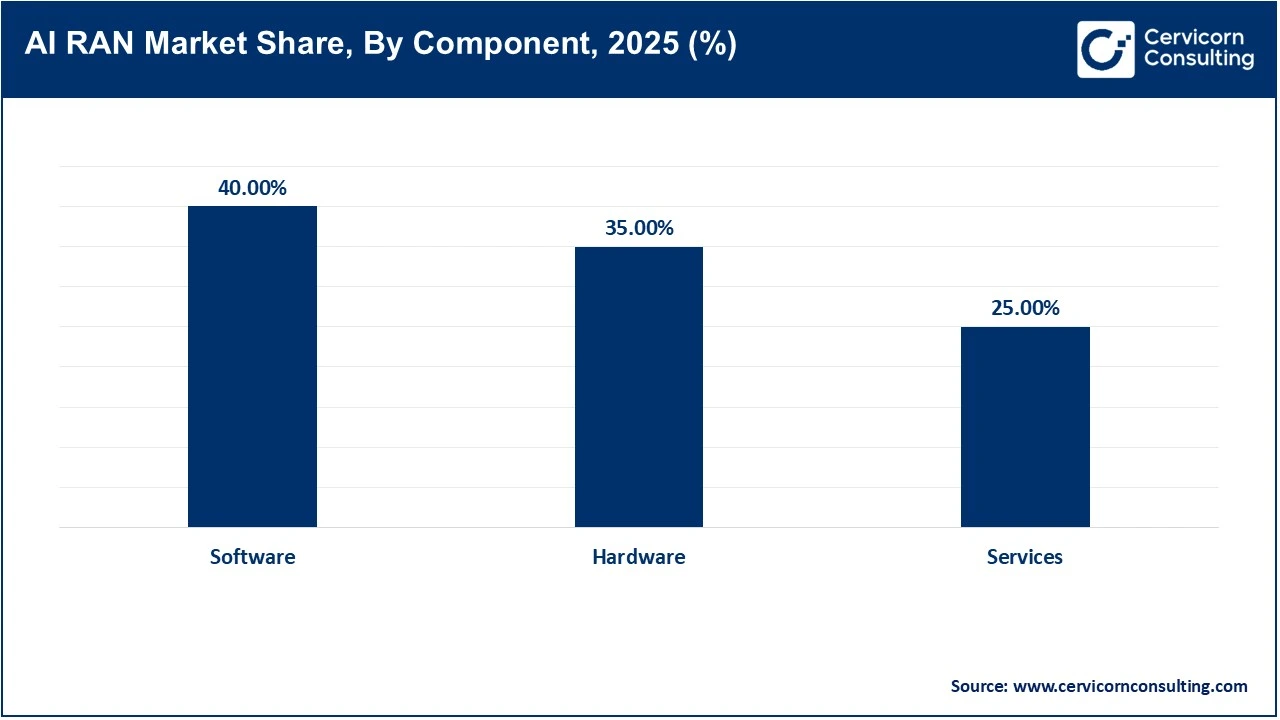
Hardware components are the fastest-growing segment of the market, primarily driven by increasing demand for specialised AI components such as GPUs, TPUs, and NPUs at the network edge. Traditional CPUs struggle to handle the parallel processing required for real-time AI-RAN workloads, leading to a surge in demand for specialised silicon that has effectively exploded. Additionally, telecom operators are upgrading their base station infrastructure to support AI-ready capabilities, enabling more efficient and intelligent network operations.
Deployment Mode Analysis
On-premises deployment remains the dominant model in the AI-RAN market, driven by the need for ultra-low latency and data sovereignty. AI processing near the radio unit at the “cell site” or “far edge” is essential to meeting the sub-millisecond response times required for 5G-Advanced and 6G applications. Additionally, some operators are required by regulation to process sensitive subscriber data on their own physical infrastructure.
AI-RAN Market Share, By Deployment Mode, 2025 (%)
| Deployment Mode |
Revenue Share, 2025 (%) |
| On-Premises |
55% |
| Cloud |
45% |
The cloud segment is the fastest-growing part of the market because hyperscale cloud service providers offer the massive, scalable compute resources required to train complex AI models. While real-time AI inference largely remains on-premises, the “heavy lifting” of model training and long-term network analytics is increasingly shifting to the cloud. Moreover, in the cloud model, this growth is linked to a rebound in “Edge Intelligence,” in which satellite constellations provide cloud-based data processing for the whole planet.
RAN Technology Analysis
Open RAN (O-RAN) is the dominant technology in the market, largely because of its modular, interoperable architecture, which is highly conducive to AI integration. By disaggregating RAN technologies into standardised components, O-RAN enables operators to "plug and play" AI-driven Radio Intelligent Controllers (RICs) from multiple specialised vendors. O-RAN is an attractive choice for new network deployments and for government funding of infrastructure projects.
AI-RAN Market Share, By RAN Technology, 2025 (%)
| RAN Technology |
Revenue Share, 2025 (%) |
| Open RAN (O-RAN) |
45% |
| Virtual RAN (V-RAN) |
30% |
| Hybrid RAN |
25% |
Hybrid RAN is the fastest-growing segment of the RAN market, offering a practical solution for operators with a significant installed base of equipment. Hybrid RAN allows operators to integrate software-based AI capabilities while continuing to use their legacy proprietary equipment without fully rebuilding the system. This approach enables telecom providers to modernise their systems more efficiently and cost-effectively.
End-user Analysis
Telecom operators are the dominant end-user segment, as they own and manage the core radio infrastructure. These operators are the primary beneficiaries of AI-driven improvements, including reduced operational costs and enhanced spectral efficiency. They are mostly focusing on cities and urban-scale deployments, where traffic density is highest and the return on investment from AI-enabled 5G optimisation is most significant. Additionally, telecom providers are utilising AI-RAN technology to unlock new revenue streams through advanced services such as network slicing and ultra-reliable low-latency communication (URLLC).
AI-RAN Market Share, By End-user, 2025 (%)
| End-user |
Revenue Share, 2025 (%) |
| Telecom Operators |
70% |
| Enterprises |
15% |
| Government |
10% |
| Others |
5% |
The government segment is the fastest-growing end-user category, primarily due to the rapid adoption of private AI-RAN networks to support defence, public safety, and smart city projects. Governments are investing heavily in secure, autonomous communications that can operate independently of commercial networks during emergencies. This investment is also supported by a focus on leading technology to reduce vulnerabilities in critical infrastructure against evolving cybersecurity threats.
AI-RAN Market Top Companies
Recent Developments
- In March 2026, Huawei launched Atlas 950 AI SuperPoD at MWC 2026, expanding its AI infrastructure capabilities to support large-scale AI workloads and next-gen RAN evolution.
- In October 2025, Qualcomm introduced AI200 and AI250 AI inference accelerators, targeting high-performance AI workloads and enabling scalable AI infrastructure for telecom and data center environments.
- In March 2026, NVIDIA partnered with T-Mobile and Nokia to deploy AI-RAN-ready infrastructure supporting real-time AI applications at the network edge.
Market Segmentation
By Component
- Software
- Hardware
- Services
By Deployment Mode
By RAN Technology
- Open RAN (O-RAN)
- Virtual RAN (V-RAN)
- Hybrid RAN
By End User
- Telecom Operators
- Enterprises
- Government
- Others
By Region
- North America
- APAC
- Europe
- LAMEA