AI in Supply Chain Market Size and Growth 2026 to 2035
The global AI in supply chain market size was valued at USD 13.25 billion in 2025 and is projected to grow from USD 17.47 billion in 2026 to nearly USD 210.53 billion by 2035, registering a CAGR of 31.8% over the forecast period 2026 to 2035. The market is growing due to the increasing adoption of AI for automation, demand forecasting, and supply chain optimization.
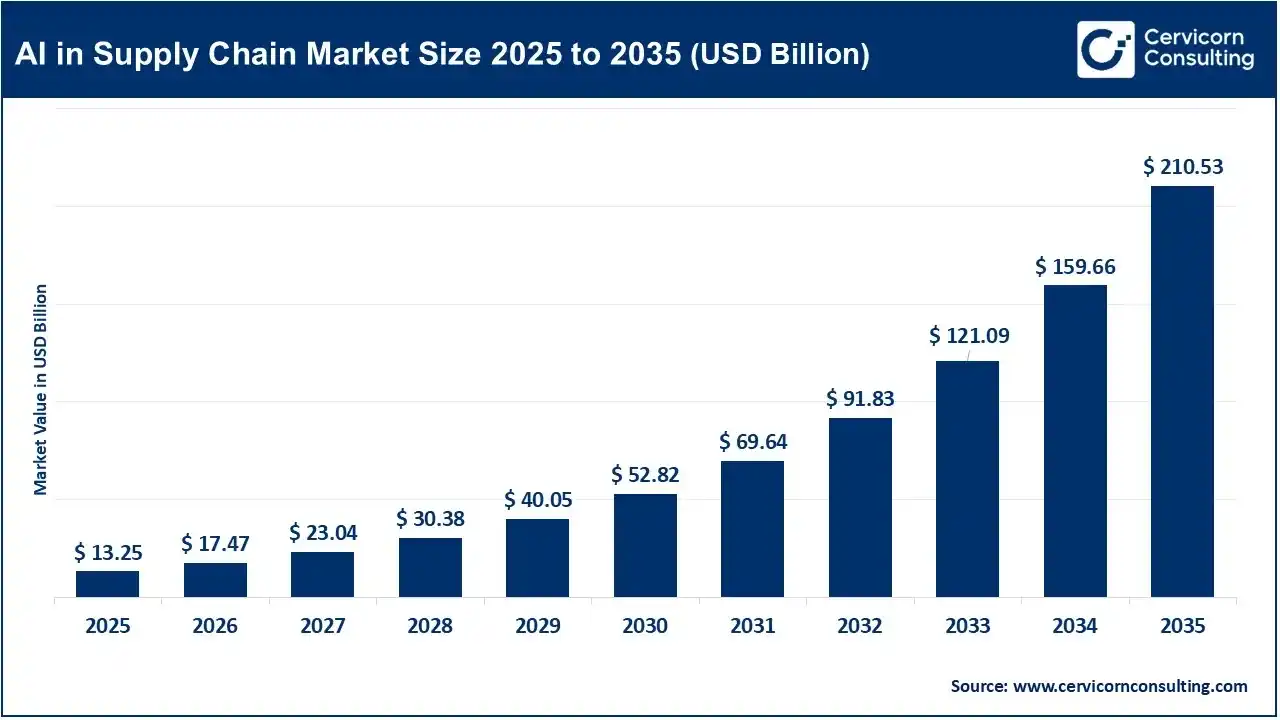
Report HIghlights
- By region, North America dominated the market in 2025 with revenue share of 35%, supported by strong AI adoption, advanced digital infrastructure, and growing supply chain automation.
- By region, Asia Pacific is expected to grow rapidly during the forecast period, driven by expanding manufacturing, e-commerce, logistics, and digital transformation.
- By offering, software segment has captured revenue share of 55% in 2025, supported by rising adoption of AI-powered forecasting, planning, and inventory solutions.
- By offering, services are expected to grow rapidly, driven by increasing demand for AI consulting, implementation, integration, and support.
- By technology, machine learning segment has generated revenue share of 27% in 2025, owing to its widespread use in forecasting, planning, and risk analysis.
- By technology, generative AI is expected to grow rapidly, driven by increasing demand for intelligent automation and decision-making.
- By deployment, cloud segment has held revenue share of 57% in 2025, supported by its scalability, flexibility, and real-time data access.
- By application, demand forecasting and supply chain planning dominated the market in 2025, driven by the need for better demand and inventory management.
- By application, supply chain visibility and risk management are expected to grow rapidly, supported by the increasing need to identify disruptions and improve resilience.
- By supply chain function, planning and forecasting dominated the market in 2025, owing to growing AI adoption across demand, inventory, and production planning.
- By organization size, large enterprises segment accounted for a revenue share of 68% in 2025, supported by complex supply networks and greater technology investments.
- By organization size, small and medium enterprises are expected to grow rapidly, driven by greater access to scalable and cloud-based AI solutions.
- By end user, retail and e-commerce dominated the market in 2025, supported by strong demand for forecasting, inventory, fulfillment, and logistics optimization.
How Is AI Transforming the Supply Chain Market?
The increased use of AI for demand forecasting, inventory optimization, procurement, logistics management, risk identification, and supply chain automation is driving the growth of the AI in supply chain market. Businesses may use AI to evaluate massive amounts of data, make better decisions, cut down on operational delays, and react to disturbances more quickly. Growing e-commerce activity, the complexity of global supply chains, and the need for real-time visibility are all contributing factors to the market's expansion.
- Example: In February 2026, Oracle announced new AI agents within Oracle Fusion Cloud Applications to help supply chain leaders automate planning, procurement, manufacturing, maintenance, and logistics processes. The AI agents are designed to improve decision-making, reduce manual errors, optimize resources, and strengthen supply chain resilience.
Recent Trends
- AI-Powered Demand Forecasting: AI is increasingly used to predict demand and improve inventory planning.
- Automated Supply Chain Planning: Businesses are adopting AI to automate planning, scheduling, and decision-making processes.
- Real-Time Supply Chain Visibility: AI enables real-time tracking of shipments, inventory, suppliers, and logistics operations.
- Predictive Analytics for Risk Management: AI helps identify potential disruptions and supply chain risks before they affect operations.
- AI-Driven Inventory Optimization: Companies are using AI to maintain optimal inventory levels, reduce shortages, and minimize excess stock.
- Intelligent Logistics and Route Optimization: AI is being used to optimize delivery routes, transportation schedules, and fleet operations.
- Generative AI in Supply Chain Operations: Generative AI is gaining adoption for creating reports, analyzing supply chain data, and supporting procurement and operational decisions.
- Integration of AI with IoT and Automation: AI is increasingly combined with IoT sensors, robotics, and automation to improve real-time monitoring and operational efficiency.
Market Dynamics
Driver: Growing Demand for Supply Chain Automation and Real-Time Decision-Making
The increasing need to automate intricate supply chain procedures, enhance demand forecasting, optimize inventory, and facilitate quicker decision-making is driving the AI in supply chain market. Businesses may use AI to evaluate massive amounts of operational data, spot any interruptions, and enhance planning, procurement, and logistics processes. Businesses are being encouraged to use AI-based solutions for improved visibility and operational efficiency due to the growing complexity of global supply chains. AI-powered solutions can also assist businesses in reacting faster to shifting consumer demands and market dynamics. Additional potential for AI integration across supply chain operations is being created by the increasing usage of cloud platforms and real-time data.
- Example: In April 2026, project44 launched an AI agent portfolio covering supply chain activities from freight procurement and disruption response to carrier onboarding. The company said the AI agents are designed to reduce freight spending, accelerate exception resolution, lower inventory carrying costs, and improve on-time performance.
Restraint: Data Quality, Integration, and AI Governance Challenges
The challenges of integrating AI technology with current supply chain systems and fragmented data environments may limit the market for AI in supply chains. The accuracy of forecasts and recommendations produced by AI may be impacted by inadequate or low-quality data. Cybersecurity, data privacy, employee adoption, and the availability of qualified AI specialists are some issues that businesses may encounter. Additionally, when AI systems are utilized to make critical operational choices, businesses require proper governance and human oversight. These difficulties may make deployment more difficult and cause companies with old infrastructure to adopt it more slowly.
- Example: In August 2026, Kinaxis announced findings from an IDC study highlighting gaps in AI accountability, trust, measurable outcomes, and governance among supply chain organizations. The study also identified data quality and integration as major factors influencing AI investment, demonstrating the practical challenges businesses face when scaling AI across supply chain operations.
Opportunity: Increasing Adoption of Agentic and Generative AI
The increasing use of generative AI and autonomous AI agents in the supply chain industry offers substantial prospects. Demand planning, procurement, logistics, supplier management, inventory optimization, and disruption response can all be aided by these technologies. AI agents can reduce human labor and speed up response times by analyzing real-time data and recommending or carrying out actions based on predetermined business rules. Opportunities for more intelligent and independent operations are also being created by the growing availability of real-time supply chain data. The incorporation of AI agents into supply chain systems is anticipated to generate new development prospects as companies strive for increased resilience and efficiency.
- Example: In January 2026, IBM announced AI-powered supply chain transformation capabilities focused on helping organizations apply agentic AI across planning, execution, and fulfillment. IBM highlighted the use of AI to make supply chains more intelligent, resilient, and sustainable.
Regional Analysis
Why did North America region dominate the AI in supply chain market?
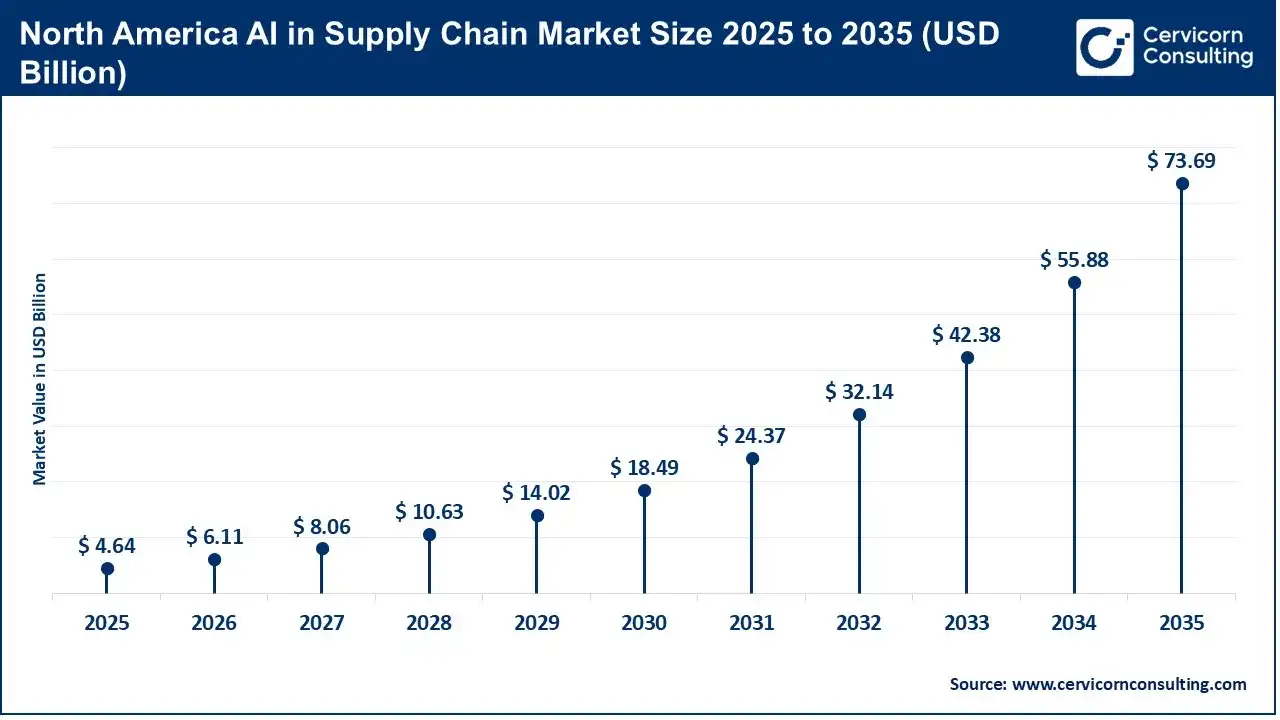
The North America AI in supply chain market size was valued at USD 4.64 billion in 2025 and is expected to hit USD 73.69 billion by 2035. The North America region dominated the market in 2025 because of the widespread adoption of cutting-edge digital technology and the expanding application of AI in supply chain operations. Businesses in the area are using AI more and more for supply chain optimization, inventory management, logistics, forecasting, and planning. Additionally, the area boasts a robust technology environment that facilitates the deployment of AI across several businesses. The application of AI in supply chain operations is being further supported by ongoing investments in digital transformation.
Why is Asia-Pacific region growing rapidly in the AI in supply chain market?
The Asia-Pacific AI in supply chain market size was estimated at USD 3.84 billion in 2025 and is projected to surpass USD 61.05 billion by 2035. The Asia Pacific region is growing rapidly in the market, propelled by growing efforts in digital transformation, e-commerce, manufacturing, and logistics. Businesses in the area are using AI more and more to handle intricate supply networks, enhance forecasting, automate processes, and react to shifting consumer demand. AI-enabled supply chain solutions are becoming more and more in demand due to the region's expanding manufacturing and technological base. Adoption is anticipated to be accelerated by a greater emphasis on supply chain efficiency and automation.
AI in Supply Chain Market Share, By Region, 2025 (%)
| Region |
Revenue Share, 2025 (%) |
| North America |
35% |
| Europe |
25% |
| Asia-Pacific |
29% |
| LAMEA |
11% |
Segmental Analysis
Offering Analysis
The software segment dominated the market in 2025 as businesses employed AI-based solutions more frequently to enhance supply chain operations such as planning, forecasting, inventory control, and procurement. These technologies assist businesses in automating repetitive processes and using supply chain data to make choices more quickly. Additionally, many supply chain operations can be linked together in a single digital environment using software platforms. Their position in the market is being further strengthened by their capacity to facilitate data-driven operations and ongoing monitoring.
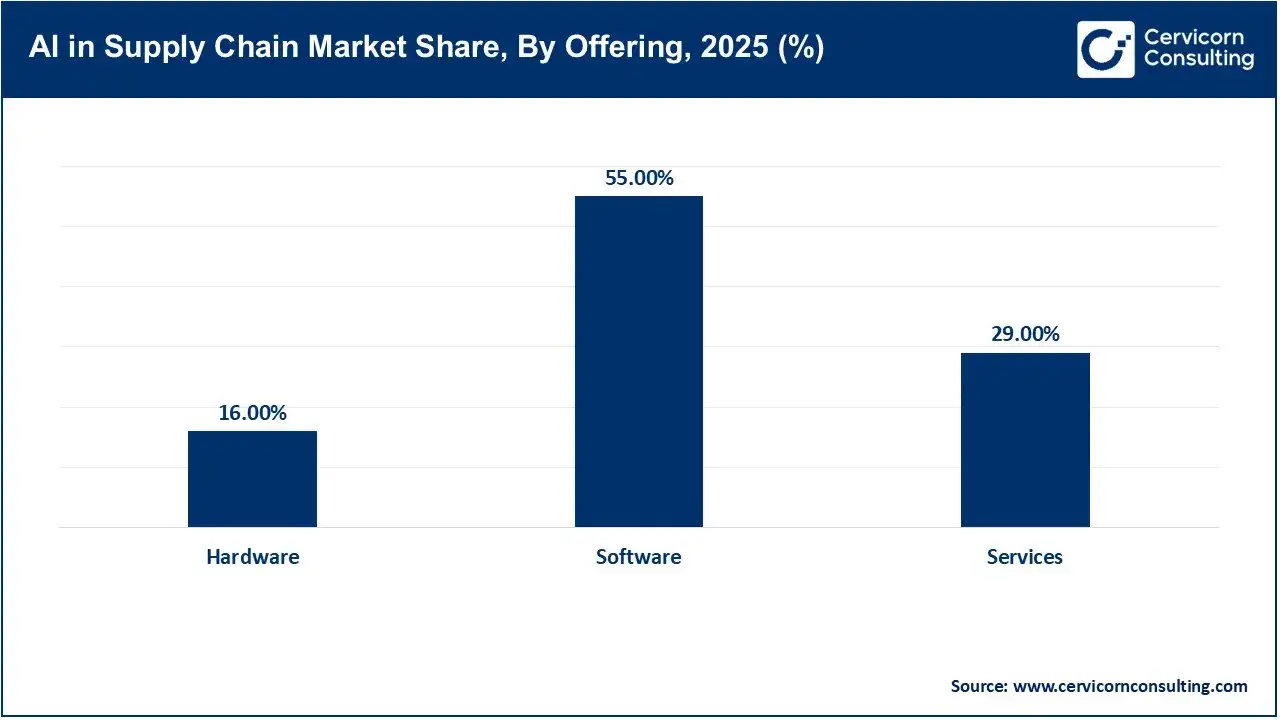
The services segment is growing rapidly in the market, motivated by the growing need for managed services, system integration, implementation, consulting, and continuing support. Businesses need specialized knowledge to connect AI solutions with current systems and workflows as they implement AI across various supply chain operations. The need for expert services is rising due to the increasing difficulty of implementing AI. In order to maintain and enhance their AI-based supply chain systems, businesses are also looking for ongoing support.
Technology Analysis
The machine learning segment dominated the market in 2025 because it is capable of analyzing vast amounts of supply chain data and finding patterns that are helpful for forecasting and making decisions. Demand forecasting, inventory control, planning, and risk analysis are just a few of the many fields in which it finds extensive application. As supply chain conditions change, machine learning can continuously process fresh data and offer insights. Its widespread application in a variety of operational tasks supports its dominant position.
AI in Supply Chain Market Share, By Technology, 2025 (%)
| Technology |
Revenue Share, 2025 (%) |
| Machine Learning |
27% |
| Natural Language Processing (NLP) |
14% |
| Computer Vision |
13% |
| Context-Aware Computing |
7% |
| Generative AI |
16% |
| Predictive Analytics |
15% |
| Reinforcement Learning |
5% |
| Others |
3% |
The generative AI and context-aware computing segment is growing rapidly in the market, motivated by the growing need for intelligent technologies that can comprehend supply chain scenarios and deliver quicker, more pertinent insights. These tools can help with data analysis, automatic suggestions, and quicker decision-making. Additionally, they can make it easier for companies to deal with complicated supply chain data. Their adoption is anticipated to be further supported by the growing interest in intelligent and adaptive AI capabilities.
Deployment Analysis
The cloud segment dominated the market in 2025 as companies favored scalable and adaptable platforms for implementing AI throughout their supply chain processes. Cloud-based technologies facilitate the connection of various supply chain operations and the access of data from many places. Additionally, they enable businesses to increase AI capabilities without significantly altering their physical infrastructure. Cloud adoption is being further strengthened by its capacity to facilitate collaborative and connected operations.
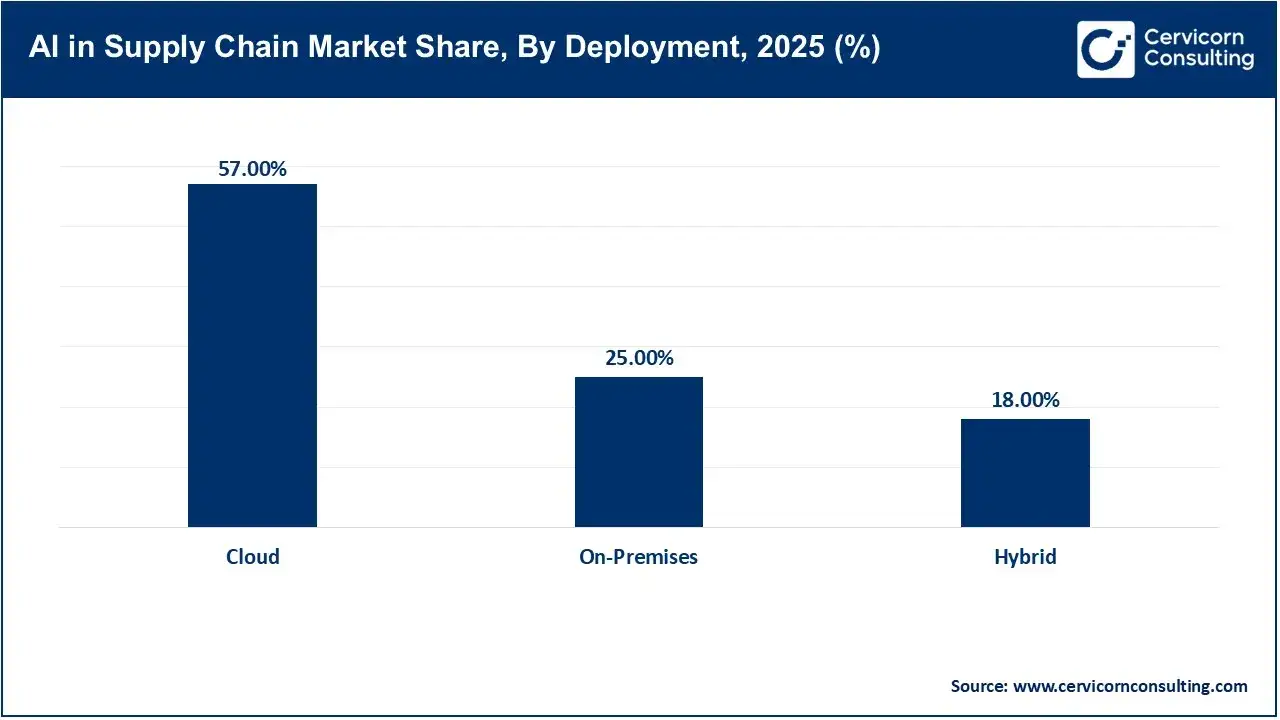
The cloud segment is also growing rapidly in the market, driven by the growing need for AI solutions that are adaptable, scalable, and readily available. In order to connect supply chain data, enhance AI capabilities, and support operations across numerous locations, businesses are shifting to cloud-based solutions. Additionally, cloud deployment enables businesses to add new AI applications as their needs evolve. Because of its adaptability, companies can progressively increase the usage of AI throughout supply chain operations.
Application Analysis
The demand forecasting and supply chain planning segment dominated the market in 2025. Businesses are using AI more and more to better identify demand trends and make supply decisions. Improved forecasting facilitates more effective inventory, manufacturing, purchasing, and distribution planning for businesses. AI is capable of processing various kinds of supply chain data and detecting shifts in demand. This aids businesses in better coordinating their supply chain's various phases.
The supply chain visibility and risk management segment is growing rapidly in the market, motivated by the growing requirement to keep an eye on supply networks and spot possible disruptions early. AI can assist businesses in identifying changes, evaluating risks, and reacting faster to unforeseen disruptions. Supply chain responsiveness can be enhanced by increased visibility across suppliers, inventories, transportation, and operations. Adoption in these areas is being aided by the increased emphasis on creating more robust supply networks.
Supply Chain Function Analysis
The planning and forecasting segment dominated the market in 2025 as demand planning, inventory planning, production scheduling, and supply coordination all saw a surge in the use of AI. AI enables companies to handle massive volumes of data and modify their strategies in response to shifting supply and demand. Additionally, it can spot trends that conventional planning techniques would find difficult to spot. Organizations can more successfully manage various supply chain activities with improved planning.
The warehousing and fulfillment and risk management segment is growing rapidly in the market, motivated by the growing emphasis on supply chain resilience, quicker order processing, and effective warehouse operations. AI can help with order processing, risk assessment, warehouse operations, and quicker reactions to operational changes. Businesses are being motivated to enhance warehouse operations by the increasing demand for effective fulfillment. Stronger risk management is also becoming crucial to sustaining dependable supply chain operations.
Organization Size Analysis
The large enterprises segment dominated the market in 2025 because major companies typically have more resources for implementing cutting-edge technologies and run bigger, more intricate supply chains. Wider usage of AI is being encouraged by their need to handle numerous suppliers, facilities, inventory locations, and distribution networks. AI can also be used simultaneously by large firms in several supply chain tasks. There is a high demand for sophisticated planning, monitoring, and optimization skills due to their intricate operational requirements.
AI in Supply Chain Market Share, By Organization Size, 2025 (%)
| Organization Size |
Revenue Share (%) |
| Large Enterprises |
68% |
| Small & Medium Enterprises |
32% |
The small and medium enterprises segment is growing rapidly in the market, motivated by the growing availability of scalable and cloud-based AI solutions. Smaller companies are using AI for forecasting, inventory control, logistics, and planning thanks to simpler implementation options. SMEs can progressively increase their use of technology as AI becomes more easily integrated with current business systems. As a result, there is more potential for AI providers to assist smaller businesses.
End User Analysis
The retail and e-commerce segment dominated the market in 2025 because companies in this industry must handle high product and order volumes and react swiftly to shifting consumer demand. AI is being utilized more and more to assist with order fulfillment, inventory management, forecasting, and logistics. Increased usage of AI is being encouraged by the need to manage shifting purchase trends while maintaining product availability. Retailers can also coordinate various phases of the client order process with the aid of AI-based supply chain technologies.
AI in Supply Chain Market Share, By End User, 2025 (%)
| End User |
Revenue Share, 2025 (%) |
| Retail & E-commerce |
17% |
| Manufacturing |
16% |
| Automotive & Transportation |
12% |
| Food & Beverages |
9% |
| Consumer Packaged Goods |
8% |
| Healthcare & Life Sciences |
7% |
| Others |
31% |
The manufacturing and healthcare and life sciences segment is growing rapidly in the market, driven by the growing demand for effective risk monitoring, forecasting, procurement, inventory management, and planning. Healthcare organizations need reliable supply networks, and manufacturing companies are utilizing AI to handle complicated production and supply tasks. Adoption of AI in various sectors is being stimulated by the increasing demand for improved coordination and operational efficiency. It is anticipated that growing supply chain complexity would present more chances for AI-based solutions.
Government Initiatives
- In January 2025, the UK Government launched the AI Opportunities Action Plan to accelerate AI adoption across the economy, improve productivity, and strengthen the country's AI capabilities. The plan includes measures to expand AI infrastructure, skills, and adoption across businesses and public services. These measures can support wider use of AI in areas such as supply chain planning, logistics, forecasting, and automation.
- In April 2025, the European Commission launched the AI Continent Action Plan to accelerate AI adoption and strengthen Europe's AI ecosystem. The initiative focuses on AI infrastructure, data, skills, and wider deployment across important economic sectors. Greater AI adoption across European industries can support applications in manufacturing, logistics, procurement, and supply chain management.
- In April 2025, the U.S. White House announced revised policies covering federal agency AI use and procurement. The policies are designed to facilitate responsible AI adoption and encourage the use of AI to modernize government operations and services. The initiative can also support demand for AI technologies used for data analysis, planning, automation, and operational decision-making.
- In April 2025, the U.S. Office of Management and Budget issued guidance to help federal agencies acquire effective and trustworthy AI capabilities in a timely and cost-effective manner. The guidance supports more efficient government procurement and adoption of AI technologies. It can encourage the development and deployment of AI solutions for operational efficiency, data analysis, and automated decision-making.
- In February 2025, the UK Government opened bidding for AI Growth Zones to accelerate investment in AI-enabled data centers and supporting infrastructure. The initiative focuses on improving access to power and planning support while strengthening the country's AI infrastructure. Expanded AI infrastructure can support the growing deployment of AI applications across industrial, logistics, and supply chain operations.
- In January 2026, the UK Government published a progress report on its AI Opportunities Action Plan, highlighting progress in AI infrastructure, skills, public-sector adoption, and private-sector deployment. The report notes the designation of AI Growth Zones and expansion of national computing capacity. These developments strengthen the infrastructure and capabilities needed for broader AI adoption across industries.
Recent Developments
- In January 2026, IBM announced AI-powered supply chain transformation capabilities focused on helping organizations apply agentic AI across planning, execution, and fulfillment. IBM highlighted the use of AI to make supply chains more intelligent, resilient, and sustainable.
- In February 2026, Kinaxis introduced Maestro Agent Studio, enabling supply chain teams to create AI agents without coding. The solution allows organizations to use their existing data, workflows, and tools to support supply chain decisions and automate repetitive activities.
- In April 2026, Oracle introduced Fusion Agentic Applications for Finance and Supply Chain, designed to coordinate AI agents across business workflows. The development expands the use of AI for supply chain planning, procurement, and operational decision-making.
- In 2026, Blue Yonder expanded its AI-powered supply chain capabilities through its 2026.2 release, adding agentic AI, connected workflows, AI-driven forecasting, and decision intelligence. The update is designed to connect planning, execution, and multi-enterprise supply chain operations.
- In August 2026, Kinaxis announced findings from an IDC study on supply chain AI accountability, highlighting the growing adoption of autonomous AI and the need for stronger governance, data quality, and explainability. The development reflects the increasing focus on deploying trustworthy AI in supply chain operations.
Top Companies
Segments Covered
By Offering
- Hardware
- Software
- Services
- Consulting
- System Integration
- Implementation
- Managed Services
- Support & Maintenance
By Technology
- Machine Learning
- Natural Language Processing (NLP)
- Computer Vision
- Context-Aware Computing
- Generative AI
- Predictive Analytics
- Reinforcement Learning
- Others
By Deployment
By Application
- Demand Forecasting
- Inventory Management
- Supply Chain Planning
- Warehouse Management
- Logistics & Transportation Management
- Supply Chain Visibility
- Procurement & Sourcing
- Risk & Disruption Management
- Fleet Management
- Virtual Assistant
- Freight Brokerage
- Others
By Supply Chain Function
- Planning & Forecasting
- Procurement & Supplier Management
- Manufacturing & Production Planning
- Inventory & Order Management
- Warehousing & Fulfillment
- Transportation & Logistics
- Customer Service
- Returns & Reverse Logistics
- Risk & Compliance Management
By Organization Size
- Large Enterprises
- Small & Medium Enterprises
By End User
- Retail & E-commerce
- Manufacturing
- Automotive & Transportation
- Food & Beverages
- Consumer Packaged Goods
- Healthcare & Life Sciences
- Pharmaceuticals
- Aerospace & Defense
- Logistics & Transportation
- Chemicals
- Energy & Utilities
- Others
By Region
- North America
- Europe
- Asia Pacific
- Latin America
- Middle East & Africa